



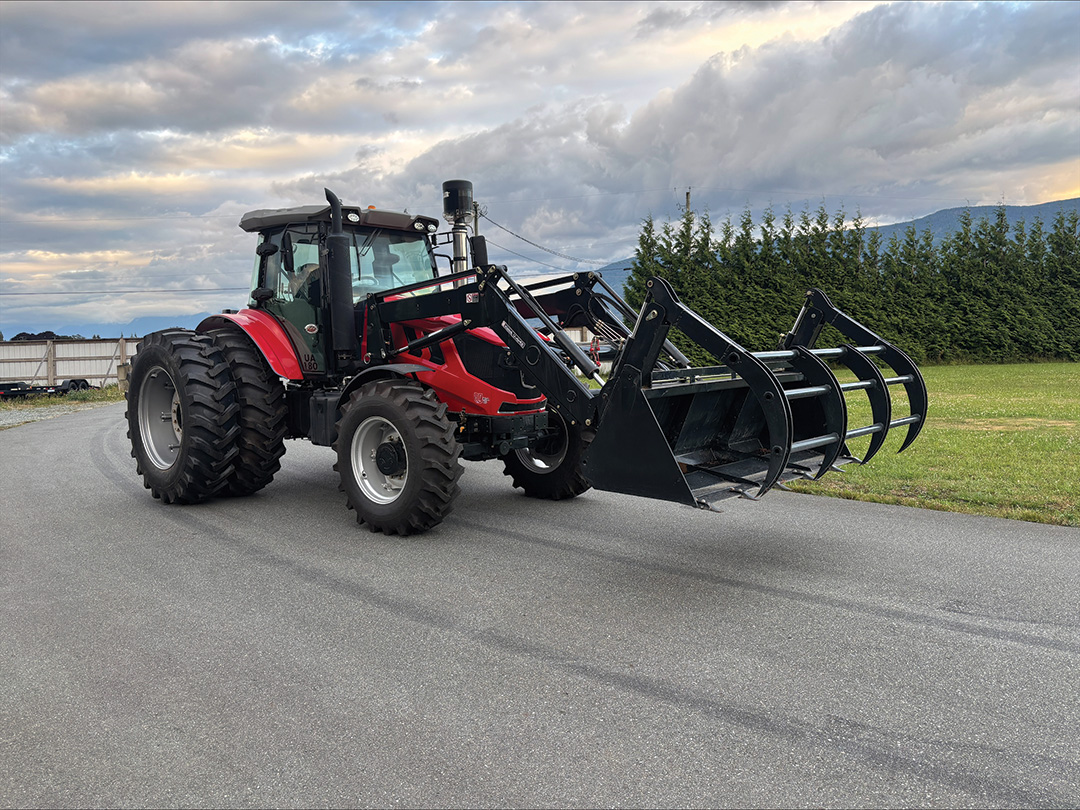
TRACTOR TECH DEJA VU
BY JAMIE ZACHARY • PHOTO COURTESY OF URSA TRACTOR
The first thing you notice about Ursa Ag headquarters is how unassuming it is. Located just off the Queen Elizabeth II Highway in Bowden, there is little to suggest the low-slung, metal-sided industrial building is home to a tractor manufacturer that has received international attention in recent months.
Through the front door and past a handful of offices is a modest workshop. There, on an afternoon in August, a small team of employees worked to assemble an Ursa Ag tractor. Another sat ready to be shipped to Montana. Several more tractors were parked off to one side in various stages of production. Nothing in the modest room suggested a reverse revolution is underway to take modern tractor manufacturing back to its analog roots.
Ursa Ag has caught the farm community’s attention with an approach that abandons the technological complexity found in contemporary tractor design. No software. No computer interface. No proprietary technology stands between a farmer and the machine. Instead, the company’s 150- to 260-horsepower models rely on a familiar 12-valve Cummins diesel engine and mechanical systems that can be serviced by virtually any mechanic. Components are purchased from Alberta and international manufacturers.
Doug Wilson is the company’s owner and founder. Welcoming and quick to discuss the ins and outs of the business that he has spent the last five years building, he exudes the enthusiasm of someone who enjoys the problem as much as the solution. Wilson talks about tractors, farmers and the machinery industry with the same zeal he has addressed the challenges that have shaped Ursa Ag. After all, his company entered an industry dominated by established manufacturers and increasingly sophisticated equipment. Building Ursa Ag required a leap of faith and investment in a product that runs counter to the industry’s prevailing direction. “I love innovation, and I love puzzles,” he said. “So, figuring out stuff is great.”
While most manufacturers have spent years making tractors that are increasingly digitally connected, Wilson sees an opportunity in almost the opposite. Ursa Ag tractors are built to do the work without the requirement that farmers must be dependent on their advanced technological components.
“To use a Spaceballs analogy, the tech industry has gone ‘ludicrous speed’ and passed their customer right by. Complexity does not equal progress,” said Wilson.
His company’s early success comes as certain farmers question whether increasingly digitized equipment makes their work easier. The right-to-repair debate has seen manufacturers wrestle with farmers for literal control of the machinery they purchase. At the same time, the cost and complexity of these digitally equipped tractors have increased.
COST VERSUS BENEFIT
Dustin Farr, an agronomy instructor at Olds College, suggested the right-to-repair debate and limited access to proprietary software have become massive hurdles for farmers. He pointed out that farmers tend to be self-sufficient and want to be able to repair their own tools. So, when major machinery companies lock down software diagnostics, this forces them to question whether they are willing to trade their independence for a high-tech platform. “They weigh those things out,” said Farr. “They ask, ‘Can I repair my own equipment and get it working the way I want?’ And then there’s the cost factor. What does it cost to repair? What does it cost to invest? Does the return on investment make sense for me as a farmer?”
Like Wilson, Farr emphasized that the benefits and efficiencies of advanced precision technology are undeniable. Instant combine adjustment eliminates the need to manually configure concaves. And, auto steer has “revolutionized” field days. While days in the cab remain long, operators must no longer sit turned around in their seats.
The clincher is whether these efficiencies justify the investment. This calculation, said Farr, varies greatly with the size of the farm operation. “If I’m a larger producer, it’s a little bit easier to move into utilizing some of that technology because they can see that return on investment a little bit easier, whereas for a mid-range producer or smaller producer, it might take a little bit longer for that return on investment to come to fruition.”
He has noticed many small- and mid-range farmers have found a middle ground. They start with simpler, highly repairable mechanical platforms, and selectively retrofit them with tools such as auto steer. This gives them some of the benefits of precision technology without giving up the control and independence that come with simpler machinery.
WORKHORSES AND SPACESHIPS
Wilson acknowledged digital technology holds a central place in today’s ag industry. This is particularly true for large-scale operations that commonly require features such as GPS steering, variable seeding rates, precise ground speed monitoring and fuel optimization.
He argued, though, that basic, high power tasks, such as turning a grain auger that simply requires the requisite 200 horsepower, do not require any of this technology. “Every farmer, big and small, has an application where he can just use a basic tractor. It doesn’t need to be a spaceship,” said Wilson.
On Stu Mead’s hobby farm in the Spruce View area, haying is such an application. He oversees a couple of quarter-sections and puts up about 150 acres of hay each year. For the work he does, Mead didn’t see the need for an overly complicated tractor. In fact, he had grown frustrated with the complexity and cost of the newer machinery.
The bigger issue, said Mead, was what happened when something went wrong. This included repeated sensor problems that left one tractor in limp mode and required an extensive repair job. “Every time a sensor went down, I had to get someone out to reset the computer. And, to be honest, I didn’t need something so complicated. I also didn’t want to go out and spend $300,000 on a replacement. I just needed a smaller tractor, something simple, tough and reliable; something I could dump fuel in it, keep an air filter on it and change the oil once in a while. That’s all I was interested in.”
Mead toured Wilson’s shop where he almost immediately purchased a smaller frame, 180-hp tractor that Ursa Ag had customized. Mead took delivery in late July, just in time for haying, where it has performed well pulling his hay cutter. “The way I look at it, if you can buy a tractor that does the same job as something a bit fancier, who cares? You’re still pulling an implement down the field,” said Mead.
Wilson noted his customer base primarily consists of ranchers, cow-calf operators and small-acre grain farmers. Demographically, these buyers are mixed. Many are 50-plus. Others are younger operators who see an Ursa Ag tractor as their first realistic opportunity to buy new equipment due to its affordability. Ursa tractors typically hover around 50 per cent of the cost of comparable units by the big brands, said Wilson.
Wilson said his team is currently assembling roughly 50 units annually at the Bowden shop. He hopes to eventually reach 1,000 units per year. “I’m truly trying to control that growth. I’m trying not to get ahead of what we’re capable of supporting.”
Ursa currently sells its tractors in Canada and the U.S., but Wilson’s ambitions extend beyond North America. He has identified strong growth potential with international markets and suggested the appetite for simpler machinery may not be limited to farmers on this continent. “We’ve seen that there’s a lot of opportunity around the world. But it’s a journey. It’s not something that will happen overnight.”

Comments