


DRONE APPLICATION OK’D
BY TREVOR BACQUE • PHOTO COURTESY OF TOM WOLF
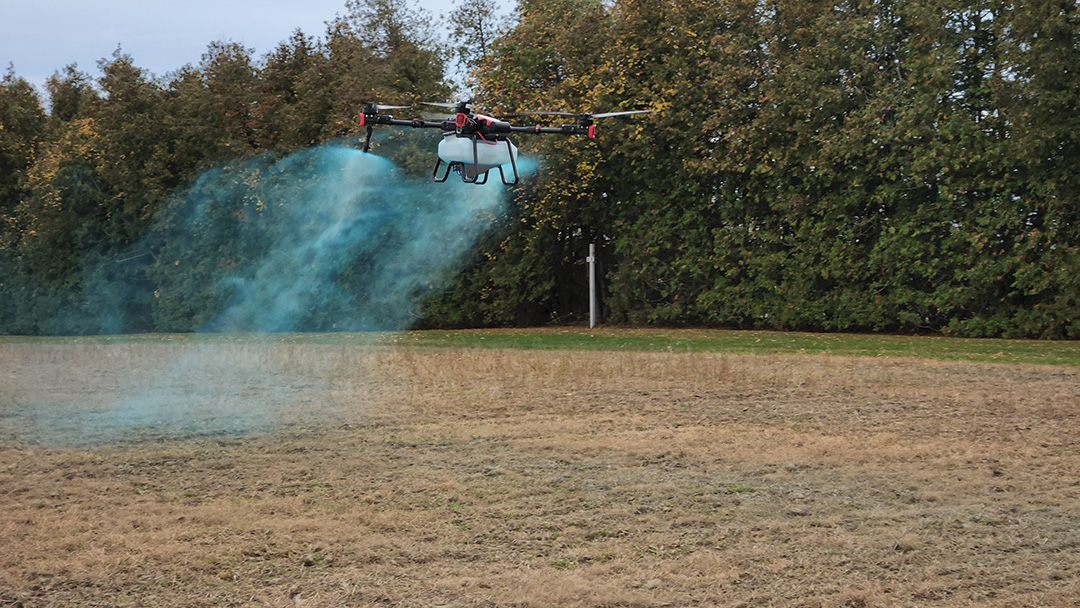
Health Canada’s recently approved change to allow for broader drone spraying of pesticides is being hailed both as a win for farmers and a non-scientific head scratcher. Until this spring, pesticides labelled safe for aerial application could be applied by conventional aircraft, typically a spray plane. As of June 30, this provision has been extended to drones.
The rule change may allow farmers to save money by applying products with a drone rather than a sprayer.
The federal government boasts that this makes the country more competitive with other nations. Currently, Australia, Japan and additional jurisdictions have drone regulations already in line with the Canadian update.
The announcement has only been framed as a net positive for farmers. “Innovative practices are being adopted by farmers across the country to improve crop production and support the long-term health of their farmland,” said federal ag minister Heath MacDonald. “By supporting our hard-working farmers with the use of drone technology, we are strengthening the resiliency and competitiveness of Canada’s agricultural industry and food system.”
Provincially, the UCP similarly welcomed the change and noted it will give farmers greater flexibility in manage of their fields. “The use of drones can improve field access in wet or soft conditions, reduce crop damage, enable more precise applications, lower input needs, support innovation and competitiveness and offer worker safety advantages through remote operation,” said Tara Sawyer, agriculture and irrigation minister.
TWO WRONGS DON’T MAKE A RIGHT
Spray expert Tom Wolf said the change in government regulations is the “wrong decision at the wrong time,” and not based on science. While he initially balked at the Pest Management Regulatory Agency’s decision to require a new label application for drones about eight years ago, Wolf has increasingly come to agree with the decision.
“It is a unique and different application method,” he said. “Many of the things we know and assume in spraying practice don’t apply with drones. There is a whole new bit of learning that needs to be done by regulators and applicators both.”
When the government required new labels in 2018, Wolf said it was a good way to gauge drone demand. The results have spoken for themselves. “There was a surprising absence of interested parties,” he said. There are even companies that intend to generate new labels that advise against drone spraying in response to the government’s regulation change, he added.
A primary issue with drone spraying relates to small tank capacity and the corresponding low water volumes. The single-largest available drone sprayer in Canada is the DJI Agras T-100, which carries a tank capacity of 100 litres. Wolf said lower water volumes put the aircraft “on the very edge of performance,” and not in a good way.
If a farmer applies two to three US gal/ac there aren’t many opportunities to increase droplet size to reduce drift or evaporation, because low droplet density means coverage is no longer achievable. “That means you don’t have performance,” he said plainly.
By contrast, a major upside of drone spraying is that it allows convenience and flexibility. A farmer can get into wet fields where nobody in their right mind would send a sprayer. In another instance, they may treat the last pesky 20 acres on a field 30 kilometres from the farmyard. Packing a drone in the back of a truck sure beats an all-day excursion driving the sprayer up and down the highways. “Drones do represent some opportunity to get this done on your own,” said Wolf.
The economics of drone spraying pencil out on various columns, as well. While certain new sprayers with options inch closer to $1 million, the purchase price of the biggest available drone is about $50,000. Additional costs include a tendering unit, landing platform, multiple batteries and a generator to charge them, licensing and a second crew person to satisfy federal regulations. Even so, they are still substantially cheaper than sprayers.
In many cases, time may be the deciding factor in drone adoption. The average aerial applicator plane may take 20 minutes to spray a quarter-section. A drone might take about three hours and need to refill 30 to 40 times to cover that same field.
Wolf recoils at recent talk that drones are vital, non-negotiable components to a successful farm as many companies that market them now purport. He does agree they are yet another tool available to farmers. So, why not try it out? There are plenty of reasons, from the fun factor to ease of use. Still, he doesn’t expect drones to replace sprayers anytime soon. “It’s more likely that the adoption rate will peak and then go down again,” he said. “The quality of the work that drones do is questionable.”
In the field, he has serious concerns about the uniform deposition of droplets and swath width. The uniformity has been greatly studied and remedied with ground sprayers through boom height and pressure adjustments. Drones, however, are much more variable.
“The tools to decrease [non-uniformity] are much more difficult to figure out and implement,” he said. “If you have a terrible pattern with a drone, I don’t know how to correct that.”
Farmers must find a way to measure swath width, said Wolf. This is a constant issue because the swath width continues to change as you spray. “This is like driving your sprayer and your outer boom sections randomly turn on and off between 10 and 30 per cent of the time,” he said.
COLLEGE LEVEL
At Olds College, Russell Milk said he isn’t surprised by the rule change as demand and interest in drones continues to rise. As the College’s remote sensing specialist, he is up on the latest drone rules and regulations. Milk said the change is a mixed bag and the issue at hand isn’t if drones are up to the task, but moreso about in-field performance.
“There’s a big difference in the predictability of an aerial sprayer versus a drone,” he said. “Lots of the apprehension previously was just about how the spray is influenced by the drone’s downwash. There’s a lot more variability with how it’s applied. It’s not like there was ever an issue with the products, but rather just the need for proof for how the drone affects the deposition of the product.”
Like Wolf, Milk said a drone’s greatest advantages are its ability to access hard-to-reach areas that are wet or hilly and that it reduces field compaction. There is a time and place for each tool, and spraying is no different than painting a picture. “I liken the drone sprayer to more of a precision application instrument. It’s more of a detail brush than a large paintbrush.”
With interest only increasing and more farmers using them, Milk believes the tech will improve and continue to legitimize the use of drones. This could also lead to a broader variety of applications. He suggested drone spraying will likely become yet another service that agronomists may offer to clients. This will also drive the need for proper training and guidance on how to use drones, which will likely only become bigger and more complex.


Comments