




GOOD LISTENER
BY IAN DOIG • ILLUSTRATION BY EMILY CHU
Born and raised in a small agrarian village in India’s Punjab region, that nation’s breadbasket, Balwinder Kumar has been immersed in agriculture since childhood. His family grew forages for their small cattle herd, and though his parents encouraged him to study medicine, he was intensely curious about farming processes and problem solving. “Going into agricultural research was a natural progression,” he said. Since he earned his PhD from Punjab Agricultural University, his research has allowed him to act on his scientific curiosity while interacting with farmers. After earning an undergraduate degree in agronomy, he completed a doctorate in crop science while also studying crop physiology, crop production, genetics and soil science. He focused on how agronomics can improve farm efficiency and productivity while maintaining soil health. He drew upon this interconnected foundation as a full professor and associate director at his alma mater, where he led a team of 25 scientists and support staff. His immersive experience continues to serve him as a research scientist at Lakeland College in Vermilion.
GrainsWest: Why did you choose to work in Canada?
Balwinder Kumar: Canada, especially the Prairie region, has a very strong and progressive agricultural system that has always attracted scientists from around the globe. What attracted me was the close connection between the researchers and producers in Canada, and there is strong emphasis on applied research. Industry and research institutions—universities, colleges and producer organizations—collaborate to solve problems.
In my early career as a university professor in India, I focused on publishing research papers. Then I moved 150 kilometres from the main campus and was totally immersed with the farming community. Farmers would visit my research and extension institute and say, ‘This is the problem, do you have a solution?’ It was like applied research, and I framed my research experiments based on what producers needed.
That was a golden period for me. Same here in Canada; to frame my projects, I go to the producer first. What is their real problem?
GW: What was your first experience with Canadian agriculture?
BK: I got permanent residency in 2023, then we landed in Toronto. My wife’s relatives advised I would find a job there. But agriculture is in my blood, and I love to do research and bring new technologies to farmers, like I have done back home. When a good solution makes a producer smile, I’ve done my job.
GW: Was Prairie agriculture everything you’d hoped it would be?
BK: There is a huge difference in the agriculture system between Asian countries and here. Here we have large farms, and in those countries, smallholder farmers have 10 or 15 acres of land. The transition was not easy for me. I started working at the University of Saskatchewan as an associate researcher in the soil department.
In July 2024, I got this position at Lakeland College as a research scientist.
I do applied cereal crop research full time. This allows me to dedicate more time to designing experiments, working with industry partners and addressing real challenges faced by Prairie producers.
GW: What areas of study do you focus on?
BK: I focus on cereal and forage agronomy. Specifically, nutrient management, variety evaluation, micronutrient biofortification and climate resilient cropping systems. These areas directly address key challenges in modern agriculture; for example, rising input costs, climate variability and the need for sustainable production systems.
In Western Canada, a cereal such as barley is closely linked with livestock systems, so improving crop productivity and quality supports the livestock sector. In one project I handled that was completed last year, we studied mitigation of lodging in feed barley here in Vermilion, in Lethbridge at Farming Smarter and in Falher up north.
Lodging in barley causes yield reduction, which is a significant problem. With a PGR and improved genetics, we were able to increase yield per acre and improve the quality of the grain. Such projects are essential because they add up to increased profitability for farmers.
GW: What are you working on now?
BK: I have submitted another project for funding to study the use of a new PGR and lodging mitigation in feed barley. Over the last decade, Canadian feed barley production has gone down a little bit. There is demand to enhance productivity of all barley. New varieties with higher yield potential are being released every year and, under higher fertility regimes, are prone to lodging.
And, funded by Saskatchewan’s Agriculture Development Fund, we’re working with the University of Saskatchewan on biofortification of feed barley with copper and zinc. Surveys indicate 70 to 80 per cent of pasture forage samples are deficient in copper and zinc. Why not agronomically biofortify feed or forage barley so animals get these minerals naturally?
Apart from that, I’m handling regional variety trials with Alberta Grains for wheat, barley, oats and triticale. I am also collaborating with other scientists from Lakeland Applied Research Association on a relay cropping system with clovers and barley to improve forage quality during grazing. Funded by SaskBarley, we are also going to do a greenhouse study in collaboration with Agriculture and Agri-Food Canada on mitigating pre-harvest sprouting in malting barley.
This year, collaborating with Agriculture Environmental Renewal Canada, we are going to try Canadian-bred millet and sorghum varieties to diversify the cropping system because they need very little water and perform well under drought conditions. Some varieties should work here because they are grown successfully in Ontario.
GW: There is a lot of collaboration required in these initiatives and in your research projects.
BK: I place strong emphasis on collaboration with industry, universities and producers, because agricultural challenges are complex and require multidisciplinary approaches, but what the producer wants is foremost for me. Farmers are scientists in their own way. They closely observe their crops and often provide practical insights that are extremely valuable. My research is now multi-disciplinary, so to maximize success when I submit a research application, I work closely with producers, industry and other scientists to ensure projects align with the needs of farmers and industry.
GW: What are the top three emerging technologies in agricultural research and development on the Prairies?
BK: Number one is precision agriculture and remote sensing, including drones, which allow us to monitor crop variability in the field and the producer to make site-specific decisions for crop production.
Second is enhanced efficiency fertilizers. Fertilizers are becoming more expensive, so we need to do more research for the Prairie region on advanced nutrient management, which can help to improve input-use efficiency and reduce environmental impact.
The third is data-driven decision-making. For example, predictive modelling helps farmers make timely decisions at the farm level.
GW: What advice would you give to young people who may be considering a career in agricultural science?
BK: Agriculture is a very exciting and dynamic field. It’s not just about farming; it’s about science, technology and innovation. I would encourage young people to stay curious and develop strong scientific and analytical skills and stay connected with real world agriculture.
There are tremendous opportunities to contribute to food security, environmental sustainability and rural development. If they want to be a world leader, agriculture is the profession for them. Whatever you do as an agricultural researcher, the solutions you produce for farmers are applicable to global situations. For example, drought is the biggest problem where I grew up, and it continues to be a major challenge in Canada.
The goal is to have sufficient food for the world’s burgeoning population. College and university students today will be real heroes in the future.
Be an agricultural hero
Balwinder Kumar on Lakeland College educational opportunities
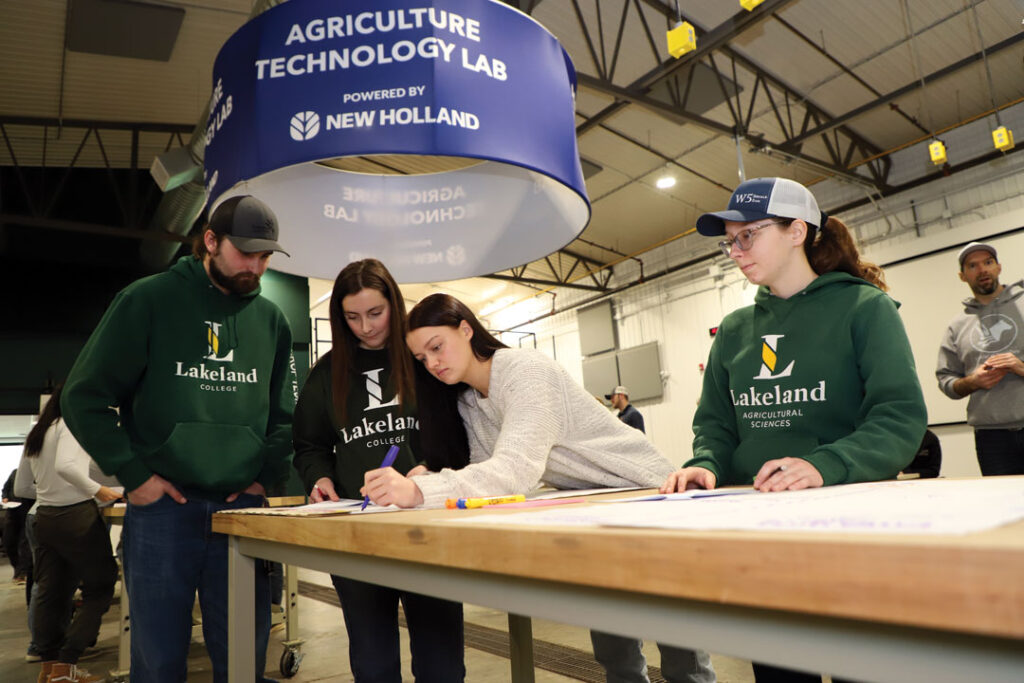
GrainsWest: What does the Lakeland College Bachelor of Agricultural Technology degree program offer students interested in agricultural science?
Balwinder Kumar: Lakeland offers diverse pathways, from one-year certificates to diplomas and degree programs. This allows students to find a learning option that matches their background, goals and stage of career development.
The Bachelor of Agricultural Technology program offers a strong blend of science, technology and hands-on agricultural learning. Designed to meet the evolving needs of modern farming and agribusiness, the program equips students to address real world challenges in crop and livestock production using data-driven, research-informed solutions. What makes the program particularly valuable is its applied approach. Students learn theory but also work with real world agricultural systems, industry technologies and problem solving situations. For students interested in agricultural science, it provides an excellent pathway to careers in research, agronomy, production agriculture, agribusiness and innovation.


Comments