



BUILD WEALTH WITH SOIL HEALTH
BY GEOFF GEDDES • LEAD PHOTO COURTESY OF AAFC
More than ever, farmers and researchers recognize the benefits of good soil health. For example, healthy soil is better able to absorb water, which reduces evaporation so plants can better withstand drought and other adverse conditions. Supportive soil conditions also help crops better withstand pests and diseases.
Through tools such as the Alberta Soil Health Benchmark and research projects such as a recent soil microbe study, researchers are learning more about current soil conditions and how to maximize soil health.
A BETTER BENCHMARK
The Alberta Soil Health Benchmark project was initiated in 2019 by Chinook Applied Research Association (CARA) to establish baseline soil health conditions across Alberta under real agricultural management. At the time, there was limited co-ordinated provincial information that integrated biological, physical and chemical soil health indicators across regions, soil types and production systems.
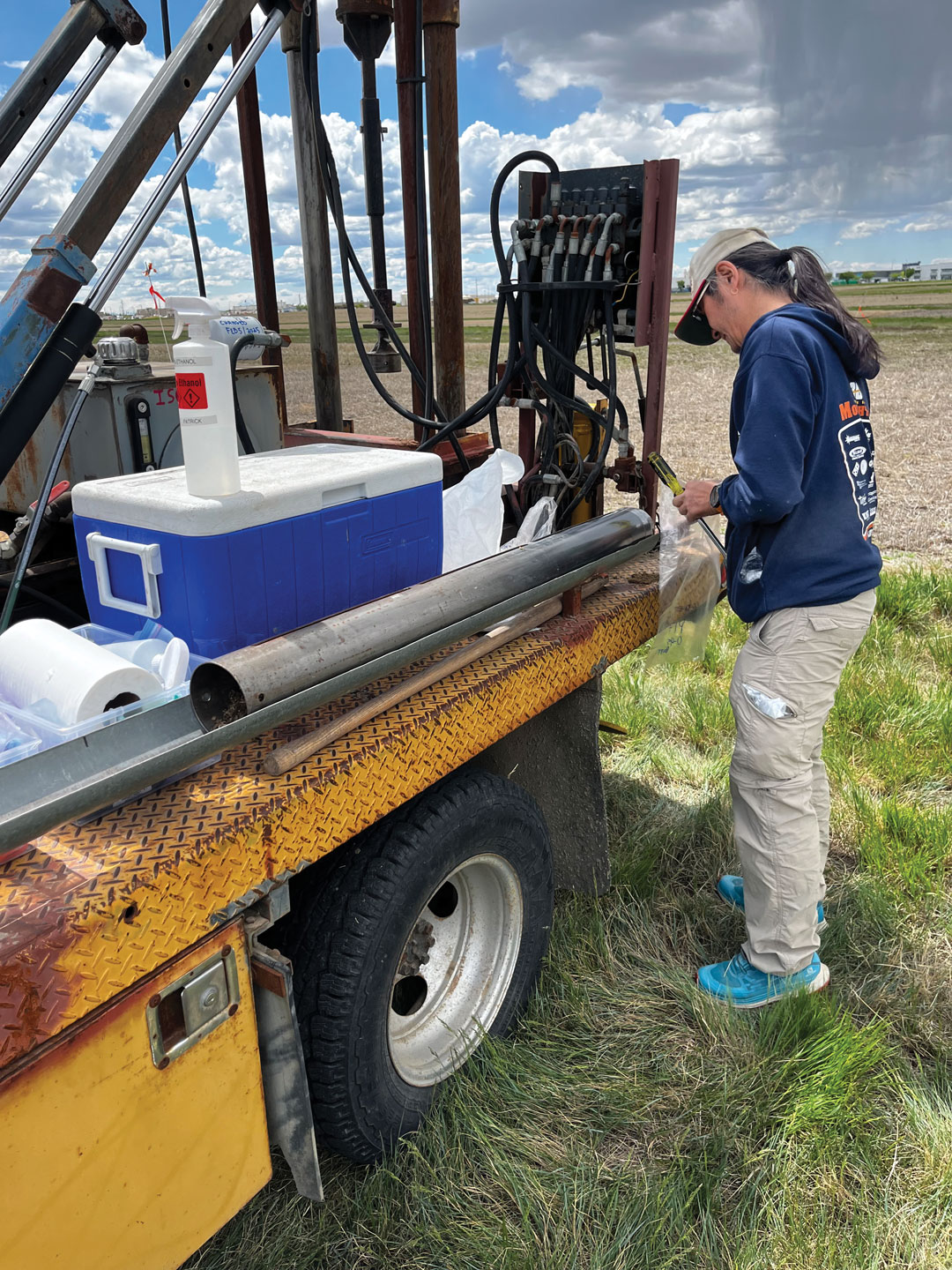
To build this foundation, Benchmark project staff collected soil samples across Alberta. Funded by RDAR, this work was later expanded through the Soil Health Verification project. “One of the major strengths of the project was the level of collaboration involved,” said Yamily Zavala, soil and health crop management specialist at the CARA Soil Health Lab. The two projects followed an identical protocol to create one provincewide dataset, the first of its kind, that spans 2019 to 2025.
“Other countries have also created something similar but given the wide variety of soil conditions in Alberta, I felt the province needed its own benchmark data,” said Zavala. “We also wanted to forge a stronger understanding of soil biological, physical and chemical interactions.”
The initiative employed standardized sampling protocols. Soil samples collected from farms were analyzed by the CARA Soil Health Lab. Eleven of the province’s 12 Applied Research and Forage associations also participated in the project. R. A. West International donated use of laboratory facilities. The University of Alberta conducted soil carbon and nitrogen analyses, while A&L Canada Laboratories measured additional soil health indicators.
The project was supported by the Canadian Agricultural Partnership. Collaboration and in-kind support were provided by the various associations. Collaboration, technical support and funding were also supplied by the University of Alberta and A&L Canada Laboratories. As well, many participating farmers financially supported the CARA Soil Health Lab.
“One of the important long-term goals of this work is the development of Alberta-specific soil health and scoring systems based on provincial data,” said Zavala. “This will be more effective than relying entirely on datasets generated from other regions or environments.” The project also promises long-term monitoring potential and guidance for future research and funding priorities based on local soil conditions.
“The value of the database extends beyond the initial projects,” said Zavala. “Future soil health assessments can be compared directly with the existing dataset. This provides a foundation for ongoing monitoring of soil health trends over time and allows collection of new samples using the same methods that will be incorporated into the database.”
This soil information can guide future research, support soil health interpretation efforts and provide a reference for farmers, researchers and organizations interested in evaluating changes in soil health under western Canadian conditions. This will be especially valuable in regions with soils, climate and agricultural systems like those in Alberta.
“I believe this type of long-term dataset is extremely valuable, because soil health monitoring is still evolving,” said Zavala. “The value increases significantly as additional years, management histories and regional information are added. Continuing this work is important to fully realize the potential of the information being generated for producers, researchers, industry and future agricultural decision-making in Alberta.”
Alberta-specific information was critical to the project, said Trevor Deering, commercial innovation manager at Farming Smarter, one of the supporting associations. “In understanding the properties and indicators of soil health, growers need to know what those details mean to them,” said Deering. “If my field is showing a certain level of water infiltration speed, does that mean it is healthy or not?”
In addition to funding and assistance with the trials, Farming Smarter worked to spread the word about project results and the importance of soil health. “We have been sharing details of the project at events and conferences,” said Deering. “It’s a complex topic, so the more we can raise awareness and advocate for future projects, the better it will be for growers.”
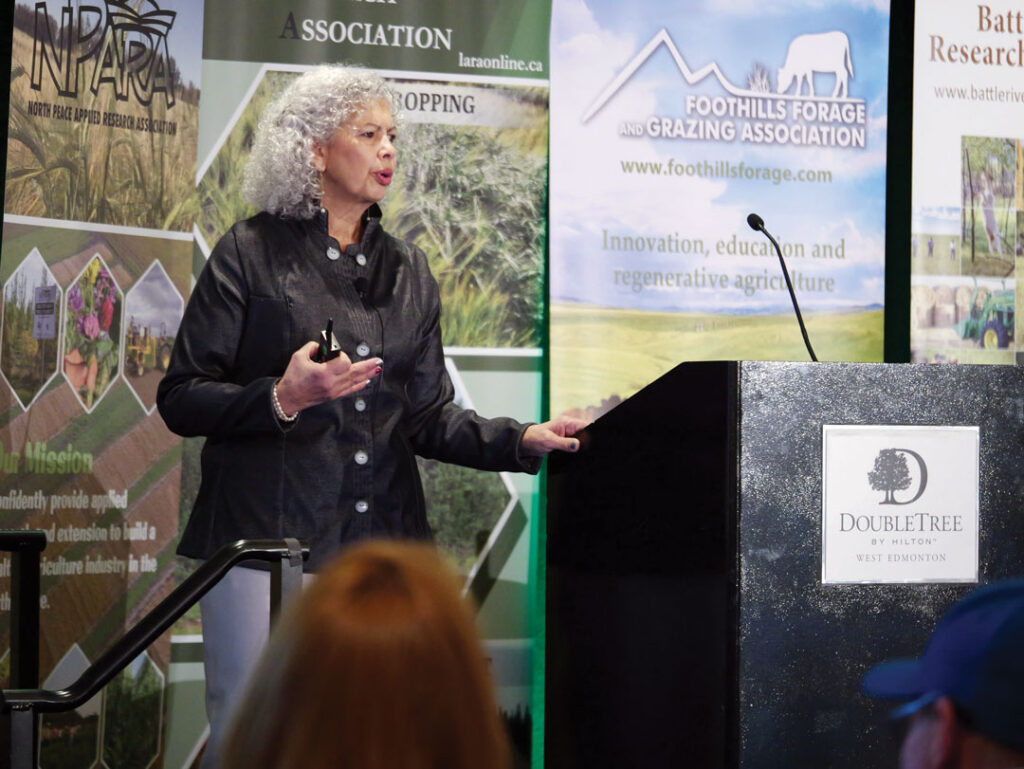
Future soil health assessments can be compared directly with the existing dataset.—Yamily Zavala
MICROBE MANAGEMENT
Microbes are key to the preservation of soil health and fertility. A recently completed project examined how microbial communities shape the carbon and nitrogen cycles in soils at a much deeper level than typically studied.
Led by Monika Gorzelak, a soil microbial ecologist with Agriculture and Agri-Food Canada (AAFC), the project was conducted with the assistance of a regenerative farmer. “We were interested in how Canadian agroecosystems can be altered with different agricultural management practices, including conventional cropland, rotational grazing and adaptive multi-paddock grazing,” said Patrick Neuberger, AAFC microbial ecology research technician. “We investigated this through the lens of microbial community analysis and carbon storage analyses.”
Researchers sampled soils to a depth of one metre and found regenerative grazing practices created systems with more chemically stable forms of carbon than conventional systems. These changes in carbon content were also associated with bacterial diversity.
“The findings suggest an interaction between microbial communities and carbon chemistry, where microbes regulate how carbon stabilizes and is stored over long periods of time,” said Neuberger. These results prompted scientists to further investigate how deeper soil horizons may represent a major and understudied reservoir of microbiology and carbon. Expanding their work into deep subsoils, they focused on how microbial communities survive, and how, when they die, their remains are recycled.
“A key advantage of this project is the use of advanced techniques to efficiently grow and isolate microbes in the lab from various environments,” said Neuberger. “This allowed us to determine what metabolic functions they have and how that relates to carbon cycling.”
“This work helps us understand how microbes regulate the formation and persistence of stable soil carbon,” said Neuberger. “This is valuable, as it contributes to agricultural and climate science through greenhouse gas (GHG) models, such as the Canadian Denitrification Decomposition (DNDC) model.” This computer simulation tool predicts the cycling of carbon and nitrogen in agricultural regions. “We know that by linking our work with the DNDC model, we will better predict GHG emissions and carbon sequestration. In doing so, we can develop agricultural systems that improve soil health, climate resilience and carbon storage.
“As we learn more about how GHGs can be sequestered within agricultural soils, we are better equipped to find solutions,” said Neuberger. “For example, it may prove effective to convert rotational and conventional grazing systems to something more regenerative such as adaptive multi-paddock.” This practice supports soil health by rotating livestock to various areas of a pasture.
As with the Alberta Soil Health Benchmark, this microbe research primarily addresses Alberta challenges and solutions. “We will be following up on this study with one examining how different types of vegetation systems contribute to microbial diversity in southern Alberta,” said Neuberger.
As scientists make strides in their understanding of soil health, this will continue to improve and refine the agronomic resources available to farmers.

Comments