



PRACTICAL AUTOMATION
STORY AND PHOTOS BY MELANIE EPP
Equipment manufacturers have long promised a hands-free future in which autonomous units seed, spray and harvest with little or no human input. At Hannover, Germany’s Agritechnica 2025, the world’s largest agricultural trade show, there was an obvious shift from this fanciful vision to practical implementation. Across all equipment categories, from sprayers and spreaders to headers and tillage tools, manufacturers switched focus away from full autonomy to machines that monitor themselves and make continuous, real-time adjustments.
I attended Agritechnica and later discussed these technologies with Herman Simons. As manager of smart agriculture applied research at the Olds College Centre for Innovation, Simons works with companies to test next generation farm technologies to determine which are worthy of adoption. The shift toward practical, self-correcting automation makes sense, he said, but farmers are not ready to step out of the cab, and they still want to feel dirt on their hands. “Producers have been promised an awful lot in the past, and have often been under-delivered,” he said. “They’re hesitant about adopting new technologies.”
PRECISION SPRAYING AT SPEED AND SCALE
For decades, precision sprayer technology has operated on a set-it-and-leave-it principle. The operator input settings and the system followed these instructions, regardless of what it encountered in the field. In contrast, Agritechnica featured equipment that replaces manually adjusted systems with technology that senses the environment and self adjusts.
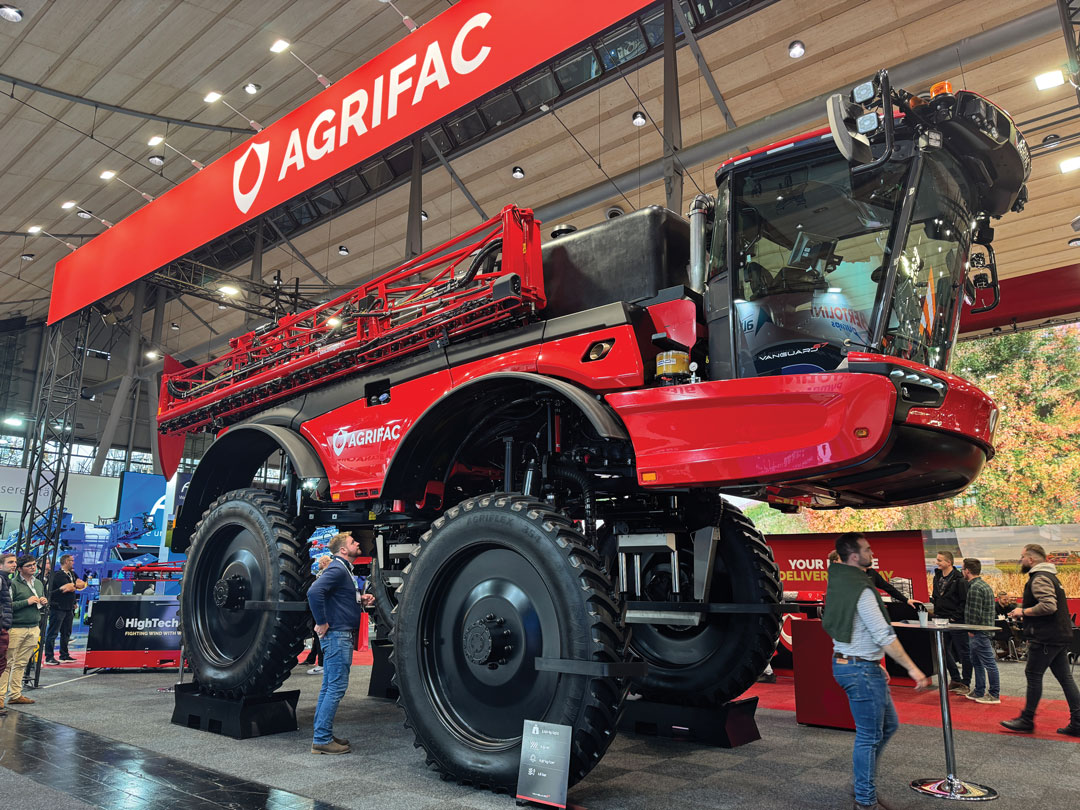
Agrifac is pushing into the Canadian market with its self-propelled sprayers and camera-based spot spraying system that directly targets weeds. Mounted at one-metre intervals along the boom, AiCPlus cameras activate nozzles accordingly to target weeds and avoid crops.
The system can carry out green-on-green and green-on-brown applications. It operates with no subscription fee or per-acre charge. Farmers who share field data with Agrifac receive free algorithm updates in return. “Canadian farmers do not like subscriptions,” said Dereck Generous, Agrifac customer experience specialist.
To better serve its western Canadian clients, the Dutch company opened a Saskatoon, SK, facility in July 2025 and counts Manitoba as roughly a third of its Canadian market. Approximately 160 of its machines operate across the country.
On self-propelled sprayers, boom movement costs time and accuracy. When booms sway or dip operators must slow down, reducing ground coverage per hour and increasing the risk of spray drift or crop contact.
German equipment manufacturer Horsch first addressed this problem with BoomControl Pro Plus, now standard across its entire Leeb sprayer lineup. The manufacturer now enhances this innovation with a radar-based upgrade that won an Agritechnica silver medal for innovation.
The system uses four ultrasonic sensors to continuously measure the distance between the boom and the ground. Hydraulic cylinders actively counteract boom swing. The system incorporates four flex points, two on the centre rack and two mid-wing, that allow sections to follow ground contours independently on variable terrain.
The next step is to shift from ultrasonic to 3D Bosch radar sensors that model the terrain approximately five to 10 metres ahead of the boom. This allows the system to anticipate changes. “We can act, and we don’t have to react. We know what the future brings,” said Moritz Breh, product manager for Horsch Leeb self-propelled sprayers. Manufactured in Bavaria, Horsch now has more than 100 of these units on the ground between Alberta and Ontario.
Most spot spraying systems rely on cameras to identify weeds. Weed-IT’s Quadro instead uses fluorescence-based sensors to detect chlorophyll. Mounted at one-metre intervals along the boom, each sensor covers four detection zones of 25 centimetres. Individual nozzles are activated in the presence of weeds.
A dual function mode applies a low base rate across the entire field while it delivers a higher dose to the weeds it detects. Albert Bosscha, product manager, said the dual function mode is particularly well suited to the Prairie pre-seed window. The system can also be retrofitted to most sprayer brands.
While pulse-width modulation had become the industry standard for sprayer nozzle control, according to Jens-Matthis Frehe, Amazone product marketing manager for crop protection technology, the company was determined to improve the system. The result is AmaXact, a pulse-width frequency modulation system. It addresses two problems common in broadacre, high speed operations: spray pattern gaps created when a valve closes between pulses, and accelerated valve wear from constant cycling.
At lower speeds, AmaXact reduces the pulse cycle to extend service life. At higher speeds, it increases frequency to narrow coverage gaps. The system also allows operators to set a pressure range rather than a fixed point. This gives the machine flexibility to maintain droplet size across variable conditions.
Technologies with a simple, clear function are embraced faster than complex systems, said Simons. “If it’s easy to implement and easy to understand why you do it, the adoption rate will go up quicker.”
PRECISE FERTILIZATION
Amazone’s innovations extend beyond sprayers to fertilizer spreaders. The company introduced two technologies that earned silver medals in Agritechnica’s innovation category. These are designed to take the guesswork out of fertilizer application.
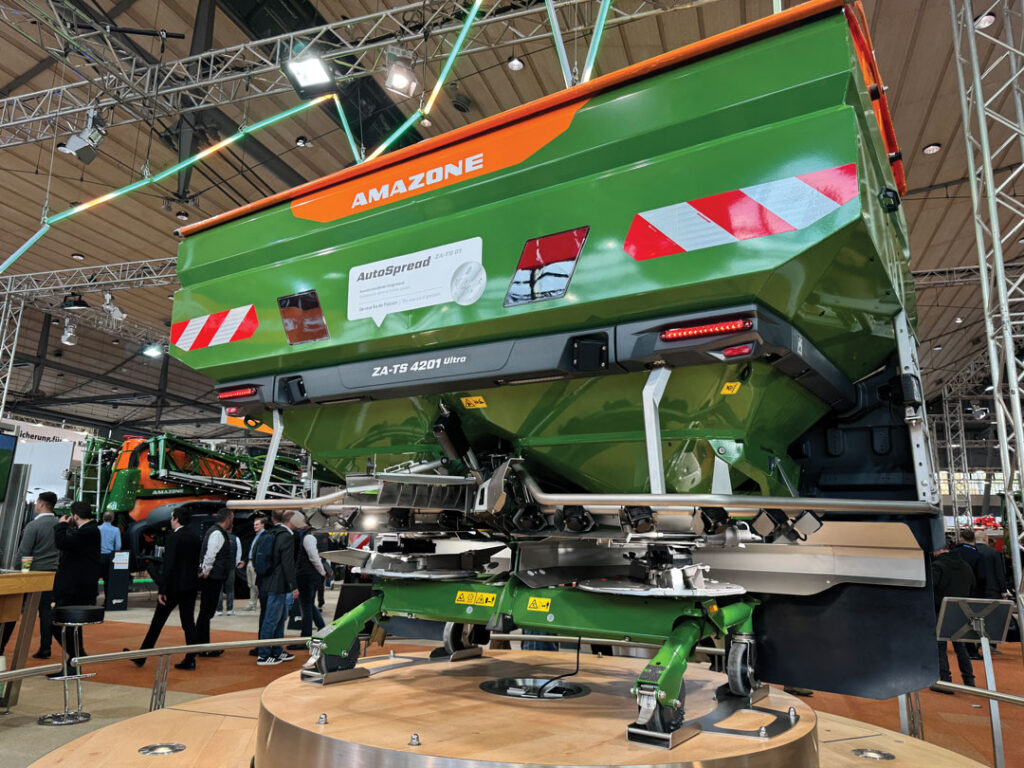
AutoSpread builds on the company’s existing ArgusTwin radar sensor system, which monitors the direction of throw with sensors that measure the deceleration rate of granules once they leave the disc. Knowing both direction and flight distance in real time allows the machine to continuously validate and correct its spread pattern without operator input. “When you say, ‘I want to do 200 pounds to the acre at 120 feet,’ you are going to get 200 pounds to the acre at 120 feet,” said Isaac Wall, territory sales manager for Canada.
EasyMatch addresses a related task: spreader setting selection for the product in the bin.
Shipping and handling changes fertilizer granules physically, altering their size, density and ballistic properties, which means the product in the bin may spread differently than the settings on the bag suggest, explained Wall. To address this, Amazone offers a product database built on tens of thousands of tested products. Its EasyMatch app can analyze a smartphone photo of a fertilizer sample against its database so the spreader can be set accordingly.
French manufacturer SKY Agriculture takes a similar approach to fertilizer spreader calibration but without a product database. Whereas EasyMatch cross-references the product with its database, SKY’s FertiEye system photographs fertilizer granules, analyzes their physical characteristics and sends the optimal spreader settings to the machine via WiFi. The smartphone solution was developed as a response to rising input costs and growing pressure to reduce fertilizer use, said SKY sales manager Fabien Desportes. FertiEye won a silver Agritechnica medal for innovation.
Simons sees these fertilizer technologies as a logical entry point into precision agriculture. Applying the right product at the right rate is a foundation for the use of additional data layers,
he said.
SEED AND FERTILIZE IN ONE PASS
Each pass across a field requires fuel and man hours all while it creates compaction. German manufacturer Lemken addresses this issue with two new machines that bridge fertilizer placement and seeding technology.
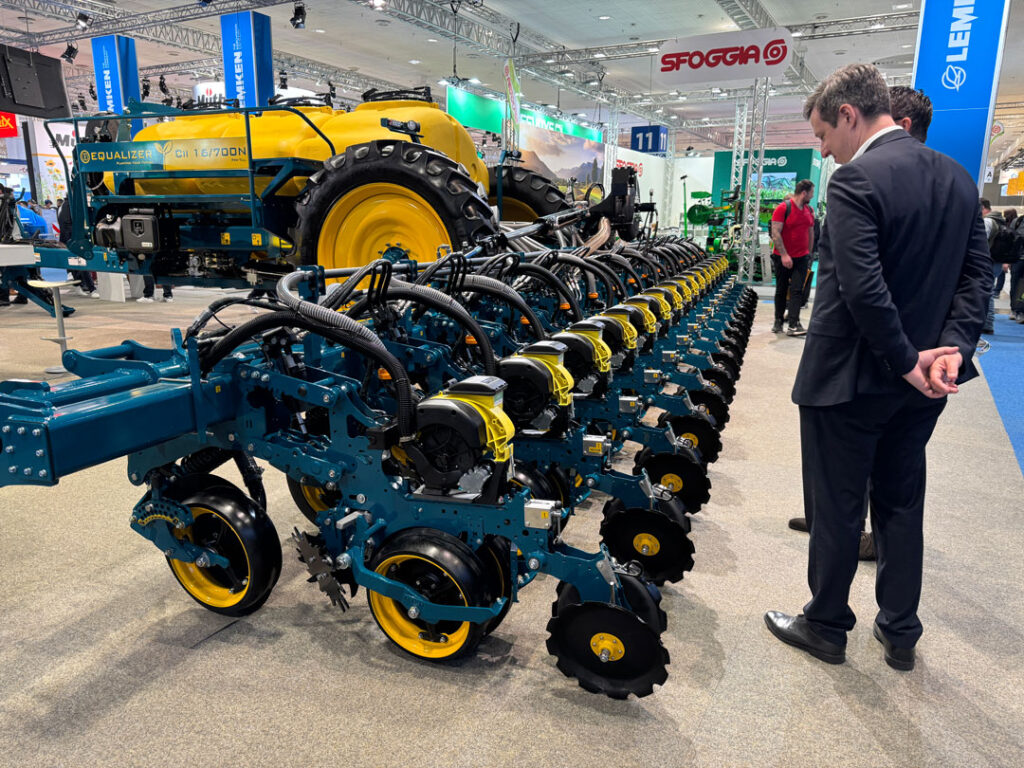
Developed in South Africa, Lemken’s Equalizer row crop planter integrates a full granular fertilizer system adapted from air seeder technology. Up to three products can be applied at seeding, including granular, liquid or a combination. Rather than broadcasting nutrients, the system places them precisely in the seed zone. The machine uses precision seeding technology that is factory fitted rather than retrofitted. Bert Badenhorst, technical support person, said the Equalizer is built for large operations and demanding conditions.
The Solitair DT drill combination brings a similar philosophy to small grain seeding by integrating seedbed preparation, fertilizer placement and seeding in one pass. Solitair DT is available in widths of four to nine metres with container volumes of up to 5,100 litres. It has made inroads in Western Canada through a series of demos in Alberta and Saskatchewan. Matt Amey, Lemken product specialist, said a customer in Idaho broke the U.S. spring barley yield record in 2025 using the Solitair DT, harvesting 239 bushels per acre, 182 per cent above his county’s average. Amey believes the drill contributed. “The accuracy, the seed bed preparation definitely has an effect on that,” he said.
LESS HARVEST LOSS
Combine operators have long relied on experience and instinct to manage harvest losses. A new generation of sensing technology is changing this, giving machines the ability to simultaneously predict and measure crop conditions and adjust without operator intervention.
John Deere’s predictive ground speed automation, available on its S7 and X9 combines, addresses the gap between what a combine encounters and what the operator anticipates. The system simultaneously draws on two data sources. A predictive yield map, generated from satellite imagery and sent to the machine via the John Deere Operations Center, gives the combine a field-wide assessment of biomass. Four stereo cameras mounted on the cab roof scan the crop up to eight metres beyond the header. They detect standing or lodged crops and adjust ground speed accordingly.
The combine also automates its internal settings. The operator sets targets for acceptable grain loss, broken grain and foreign material. Based on these parameters, the machine automatically adjusts concave clearance, chaffer and sieve clearance, cleaning fan speed and rotor speed. Together, the systems deliver a productivity increase of up to 20 per cent, said Jan Kühn, global product marketing manager for conventional combines. A wide variety of crops, including barley and wheat, are supported. From 2027, the predictive ground speed automation technology will also be available for John Deere T5 and T6 combines.
Simons said the value of combine automation is in what a machine can detect that an operator can’t. “You can see the extremes of variability in the field, but you don’t pick up the nuances,” he said. “You don’t need 20 years’ experience to operate a million-dollar piece of equipment anymore.”
Geringhoff’s Yield EyeQ addresses a problem familiar to most operators at harvest. Often, header losses go undetected. A two-camera system mounted on the draper header photographs the ground behind the cutter bar after each pass, analyzes the imagery and reports the number of kernels, pods or ears that hit the ground.
Where drop pans and post-harvest field checks once indicated the scale of crop losses, Yield EyeQ provides a continuous read. The system supports lentils, peas, soybeans and wheat. Geringhoff product manager Hendrik Schneider said Yield EyeQ could be useful to document hail damage for insurance purposes. Yield EyeQ won a silver innovation medal at Agritechnica 2025. Geringhoff ships directly to Canada and has dealers in the East and West.
Sometimes a simple design change can hugely impact combine performance. On some makes, this may overload one side of the concave. Winkler, MB-based Thunderstruck Ag Equipment has developed a concave that addresses this issue by varying bar spacing to balance threshing and separating across the entire concave. This reduces grain loss and improves fuel efficiency and separating capacity, said Jeremy Matuszewski, president and founder. In October 2025, Time Magazine named Thunderstruck’s variable bar spacing concave one of the 300 best inventions in the world.
BEYOND THE HEADLANDS
Many technologies featured at Agritechnica 2025 are not ready for the Canadian market, but two of these stood out as worth watching. The first, Mach’s RadX, uses phased array radar to see through dust and crop residue while it monitors tillage depth and profiles the ground’s surface. The technology is also able to detect plugged and broken shanks. Colin Hurd, the company’s CEO, said the technology is about making implements more self-aware. Mach won an Agritechnica systems and components trophy.
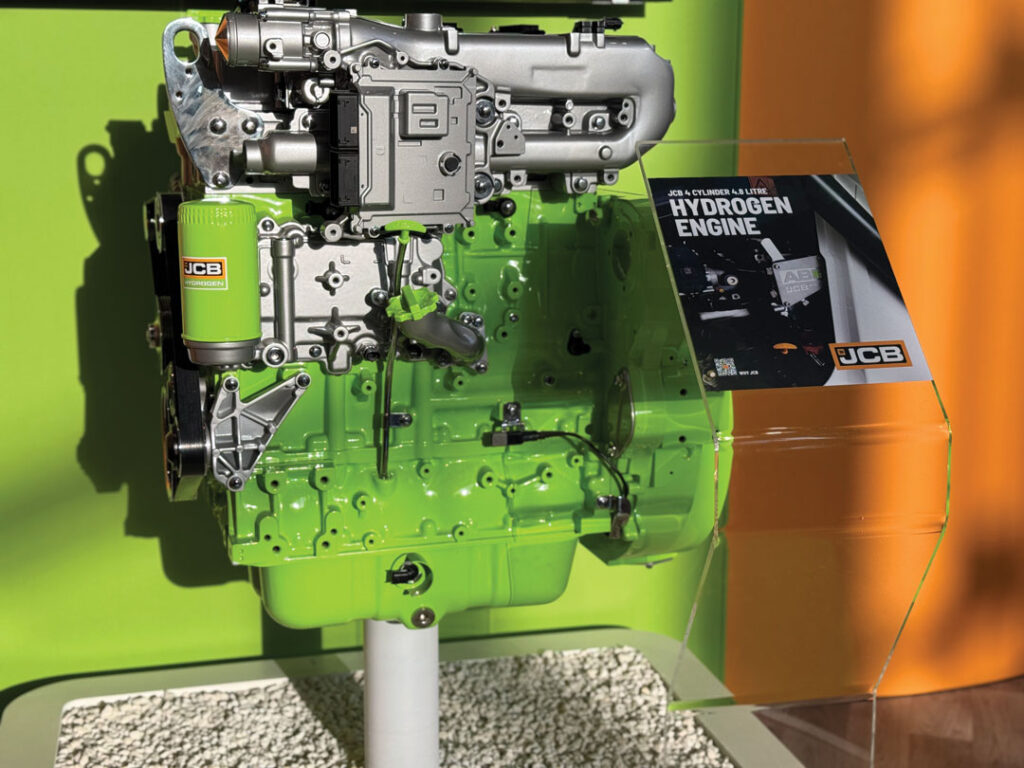
The second is JCB’s hydrogen combustion engine that produces water vapour as exhaust, yet offers the same power and torque output as diesel. Just as they adopted diesel, farmers will adopt hydrogen by having fuel delivered directly to the farm, said Jon-Peter McNulty, JCB’s OEM sales and applications manager. While the technology is ready, the Canadian supply chain is not.
Simons said hydrogen combustion technology as a whole is still in its development stages. “That’s still very, very early on.”
The technologies featured at Agritechnica indicate a move away from fully autonomous equipment to practical applications that allow automation to take on smaller tasks while leaving the operator in the driver’s seat. Each innovation represents one small piece of a larger, data-driven picture still under construction. “We’re at the cutting edge of using the data we are currently collecting in piles,” said Simons. “How we make better business decisions—every piece of technology has a small piece in that.”

Comments