



HARVEST THE SUN
BY JEANINE MOYER • PHOTOS BY BRYCE MEYER PHOTOGRAPHY
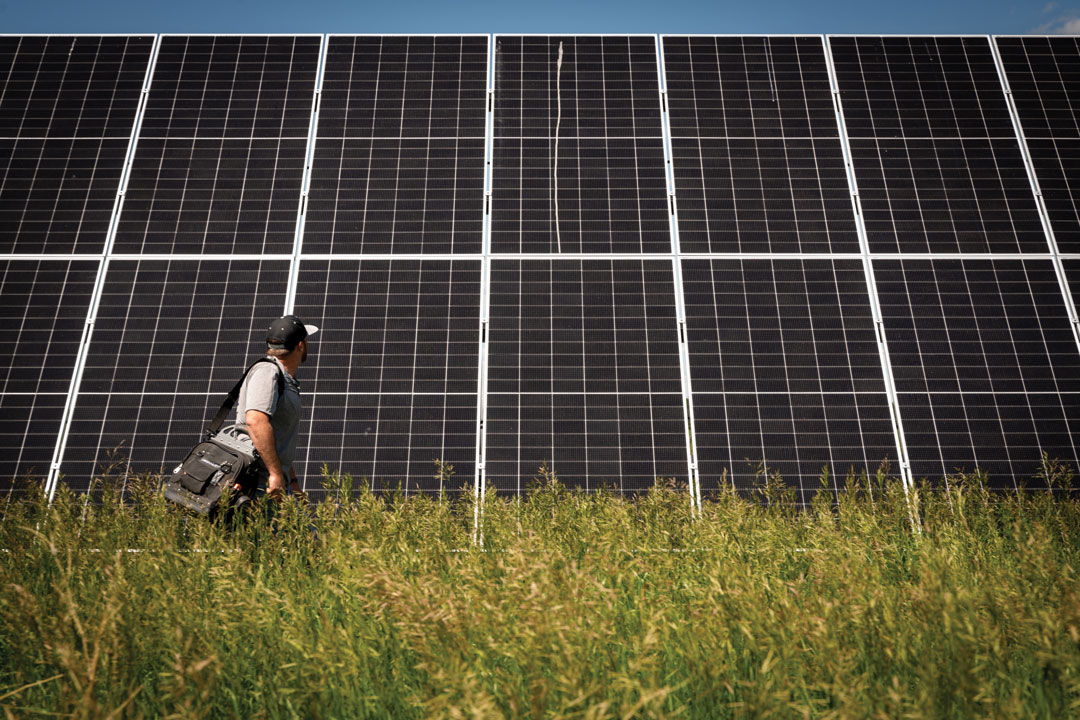
Leonard Retzlaff of Saddleridge Farming bets sunlight will help stabilize the family farm’s income. Located near Rosemary, the farm is operated by Retzlaff, his father Ralph and brothers Philip and Luke. The family raises purebred Charolais cattle, custom backgrounds beef cattle, produces pedigreed alfalfa seed supported by leafcutter bees and grows canola, corn, wheat and winter rye. All their cropland is irrigated with pivots, which require a significant supply of electricity, one of the main reasons the family pursued solar power generation.
GrainsWest spoke to Retzlaff in the spring just prior to his installation of three solar arrays he expected to begin generating power by summer. The decision “just made sense,” said Retzlaff. However, for Alberta farmers who may consider solar, the math behind the decision varies significantly. Return on investment depends on factors such as a farm’s electricity demand, the possibility of financial incentives and the time of year a given farm’s power usage hits its peak.
Retzlaff’s decision to invest came down to two central factors. First, he wished to diversify the farm’s grain and beef operation with a new revenue stream, and second, to lock in a manageable long-term electricity cost. He believes solar power generation can secure the farm’s essential energy input as well as manage risk and inflation in the future.
The decision to move ahead with the project was made in June 2025 when the numbers finally pencilled out. Retzlaff had first considered solar arrays three years prior, but the economics were not as attractive as they have now proven to be. “The value of exporting electricity has increased 10 per cent since then, and we believe this is the right time now,” he said.
Each array is designed to power a high demand area of the farm operation and generate between 50,000 and 55,000 kilowatt-hours (kWh) annually with an expected return on investment of five to six years across all three systems.
“Solar arrays are ideal for grain farmers who rely on irrigation or livestock operations with enough electricity demand to offset the costs,” said Braden Schroeder, owner of Badlands Electric in Brooks. Schroeder managed the installation at Saddleridge Farming and worked closely with Retzlaff throughout the planning process.
Once completed, the three arrays will offset electricity use across several parts of the operation. One system will offset power consumption at three yard sites that include shops, a farmhouse, an incubator for the leafcutter bees and aeration fans for grain storage. Another will supply electricity for nine irrigation pivots, while the third will service a feedlot and an additional irrigation pivot.
While Retzlaff expects the solar installations to create a new revenue stream, the projected return will come from two sources: lower electricity bills and income generated by selling excess power back to the grid. According to his projections, each array is expected to reduce the farm’s annual electricity cost by about $5,100 while generating an additional $6,000 through power exports. Combined, these arrays are expected to generate approximately $11,000 each per year, for a total of more than $30,000 annually that will be added to the farm’s bottom line.
AN INVESTMENT PENCILS OUT
Three years ago, Carmangay area grain farmer Kevin Auch installed a solar array capable of producing 100 kW, enough to power one of his irrigation pumps. Like Retzlaff, he had considered solar nearly a decade earlier. At the time, the projected payback period of nearly 11 years was too long to justify the investment.
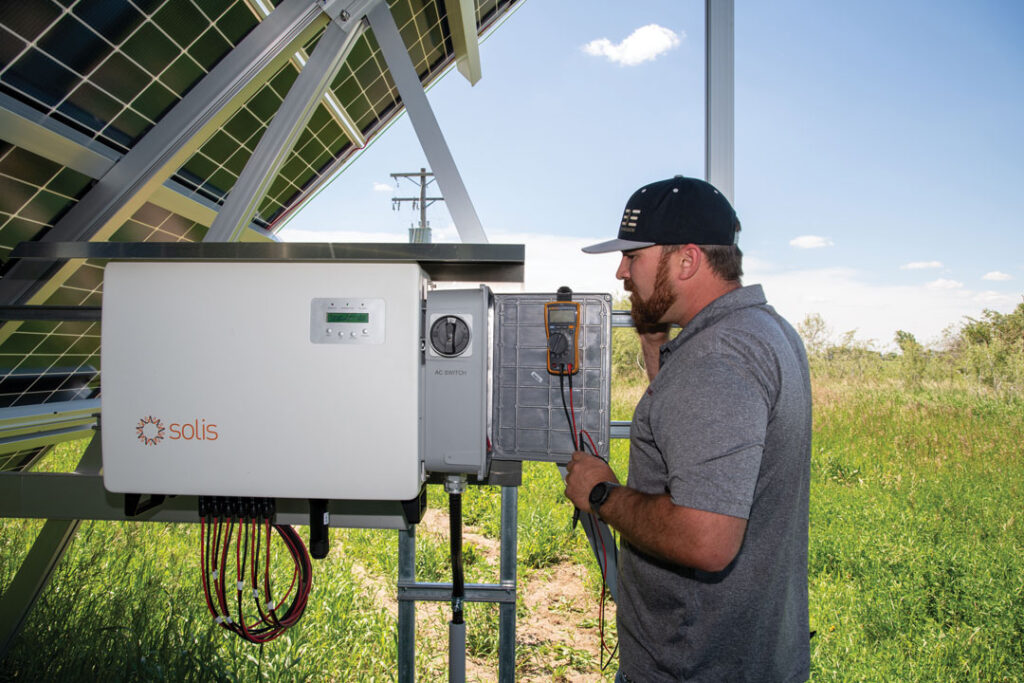
“In order to invest, I need to be able to pay back the cost of the solar array in a reasonable length of time,” said Auch. He noted the system cost about $250,000 to install. “Now, I expect the solar system to return my investment in about five years, and I’m comfortable with that.”
Auch described the installation process as smooth, and his financial projections have largely held steady. In fact, he adds that combining solar with other water-saving production practices, including no-till seeding, stripper headers and crop rotation, has further improved water-use efficiency, reduced costs and generated enough power that he hasn’t paid an electricity bill in several years.
As president of Auch Farms, he manages more than 5,000 acres of dryland and irrigated crops. He grows canola, barley, durum wheat, flax and spring wheat. He considered an investment in solar power generation after his neighbour installed a solar array. “I knew there was a solid business case for generating our own electricity to run the irrigation pumps, and after a thorough economic analysis with the installation company, the investment pencilled out.”
The array is located close to three irrigation pumps that each run two pivots and supplies all the power required, with additional electricity exported to the grid for income. Export rates in Alberta vary by season, with higher summer rates and lower winter rates, and are set by utilities or retailers under regulation from the Alberta Utilities Commission. Export rates are $0.35 per kWh for the summer peak season (March to October) and are $0.0895 per kWh during the winter off-season (November to February).
This seasonal rate structure works in Auch’s favour. His current service provider has given him the choice of lower rates in the summer when his electricity demand is the highest. While his solar system powers his irrigation pivots during the summer months, it also produces enough surplus electricity to generate an estimated $10,000 in export revenue annually. Combined with reduced electricity purchases, his solar array delivers roughly $50,000 to $60,000 in annual savings. “If I can take $60,000 a year out of my farm expenses today, and knowing electricity costs are only going to rise, that’s a pretty big win for me,” said Auch.
Beyond improved cashflow and savings, Auch also pointed to tax credits and depreciation as part of his initial economic consideration. While a solar array declines in value over time, he views it as a long-term, income-generating asset with an expected lifespan of 25 to 30 years. “Solar arrays are a depreciating asset on the farm that will be worth less every year on paper, but as long as they work, they are really a valuable asset that generates income, too,” he said.
Larry Peters, owner of Okotoks-based Big Rock Power, said farmers often underestimate the role depreciation can play in improving overall returns. He noted that solar assets can qualify for accelerated asset depreciation as high as 55 per cent in the first year alone. “As a utility retailer, we buy bulk electricity and resell it,” said Peters. “And I don’t think Alberta farmers realize just how much opportunity solar can offer them.” Peters added that grants, subsidies and carbon credits can further shift the economics of solar installations. “The lower the capital cost, the higher the rate of return,” he pointed out.
Retzlaff chose not to pursue available grants, while Auch did qualify for and opt to take advantage of an investment tax credit tied specifically to irrigation use. No matter how a farmer chooses to invest in solar, the economics remain sensitive to electricity pricing, export rates and provincial policy, meaning returns can vary considerably between operations.
SIZING A SOLAR SYSTEM
“Investing in a solar installation is a major decision, and ultimately it has to make business sense,” said Peters. Given the 25- to 30-year lifespan of most solar arrays, he believes farmers should view them as a long-term, generational investment. “Solar can add value to a farm operation not only by generating income, but by allowing the business to become more self-sufficient in producing one of its most important and costly inputs: electricity.” His advice to farmers considering a solar installation is to work with a credible company that can accurately model the economics and long-term returns of the investment.
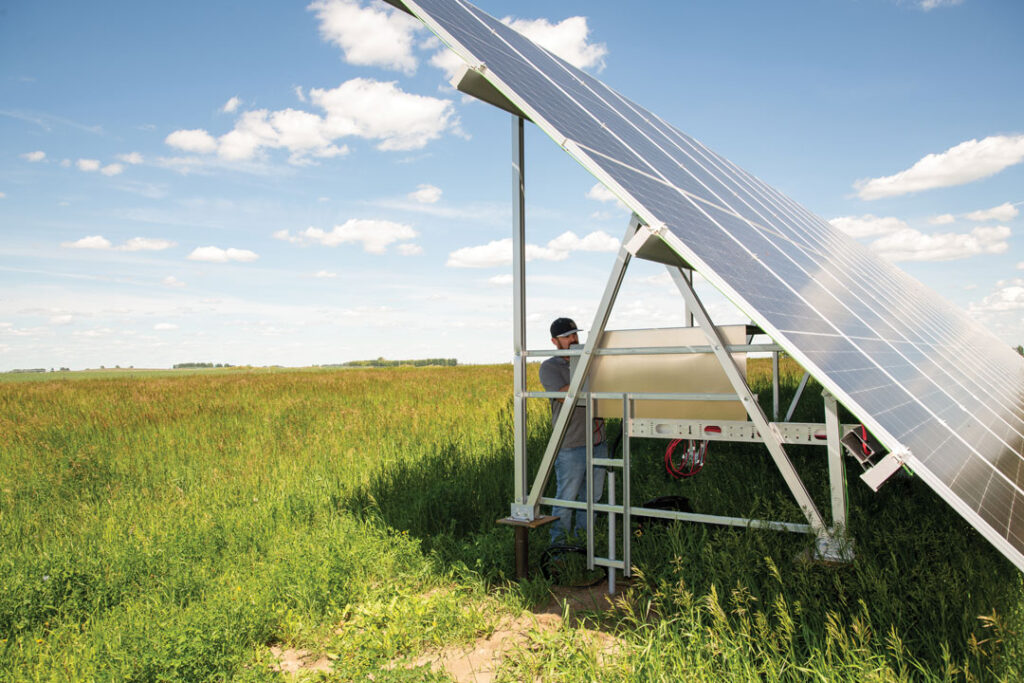
When determining the size of a solar installation, Schroeder recommends a system be designed to generate 10 per cent more power than the annual electricity consumption required to power the site. Depending on the operation, a site could range from an entire farm’s electricity use to the power required to operate a specific number of irrigation pumps. In Alberta, regulations limit systems to a maximum of 110 per cent of the previous 12 months of electricity use to ensure they remain within small-scale microgeneration rules.
These on-farm projects are also subject to a capacity limit of 150 kW alternating current to qualify for favourable high export rates. Schroeder noted that a 150-kW array should produce a minimum of 190,000 kWh in southern Alberta.
Schroeder estimated solar array installation costs $2 per W, or $2,000 per kW. He explained that 1 kW of solar capacity can produce 1,300 kW annually. When it comes to calculating the return on investment, he multiplies 1,300 kW annual production with a high energy export rate of $0.35/kW to provide a “best case scenario” of $455 income generation per year. If costs are $2,000/kW to install 1 kwH of a solar production system, in this example, a farmer can expect their investment to pay off in just under four-and-a-half years.
“This assumes a farmer is exporting everything they produce, which isn’t likely the case,” he said. “Most farmers will consume some energy before exporting the excess.” The typical payoff period, he said, is very manageable at four to seven years.
Site selection also plays a role in project economics. While the ideal installation site varies by operation, Schroeder recommends choosing locations with enough space to accommodate the array and that are near existing electrical infrastructure such as a transformer to reduce the cost of installation. Common sites include dry pivot corners. Systems can also be installed on large structures that can support an array, such as dairy barns, riding arenas and farm shops.
Where farms have multiple electrical loads, Schroeder emphasized the importance of site aggregation. Grouping solar array sites with similar usage patterns allows farmers to maximize export revenue and improve overall returns. Irrigation pumping sites, for example, are often grouped together because they have minimal electricity demand outside the irrigation season (typically, off-season is October through early May), allowing nearly all solar production during this period to be exported to the grid.
By contrast, combining irrigation sites with operations that have high winter electricity demand can reduce export potential and weaken project economics. “ROI is largely determined by how much power can be exported,” said Schroeder. “That’s why we focus on aggregating sites with similar usage profiles whenever possible.”
GROWTH OF ON-FARM SOLAR
As an electrical contractor who specializes in solar energy systems, Badlands Electric is one of the few companies in the province that manages projects from initial design and installation through to long-term maintenance and monitoring, with all services provided by in-house electricians. According to Schroeder, solar arrays generally require very little upkeep. Most systems are connected to app-based monitoring software that can alert either the farm owner or installer if problems arise.
Schroeder has successfully managed solar installations for the past two years and noted interest among farmers has steadily increased. This is particularly the case in southern Alberta where many operations rely heavily on irrigation.
Advanced software systems can accurately predict annual solar production, farm electricity usage and export capacity before installation even begins. “Unlike growing a crop or raising livestock, a solar installation generates income immediately, which is something that really gets farmers’ attention,” said Schroeder. He noted that the economics of solar tend to favour farms with consistently high electricity demands. These may include farms that rely on irrigation, or feedlots and dairy operations that typically have the energy consumption needed to justify the investment.
Schroeder believes farmers can’t look away from solar power generation any longer. With new installations now achieving projected returns in as little as three to five years, farmers have increasingly begun to explore the possibilities. When it comes to installation costs, he said that while they depend on the size and location of the array, farmers should expect $1,800 to $2,250 per kW of solar installed. He also advises farmers to work with a reputable contractor who employs qualified tradespeople.
“The greatest benefit of solar is simply more profitability,” said Schroeder. “With high export rates, solar arrays are a mechanism of generating income while preventing your farm from being susceptible to changing utility rates. You become more resilient because you are resistant to any future increases in power costs.”
The installation of a solar power system won’t make sense for every farm, but for operations with high electricity demands, the business case has become increasingly compelling. The ability to generate power, reduce costs and create a new revenue stream is turning sunlight into another productive farm asset.


Comments