



TRIPLE HEADER
BY EMILY R. JOHNSON • ILLUSTRATION BY NAOMI CLARK
Vijay Kumar Tiwari didn’t expect to become a hero in the eyes of wheat farmers. But since he and his team at the University of Maryland in Washington, D.C., identified a gene mutation capable of tripling the number of kernels on a head of wheat, the postcards have rolled in. He has received handwritten notes from farmers cheering him on. “They’ve said, ‘We’ve heard the news, and we are really excited about it.’ Hopefully it translates into farmers’ fields,” said Tiwari, an associate professor of wheat breeding.
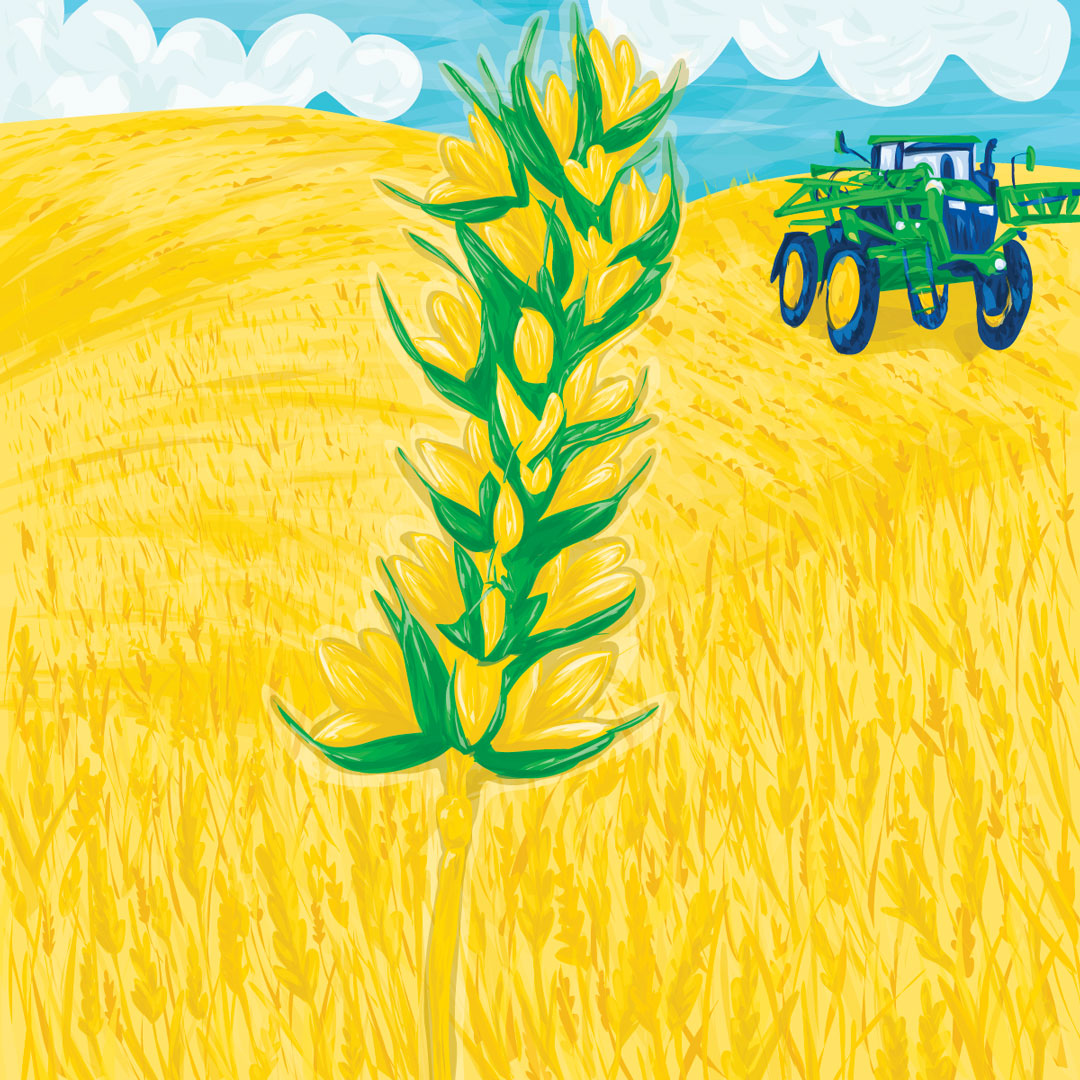
The gene is WUSCHEL-D1 (WUS-D1). Normally dormant in wheat, it was found to be switched on in naturally occurring mutations that resulted in multi-ovary wheat. An active WUS-D1 causes wheat flowers to develop more ovaries than normal. Each ovary can produce a kernel. If breeders can reliably switch on WUS-D1 in new wheat varieties, yield potential could grow dramatically. Tiwari joked that if you ask any farmer or breeder what their top research priority is, the answer is never a surprise. “Yield takes precedence over everything.”
But Tiwari admits tripling kernels may not necessarily triple yield. Because space within the flower is finite, kernel size in these wheat heads tends to be smaller. However, an increase in kernels per head produces more bran and nutritional value. This may prove valuable for niche food product categories such as breakfast cereals and whole grain products.
The team is also exploring gene editing to dial the expression back from three grains to two, working toward the optimal balance between kernel weight and count. Tiwari said the challenge is matching higher kernel numbers with a plant’s ability to fill these kernels and maintain grain size. The researchers are testing genetic combinations to improve both traits simultaneously, though he expects it will take another two to three years to identify the most promising approach. “We are making some stable and incremental progress,” he said.
The team will work to bring kernel size up while ensuring new varieties are well equipped to fight off disease. Tiwari said the multi-ovary trait could eventually be incorporated into hybrid wheat breeding programs that target new ways to boost yield. “We want to make sure it has a complete package—a nice combination that can truly deliver on the promises of hybrid wheat,” he said.
The reaction from farmers and the global research community has been overwhelmingly positive. Seed companies across the globe are watching closely to see how the discovery may produce results in the field. Canadian breeders have also taken note. “It furthers our understanding of the genetics behind wheat reproductive development and seed count,” said Harwinder Sidhu, winter wheat and triticale breeder and research scientist with the Lethbridge Research and Development Centre. “Such new variations are exciting selection targets for better varieties and/or parents for future wheat generations.” Sidhu is watching the trait’s performance as the University of Maryland work moves toward field trials.
The encouragement from farmers means a lot to Tiwari. “As a scientist you hear from other scientists, and that’s a good feeling, but to hear from the stakeholders and growers, saying they see hope, that is very extraordinary, very cool,” he said. “But it also puts a lot of pressure on us. If they’re carrying this kind of hope, we need to work harder and make it more feasible.”


Comments