



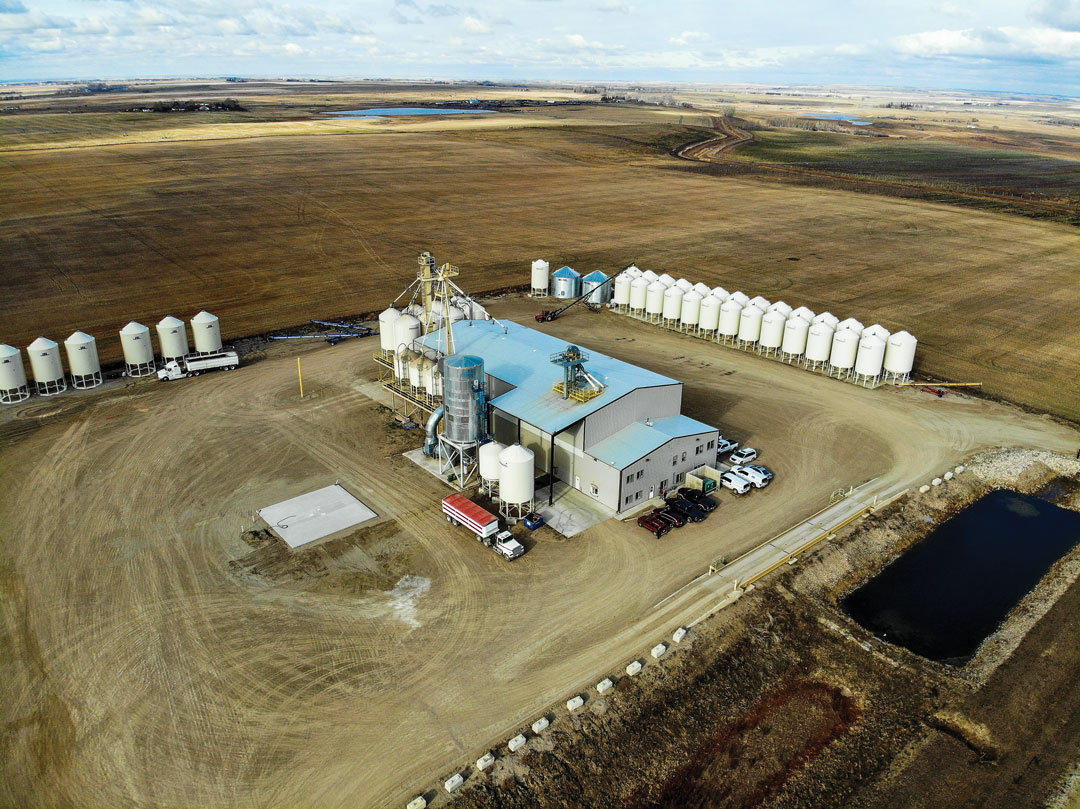
SEED PLANT MODERNIZATION ONGOING
BY GEOFF GEDDES • PHOTO COURTESY OF ALBERTA SEED PROCESSORS
Over the past 20 years, many Alberta seed plants have modernized operations with the cutting-edge equipment of the day. Such enhancements benefit customers and staff. “Whether it’s a farm or a seed plant, technology drives results,” said Monica Klaas, general manager of Alberta Seed Processors. “The more you produce from one square foot of plant space, the better your bottom line.”
Though this modernization has spanned two decades, it has not proceeded in a straight line. “Upgrading facilities stalled during the COVID-19 years,” said Klaas. “Post-pandemic, many plants are in a financial position to spend, and lower interest rates make investing in new technology pencil out.” As well, a greater array of industrial equipment suited to agricultural facilities is available than in the past.
One of the greatest gamechangers is the optical sorter. The Bashaw Seed Cleaning Co-op was the first in Alberta to adopt this equipment around 2005. This technology employs a high resolution camera to separate incoming seeds by colour and density. While mechanical sorters, for example, had difficulty distinguishing between wild oats and commercial oats, optical sorters can easily extract the darker, denser wild oats.
To date, about half of Alberta seed plants use these sorters. Purchase and installation are costly and the units require large compressors as well as a climate-controlled environment, which makes them practical for facilities that handle well over 250,000 bushels per year. “With large volume plants, technology saves time and money and improves quality, so it makes good business sense to adopt technology,” said Klaas.
Sorters are the lead actors, but equipment such as monitors and heat sensors play a supporting role. The substantial heat generated by equipment can be a source of ignition when grain dust is present. “To address the danger, monitors and sensors act as early warning systems that are key to risk management,” said Klaas.
New quality control equipment is also being adopted. Certain plants have installed metal detectors to prevent contamination by metal filings or shavings created by mechanical wear and tear. Sensors can detect that a bin has run empty and prevent seed being fed into an idle machine. Sensors also alert operators when bins are full.
“Bin monitors are not necessarily new technology; they just got better with a combination of sensors, as well as cameras that assist operators,” said Klaas. In newer plants, interconnected machines allow incoming products to be switched between machines to manage wear evenly. Variable speed motors can be programmed to start slowly rather than at full bore, this saves considerable electricity. “Technology saves a lot of manpower and prevents human error,” said Klaas. “It doesn’t replace people, but it allows them to multitask.”
Many plants have introduced software that tracks the movement of product through the facility. “In the old days, plants used a chalk or white board for such tracking,” said Klaas. Programs such as SeedTrakr and Impel Systems are now used. “Most facilities are running with the bare minimum of staff, so there’s no designated person to do tracking, billing and such, which are huge jobs. Automated tracking saves time, maximizes accuracy and allows customers to monitor the quality of their shipments.”
Most software is customized first to seed industry specifications, then to the individual plant. “Our plants vary widely, from ones handling two million bushels to those with under 100,000,” said Klaas. “At bigger facilities with multiple shifts, tracking ensures continuity between shifts. When you’re cleaning seeds for hundreds of clients, you must be sure that customers receive their own seed or grain back and that mixing of their products never occurs.”
LOUGHEED CO-OP SEED CLEANING PLANT
A major upgrade to the Lougheed Co-op Seed Cleaning Plant in 2017 incorporated a host of tech tools. They include an air blower and screen machine which are used prior to the optical sorter, said plant manager Jeremy Simpson. “The air
blower extracts light debris. The screens then vibrate to take out larger debris and small weed seeds as the grain passes over. This technology is extremely accurate and easy to maintain.”
Shaft monitors are equipped with sensors that alert staff to stoppages or jams within equipment. Bin monitors indicate the temperature and moisture content of stored seed. As well, the plant utilizes a camera system that monitors seed as it enters the bins, so staff need not check them manually. “Those cameras make a big difference in two ways,” said Simpson. “They help reduce labour and they allow us to monitor the plant remotely. The remote ability is crucial for staff safety. Like many plants, we don’t have a lot of workers, so at night there is often just one guy on shift. Thanks to the cameras, I can log in anytime and make sure he’s OK.” While some of the plant’s technology is industry standard, the cameras and optical sorters are cutting-edge equipment.
WESTLOCK SEED CLEANING CO-OP
The Westlock Seed Cleaning Co-op is one of Alberta’s largest such plants. In September of 2025, it commissioned a new multimillion-dollar 120,000 square foot facility that processes more than two million bushels of cleaned seed annually. “Technology has doubled our speed and capacity,” said manager Mack Walker. “We’ve gone from working 24 hours, five or six days a week to 18 hours per day, Monday to Friday.”
The plant uses similar equipment to Lougheed, but on a larger scale, with two air blowers and two air screen machines. This scale underlines that cost is a factor when considering new technology. “There were certainly growing pains and learning curves as we went from manual everything to full automation,” said Walker. “The technology also came with a hefty price tag, but it’s worth every penny.”
STRATHMORE SEED CLEANING PLANT
“What sets us apart is our fully automated programmable logic controller system,” said Adam Koester, export manager at Strathmore Seed Cleaning Plant (pictured above). “It involves one central computer that all our machines can talk to. When we’re cleaning grain, the system lets us balance machines so product flows through them properly.”
The Strathmore plant also uses radar sensors on bins. These update staff on the volume of grain being processed. At night, managers can check the system with their smartphones and remotely monitor the plant.
“The system isn’t cheap, but it never calls in sick,” said Koester. “In winter, we can run seven days per week for at least 12 hours per day. We don’t have to babysit each machine now, and everything has a motion alarm. If something breaks down along the line, the system halts the whole process until we make repairs.”
To assist other seed cleaning co-ops in Alberta with tech upgrades, Alberta Seed Processors is now considering the launch of a program to help plants with capital projects, said Klaas. “They provide a valuable service to farmers, and technology helps them do it better, faster and more efficiently.”
Comments