



CURL UP AND DIE
BY TREVOR BACQUE
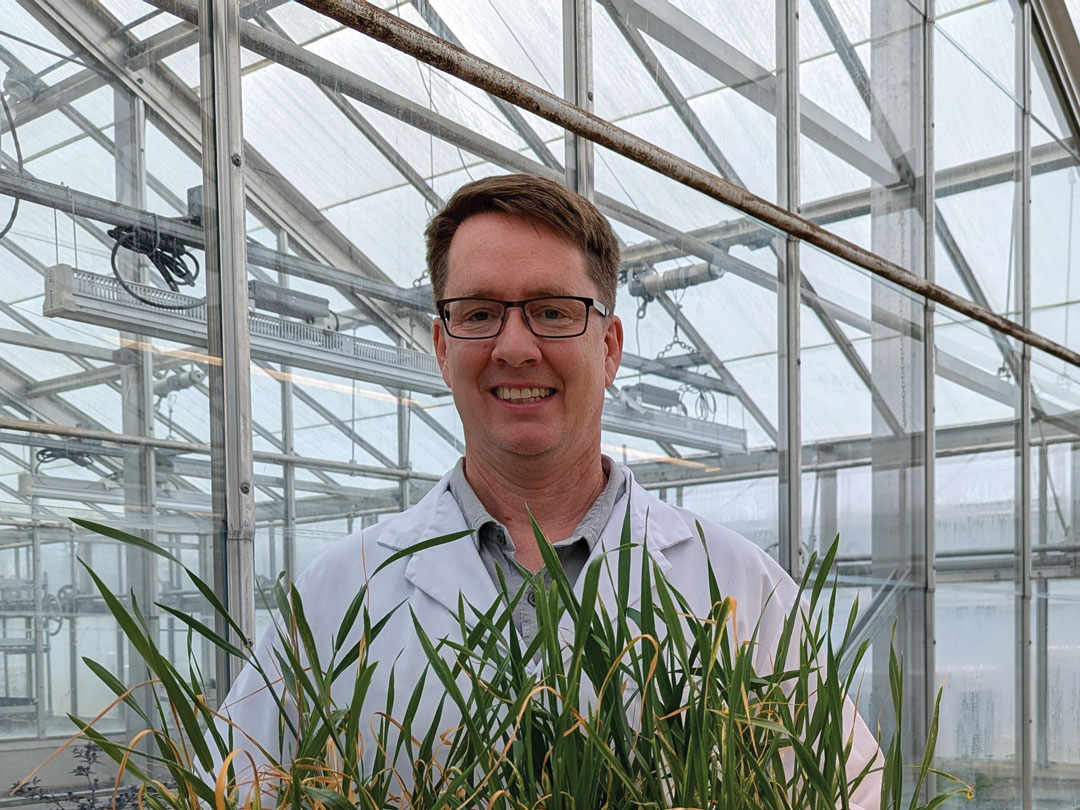
Prairie farmers will soon have access to non-chemical means in their fight against wireworm. Soon-to-be available RNA interference technology will enable new tools to combat the pernicious pest. Carried out by federal research scientist John Laurie in Lethbridge, the molecular biologist has spent most of his career working with RNA.
While certain crop protection products are being withdrawn from commercial use or have lost efficacy, some suggest the push for non-foliar control is only increasing. Many in the industry believe additional chemistries will continue to be removed more quickly than new options are introduced.
The biggest challenge with wireworm is their habitat. “They cause their damage in the ground,” said Laurie. “You can’t just spray them.”
Double-stranded RNA induces RNA interference and uniquely matches target genes in a species-specific way. To create RNA interference, Laurie and his team isolated 20-plus wireworm genes to target. They sequenced the genes expressed in wireworm larvae and found matching versions known to be lethal when knocked out in fruit flies. Laurie and his team synthesized double-stranded RNA for their target genes, and when consumed by wireworms, lab results showed good death rates.
Although there are more than a dozen wireworm species, Laurie targeted the top three found in Prairie fields. Given that the worms live in the soil, he believes seed treatment is the best option for field application. “If they munch on a seed, they will get sick, stop eating or curl up an die somewhere,” said Laurie. For heavily infected fields, this will give the seeds a fighting chance, especially once the seed establishes itself and the roots spread out.
The technology required to make RNA in bulk is a relatively new. Laurie credits COVID-19 for bringing down the cost of production. It costs his lab about $500 for a single kit that produces about 50 reactions. These reactions are done in small tubes and yield enough RNA for lab studies. The kits allow for rapid evaluation of RNA molecules, and with the new RNA bulk production methods it is becoming feasible to validate lab results in the field.
Today, companies produce RNA at an industrial scale for less than $1 per gram.
“The cost of making the RNA up until 10 years ago or so was so expensive,” he said. “It wasn’t feasible to use on a crop, but that has changed now. It’s fairly cheap to make. For agricultural uses that’s a big hurdle that’s been overcome. Projects like this that show promising results are not too far away from some really nice technologies for the field.”
Laurie had previously tried RNA on various fungi, weeds and additional plants, but had very little success, to the point he said he was banging his head against a wall. “But insects? It’s crazy,” he said. “You can just feed it to them and they die, so it’s pretty exciting.”
Laurie’s work was in part funded by Alberta Grains. The commission’s research chair is Brownvale area farmer Tasha Alexander. She is excited for this work to come to completion given the devastation wireworm can cause in the field. “It’s usually too late by the time you notice the damage and hard to effectively treat it,” she said. “That’s where the research is important. When Alberta Grains decides to fund research, we are looking for impactful research to help farmers maintain profitability and grow better cereal crops.”
Furthermore, Alexander believes this solution is positive because farmers continue to lose existing crop protection options. “Any time we can find these kinds of solutions, it’s a win for farmers,” she said.
Comments