



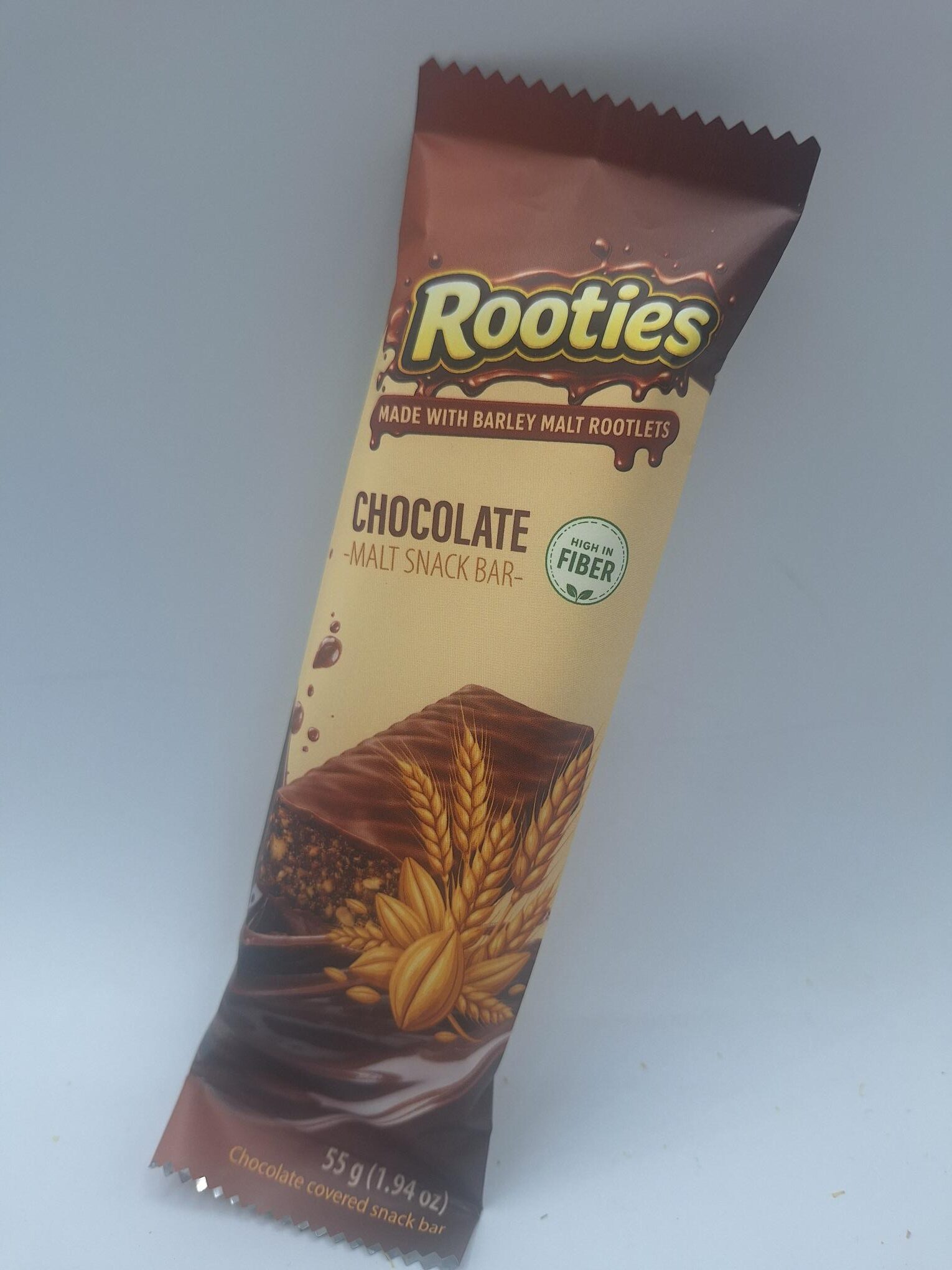
SNACK BAR FEATURES BREWING BYPRODUCT
BY IAN DOIG • PHOTO COURTESY OF SHERWIN SANTIANO
Byproducts of the beer making process such as malting barley rootlets are increasingly being used as food ingredients. A team of students from the University of Manitoba have made these sprouts the star ingredient of a chocolate bar.
The Rooties bar was developed for IFT First, an international food development competition held annually by Mars Snacking (makers of the Mars bar) and the Institute of Food and Technologies Student Association (IFTSA). Sherwin Santiano, the leader of the four-member team, is a master’s student who works full time as a brewing and malting technician at the Canadian Malting Barley Technical Centre in Winnipeg. Calling themselves The Snack Artists, his teammates included Santiago Rivera Alba, Maria de Los Angeles Garofalo and Kemashalini Kirusnaruban.
In a regional IFTSA product development competition held last year at the University of Manitoba, the team developed an ice cream sandwich that incorporated malting barley rootlets. They won first place. This entitled them to go on to the international competition in Chicago in spring of this year.
Familiar with the byproducts of the brewing process, Santiano was inspired to use rootlets as a food ingredient. He described the Rooties product as similar to other chocolate-coated bars found in any confectionery aisle. The low cost of the rootlets allowed the team to create a bar that is inexpensive yet high in fibre and protein. This is derived mostly from the rootlets, but the bar also incorporates nuts and additional soluble fibre.
The bar’s inner, chewy layer incorporates finely milled rootlets, as does its outer chocolate layer but to a lesser degree. While the hint of grassiness found in the rootlets is eliminated by toasting, their slight grittiness is camouflaged by the other ingredients. The team prepared and packaged the bars at the University of Manitoba’s pilot test kitchen in the Richardson Centre for Food Technology and Research.
Framed as a learning experience for students, the competition involved everything from development of a business plan and recipe to manufacturing processes, package design and marketing strategy. Competing against teams from around the globe, The Snack Artists were required to deliver a pitch for their product to a six-judge panel in Chicago. “It’s a little bit like Shark Tank,” said Santiano. “We did not place, but we got honourable mention. It was a great experience.”
Santiano describes the project as a thought experiment. With his background in food science, he found the world of product development with its marketing concerns to be enlightening. “Doing science, it’s about finding something novel and new. The real-world application comes second sometimes, but we also need to take that in consideration.”
Santiano’s team may yet work to commercialize the bar. “We tapped into something novel that shows a lot of promise,” he said. “It has real world application in the food industry.”

Comments