



A WORLD OF OPPORTUNITY
BY MELANIE EPP • LEAD IMAGE COURTESY OF AGRITECHNICA
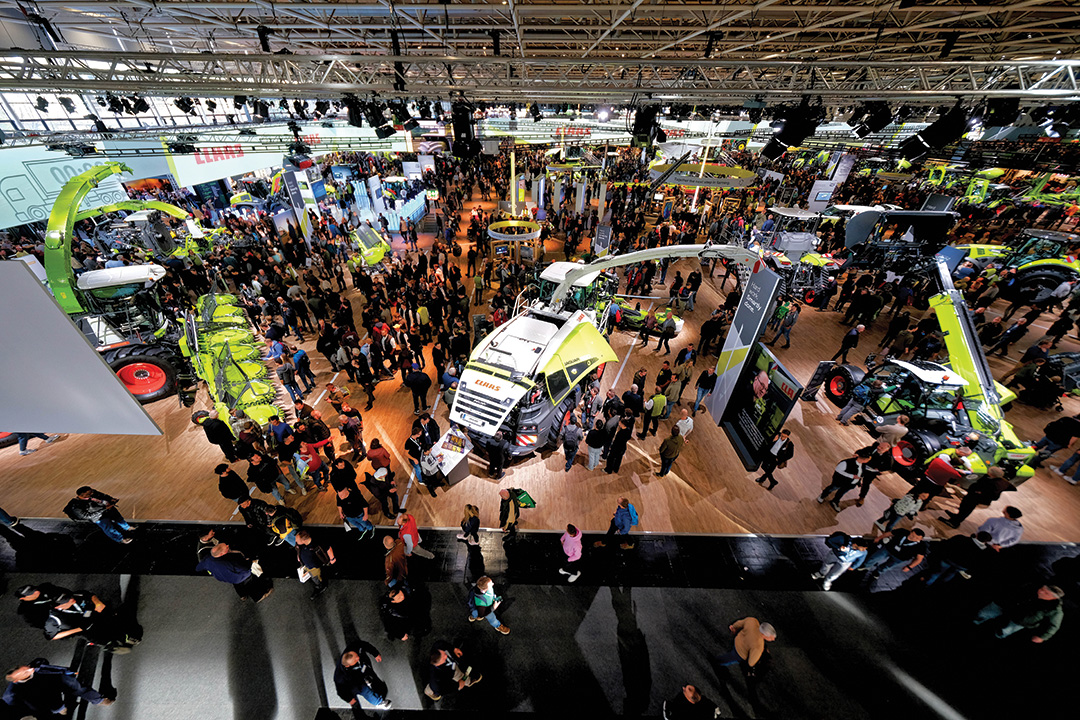
A wide variety of agritourism options are available at home and abroad to agricultural professionals and the general public. Notable among international travel destinations, every two years, hundreds of Canadian farmers visit Hannover, Germany, to attend the world’s largest agricultural equipment fair.
For most, an Agritechnica pilgrimage is not a shopping trip, but a professional development opportunity and vacation all in one. The machinery on display is largely scaled for European farms with small fields, narrow roads and tight regulations. They may find mechanical weeders created in reaction to pesticide restrictions not found in Canada and equipment engineered for hillsides steeper than those on Canadian farms. Though they may encounter solutions to problems they didn’t know existed and may not directly apply the innovations and revelations they encounter, the agronomic problem solving on display illuminates new possibilities and appeals to their natural curiosity.
The fair attracts more than 450,000 visitors every second year. It’s so popular, hotels within a 300-kilometre radius are booked a year in advance. The 2025 event saw thousands of farmers swarm the Hannover Exhibition Grounds at 9 a.m. each morning for seven days in November, a throng of caps and work jackets.
At its best, agritourism is an exchange. In Hall 12, surrounded by Brazilian, German and Italian machinery displays, a bright red carpet delineated Canadian territory. More than 30 Prairie companies were present, including Bourgault, Degelman, Duck Foot Parts, Honey Bee, Redekop and Thunderstruck. Many of them exhibited in the Saskatchewan Trade and Export Partnership’s (STEP) 1,500-square-metre kiosk. In the evenings, the pavilion hosted receptions where Canadians met current and prospective customers over Bloody Caesars in plastic cups. For the duration of the show, the STEP pavilion became the unofficial Canadian farm embassy.
EDUCATION ABROAD
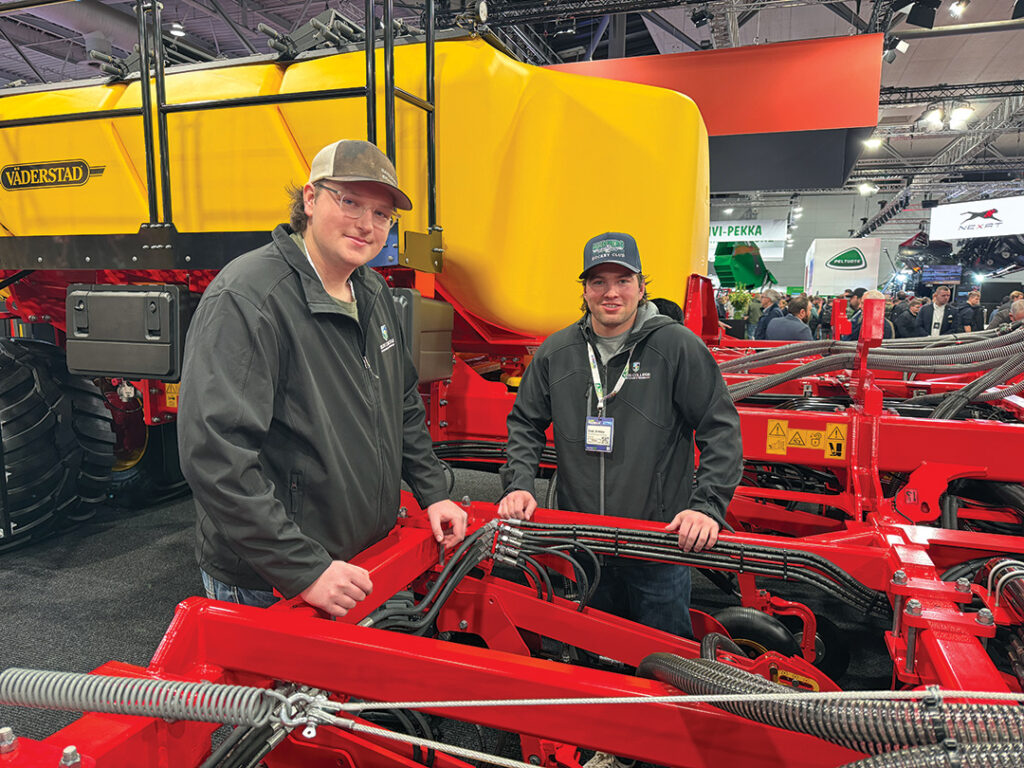
Agritourism is inherently educational. A group of students from Olds College got their first overwhelming glimpse of global agriculture at Agritechnica. Dustin Farr, an instructor in the institution’s agricultural management and precision agriculture department was equally amazed on his first visit in 2023. “I thought I knew a lot about global agriculture, and then I came here,” he said. “It just blew my mind. I know nothing.”
When he got home, Farr advised the institution’s dean, Jay Steeves, that students ought to attend the event. Steeves agreed, and a group of 33 students from agriculture technology, business and mechanical programs eventually made the trip.
“We get so locked into our own little world,” said Steeves, who emphasized the high value of such travel experiences. “Coming here, you see there’s a lot more happening, there are different ways to approach things.”
The students who made the trip confirmed it was an eye-opener. Gareth Meagher, 20, grew up in Calgary. A self-professed city boy, he’d always been interested in farming and now studies precision and digital agriculture.
At Agritechnica, Meagher was struck by the scale and specialization of European equipment. “The show is nothing I’ve ever seen before,” he said. “It just keeps going and going and going.” He also sought out innovation in drone technology and autonomy, comparing models on display to those he’d used at home. A highlight was a discussion about home country farm practices with a group of British ag students. Their experience with tractors topped out at 300 hp, a fraction of the 1,000-hp machines common on Prairie farms.
Cash Arntsen also entered agriculture without a family farm background. The 22-year-old from Swift Current, SK, became interested in the sector while working in ag retail. This led him to study precision agriculture and data-driven decision-making. Arntsen was intrigued by European farming systems. He noted European regulations, infrastructure and field size influence equipment design and adoption. “We may grow the same crops, but a lot of the way they do things is very different than how we do things back home,” he said.
BUSINESS OPPORTUNITY
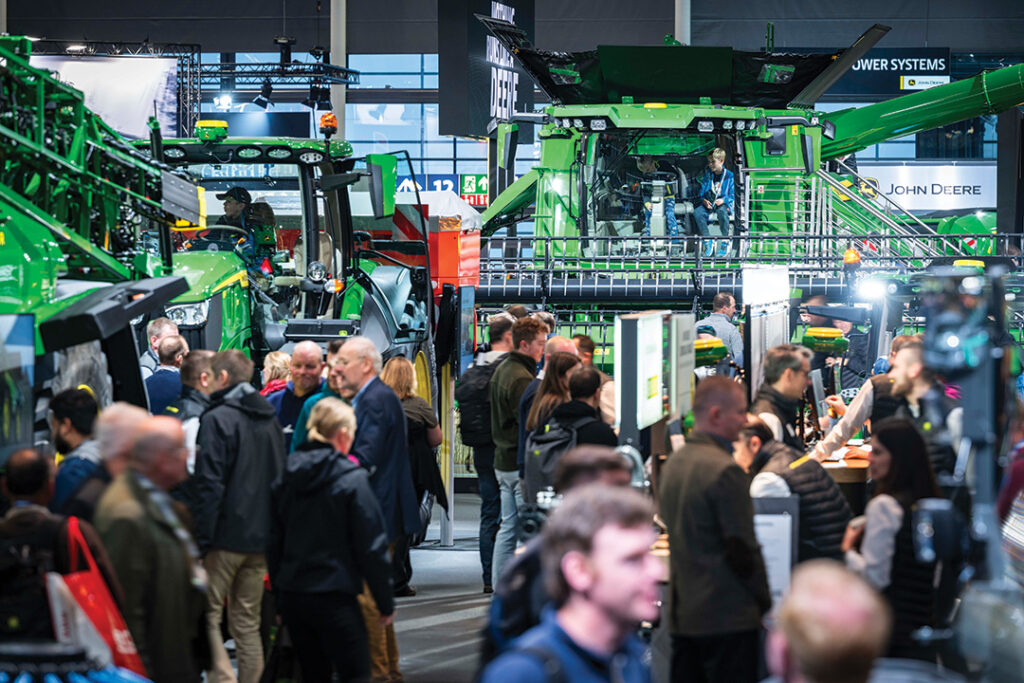
Also in attendance was Cheryl Loadman, a business professor with the University of Saskatchewan’s Edwards School of Business. Too often, she said, students overlook the agricultural sector because they associate it solely with farming, rather than with trade, innovation and global markets. “I cannot teach that in the classroom no matter how hard I try,” she said. With Loadman was a group of the institution’s business students. Paired with Canadian exhibitors through STEP, they spent the week engaged with clients to learn about export markets and to participate in business negotiations.
Zainab Khan found the experience was a revelation. The USask fourth-year marketing student previously had three potential employers in mind: Spotify, Pinterest and Aritzia. Agriculture didn’t make the list. “To me, agriculture was just farming and not relevant to business,” said Khan. “But being here, I see a whole new horizon.”
Khan was paired with Jeremy Matuszewski, owner of Manitoba company Thunderstruck Ag. Throughout the week, Matuszewski introduced her to senior women in the industry and included her in key business meetings. “Business is all about making the right connections,” he said.
USask third-year management student Parker Thiessen arrived at Agritechnica with some industry familiarity. His father owns Saskatchewan equipment manufacturer Redekop. To broaden his experience, he chose to work the show with Bourgault to observe decision-making and delegation in real time. “I’m taking a look at how everything’s coming together,” he said. “Who’s in charge, who’s calling the shots and who’s making the things come together.”
Like Loadman, Edwards School of Business associate dean Maureen Bourassa said the experience reinforced something no classroom can replicate. “Business is relational,” she said. “The world, at its core, still counts on those human relationships. That’s how business deals are made.”
TRIP CO-ORDINATION
The Olds College trip was organized by Lawrence Rowley, a former New Zealander who lives in Calgary. Fifteen years ago, he founded Leader Tours, an agritourism business aimed at farmers. “Agritechnica is pretty much a bucket list item for most grain farmers,” he said. “They really want to go and see the show.”
Leader Tours offers much more, though. Rowley has created packages for farmers who wish to visit Argentina, Australia, Brazil, New Zealand and Uruguay. Every itinerary features a customized blend of farm visits and sightseeing. Rowley handles flights, accommodation, local farm contacts and works with a partner network in each country to arrange farmer introductions and behind-the-scenes access. The trips allow participants to compare their own climate adaptations, equipment, management approaches and production systems to those of farmers whose operations look nothing like their own.
BRING IT HOME
At the Agritechnica DLG International Visitors’ Lounge, three central Alberta ag industry leaders gathered in this space set aside for professional meetings and networking. Frank Creasey of the Red Deer District Chamber of Commerce, Jesse Smith of Tourism Red Deer and Stacy Felkar of Agri-Trade Equipment Expo made the trip to study the show, its draw and economic impact. What might this global fair teach them about the operation of their regional event, Agri-Trade?
Agri-Trade has built its own international aspect for years. The annual trade show has featured a German pavilion, and exhibitors from Australia, China and the U.K. have recently joined. In 2025, it drew visitors from 15 countries.
Tourism Red Deer offers farm tours to such international guests. “Last year, we went to a fourth-generation family farm just outside of central Alberta,” said Smith. “Some of the international guests were just blown away by the operation.”
The ambition is to create “experiences within experiences” said Creasey. Such layered programming draws international visitors deeper into the region, its farms and its businesses.
Interest in Canadian agriculture extends well beyond Alberta’s borders. This autumn, a delegation of CEOs from the Belgian Feed Association (BFA) will travel to Canada to evaluate the country’s agrifood system and feed sector. BFA managing director Katrien D’Hooghe said the board’s priorities are to network and engage in technical learning. The latter will include studying how Canadian agriculture is organized and its sustainability commitments put into practice and how the corporate sector approaches carbon footprinting.
The Belgian executives seek facts, figures and face-to-face exchange. Farm visits, feed mill tours and meetings with industry representatives are all on the agenda. The tour could lay groundwork for future collaboration and expanded trade under the Comprehensive Economic and Trade Agreement.
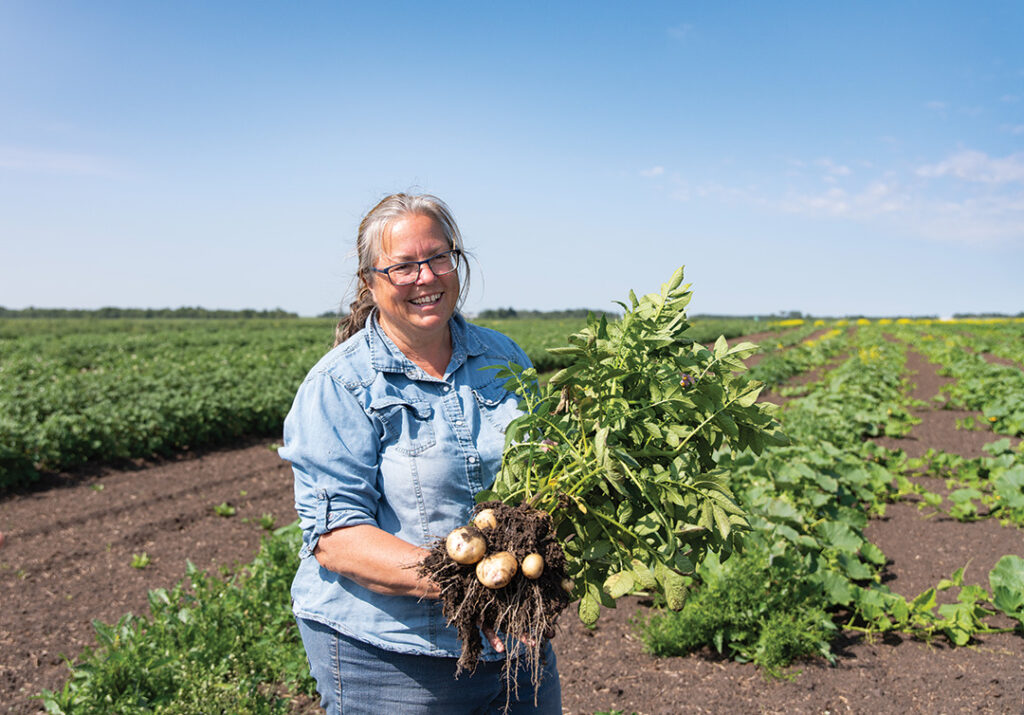
Agritourism plays a critical role in rebuilding agricultural literacy at a time when most Canadians are several generations removed from the farm.
—Tam Andersen
THE WORLD ON YOUR FARM
Interest in agritourism is growing across Alberta. Between 3,500 and 5,000 farms engage in some form of it. This number is expected to rise. Travel Alberta reports more than one million Europeans and 1.4 million Americans are actively considering rural Alberta as a destination for authentic agricultural experiences in the next two years alone.
Provincial support is growing in tandem. Following a $300,000 grant from the Northern and Regional Economic Development Program, Agritourism Alberta is developing an initiative to support farms that transition into agritourism. The organization was formerly known as the Alberta Farm Fresh Producers Association.
Agritourism Alberta president Tam Andersen said several forces drive such growth. On the farm, shrinking acreage, rising input costs, volatile commodity markets and climate uncertainty push farmers to find new revenue streams. Simultaneously, consumers—particularly younger ones—seek connections with the people and land that produce their food.
A farmer and agritourism business owner, Andersen and her husband Terry farm 3,500 acres of barley, canola and wheat near Edmonton. Forty-two years ago, she carved out a corner of the family operation and built an attraction that was unique at the time. Prairie Gardens and Adventure Farm spans 80 acres and includes a corn maze, a commercial market garden, a community-supported agriculture program with U-pick vegetables and strawberries. It also includes 25-acres of old-growth boreal forest managed as a conservation project in partnership with Indigenous elders and the David Suzuki Foundation. While her husband runs the grain operation, she welcomes the public. The rewards, she said, go well beyond the balance sheet.
“Agritourism plays a critical role in rebuilding agricultural literacy at a time when most Canadians are several generations removed from the farm,” said Andersen. “It offers both educational value for the public and economic value for farm families, creating a bridge between agriculture and the visitor economy.”
The strategies farms adopt are as diverse as the operations themselves. Some open U-picks or farm stays. Others offer direct sales, farm-to-table events or culinary tourism. Andersen points out many farmers participate without recognizing it. Selling eggs or beef at the farm gate or opening a greenhouse to customers all qualify.
Andersen is sympathetic to grain farmers who worry about welcoming strangers onto their farms. The risks are real. Liability insurance for agritourism operations is available from only two brokers in Alberta, and premiums are tied to gross receipts. Safety protocols, clear boundaries and proper signage all become part of farm management.
There are clear economic benefits to on-farm agritourism. “With access to a diverse income stream, especially into the retail streams, we are able to capitalize on every dollar we earn,” said Andersen. “We also offset the seasonality, so we have cash flow at times of year we would not normally.
“The story has equal value to the products you sell. When people become included in that story, that’s when it works. That’s when the magic happens.”

Comments