


BETTER FARMING WITH AI
BY RYYNN RATHWELL
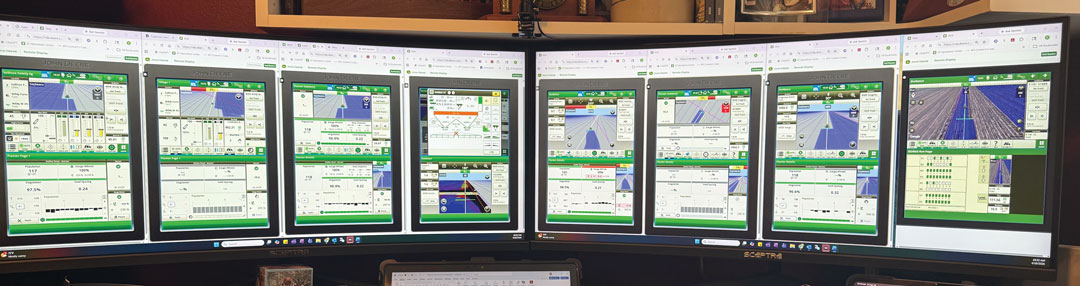
Farmers collect enormous volumes of data through yield maps, soil samples, field records and farm management software. It has been a constant challenge to figure out what to do with it. Think of all those dusty binders and unopened spreadsheets.
Artificial intelligence, especially large language models (LLMs), are beginning to change this, said North Dakota entrepreneur and farmer Nick Horob via email. “We’re moving away from the era where farmers are drowning in data to an era where they’re going to be able to uncover increasingly more insights from their data.”
Horob and Minnesota farmer and technology strategist Michael Steeke launched the four-week AI On Your Farm course in January. Delivered online, it is aimed at farmers who wish to use rapidly evolving AI tools in their operations. Horob also founded Harvest Profit, a farm management software company whose namesake product is a farm financial platform. Harvest Profit was acquired by John Deere in 2020.
Horob has long been passionately interested in AI and the construction of digital tools. His course introduces participants to LLMs such as Claude and ChatGPT and explores how these models can assist with data analysis, workflow automation and even custom software development tailored to individual farm operations. Horob believes LLMs have improved dramatically since early 2025, particularly in areas that previously limited their usefulness in agriculture. “AI has gotten exponentially better over the last 12 months at being able to do advanced data analysis,” he said. “A lot of the weaknesses of the past, like doing math, have been mostly solved.”
This potential is already changing the approach many agricultural professionals take to data management and
decision-making. Rather than simply collect and store information or utilize a limited amount, farmers and consultants are using AI tools to identify trends, compare scenarios and uncover insights that may have otherwise gone unnoticed. For operations that manage large volumes of agronomic and financial data, AI is increasingly a practical, everyday tool for doing better business.

Ask a question, get an answer, move on. I knew there had to be more to it than that, but I didn’t know where to begin.—Ryan Moore
Ryan Moore is an Arkansas-based certified crop adviser and independent agricultural data and technology consultant. Horob’s course significantly shifted his approach to farm analytics. “I was using ChatGPT the way I used to use Google,” said Moore in an email interview. “Ask a question, get an answer, move on. I knew there had to be more to it than that, but I didn’t know where to begin.”
Moore works primarily with large-scale row crop operations across the Mississippi River Delta and manages data tied to more than 150,000 acres of corn, soybeans, rice and cotton. His work can be very analytic and spreadsheet dependent. He learned AI can assist with the analysis of these massive datasets. This prompted him to ask questions he wouldn’t have considered and find anomalies more efficiently. “Analysis that used to take hours, or just never happened because there wasn’t time, can now happen in minutes,” said Moore.
Horob believes the push by North American farmers to use AI more efficiently is only beginning. Demand for the course has been strong. As of June, more than 600 participants had already completed AI On Your Farm. And while AI can’t replace human expertise, noted Horob, there is significant value in its ability to strengthen decision-making, especially during periods of volatility and tight margins.
For more information and to register for AI On Your Farm, visit fullstack.ag.

Comments