



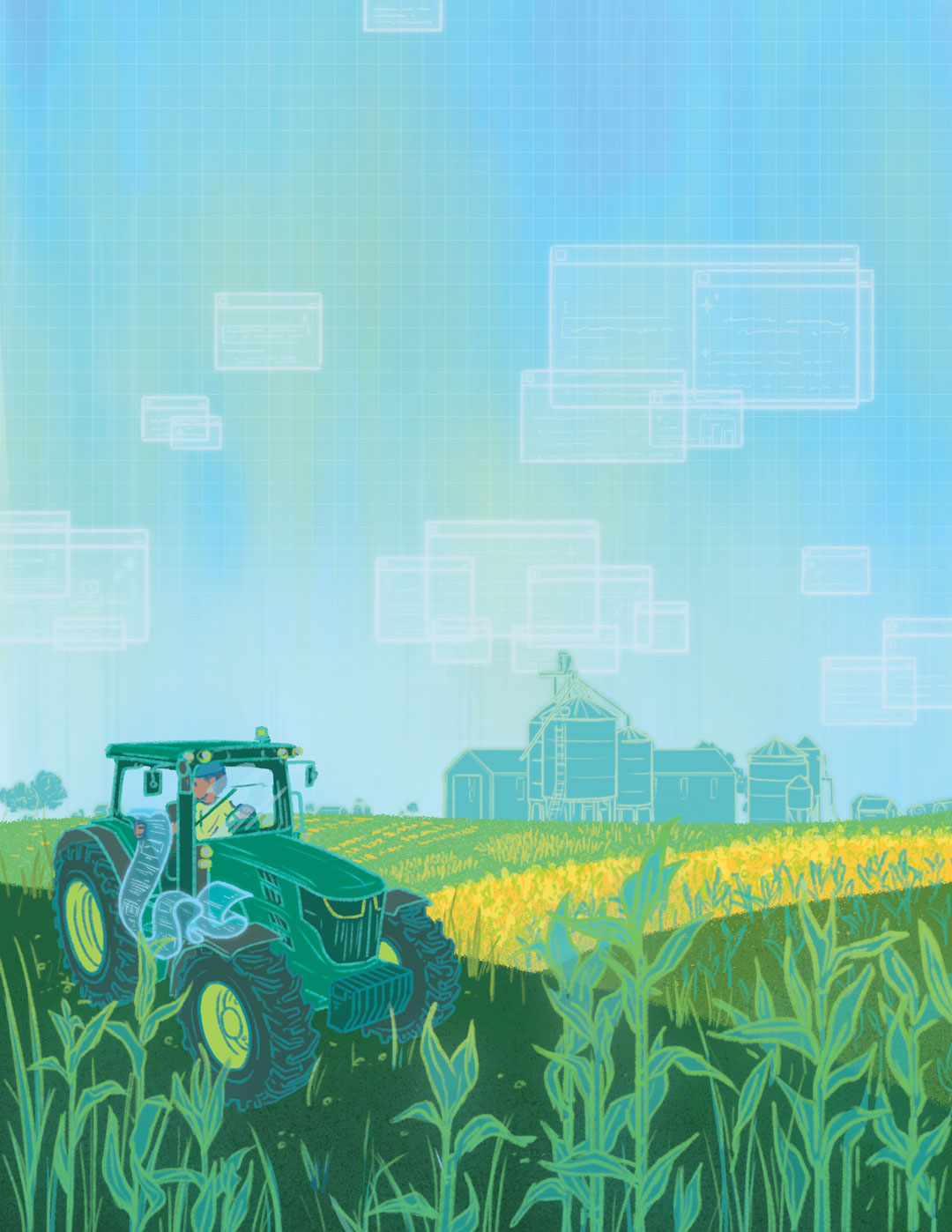
PROMPT SERVICE
BY TREVOR BACQUE • ILLUSTRATIONS BY SERENA TANG, VECTOR GRAPHIC BY VECTEEZY
It’s funny to discuss AI today as if we haven’t been living our lives with real applications of this seemingly Back to the Future technology for decades. With many examples from ’90s era voice-to-text software and Roombas to social media algorithms and Watson the AI Jeopardy contestant, artificial intelligence has been embedded in our social fabric for some time. It’s only now, given the ability to interact with it, that average citizens are starting to glimpse its true potential.
Today, large language models pull data from billions of inputs to give users a greater understanding of just about any subject. A recent Harvard Business Review tracked the 100 top uses of AI in 2026. The third iteration of the list, it tracked more than 12,000 searches by users between March 2025 and February 2026 and a report was prepared, naturally, using AI. The top 100 uses were varied and perhaps surprising. Understanding MS Office apps (99), preparing for interviews (89) and drafting a document (23) are examples of nuts-and-bolts uses of the tech. Career advice (24), generating ideas (47) and creating a holiday itinerary (83) demonstrate society at large is comfortable allowing AI to think for us. Fake reality TV (11), breaking the rules (29) and Dungeons and Dragons (77) perhaps reveal that most people will still use innovative tech for the silliest of things. The top use is therapy/companionship (also 1 in 2025), with troubleshooting and fun and nonsense at second and third.
Interestingly, the report suggests that as the breadth and depth of usage grows, “so has the anxiety that people are surrendering their cognitive responsibilities to AI,” it reads. “There’s also a parallel concern that they are relying too much on the technology for emotional support. In the business world, we’re seeing lots of activity producing marginal rather than game-changing benefits, so far.”
So, when we slip AI into a pair of Blundstones, what do we find?
Jack Bobo loves to talk about AI.
The conversation today perfectly mirrors the ones he and others had about personal computers 40 years ago. “There was a time when people asked the question, ‘Why would anybody need a computer in their home?’” he said. “It took a little while, but in less than a decade it went from only a few people having a computer at home to a lot of people.”
The executive director at the Rothman Family Institute for Food Studies at UCLA, Bobo works to reduce polarization in society, build trust in the food sector, unpack why and where these tensions lie and ultimately produce better outcomes for everyone. It’s plain to him that AI is at the centre of today’s conversation around food and its interconnected systems. Companies large and small are adopting it. Everyone is finding uses for it and as it becomes continually more democratized, it should become further enmeshed in daily life that much faster, he noted.
The agriculture industry firmly occupies the middle ground on AI with both leaders and laggards, said Bobo. He added that farmers have been the beneficiaries of AI for more than a decade and points out self-driving tractors as but one example. However, farmers have been slow on the individual level with generative AI. “The general public got access to the benefits of AI later than the farmer, but they’ve been quicker to adopt it into their personal lives than many in the farm community,” he said.
The rapid change and embrace of AI reflect blockchain adoption in the last decade, said Bobo. Pioneering farmers who embraced it were paid premiums for their products as they were able to quantify various qualities about their production methods.
At the farm level, Bobo suggested, AI has been slower for some because, unlike certain industries, farmers tend to view operations on a yearly basis. When we look at Big Data and the heavy skepticism that was prevalent among the farming community, Bobo believes this will not impede AI, “because they’re going to feel like it actually is giving them more control, not less.” With AI, a farmer arguably participates with their data, for example, at a greater level than ever before, and more so than in the Big Data boom. It’s this participation that will seamlessly drive the change.
Still, he cautions farmers to be careful how they use AI. People now have built-in biases toward certain search engines and understand that a Google search is not the same when done through Yahoo, Bing or DuckDuckGo. The realization is dawning that AI is the same. “AI systems are just as biased as the search engines,” he said. “In some ways they’re more biased, and they’re sensitive to the question that you ask and the history of what you ask.”
A chatbot’s response will differ greatly between a person with no chat history and one who is an established user. They are known to tell you what you want to hear, which underpins the goal of tech companies to keep users coming back. “It seems the tools want you to continue to use them, so they have to treat you nicely,” admits Bobo. He nonetheless believes farmers should utilize AI to collect and manage data in all areas of farm business. As well, the combination of AI and robotics will likely give rise to greater farm automation. This may assist with the perennial agricultural labour shortage.
Naturally, there will be less jobs for humans to fill. Bobo is the first to admit the AI revolution will be “highly disruptive” but ultimately beneficial. Young people especially will have to understand how they fit into this new AI-centric economy, which is likely to create a level of angst. Bobo noted this happens in any technological shakeup and always produces winners and losers.
Within 10 years, though, nobody will discuss AI. “And that’s because it’s going to become so ubiquitous most of its applications we won’t even really think of as AI anymore,” he said. Ultimately, it will improve income and livelihoods. “Certainly, that’s the story we have been telling for the last 50 years,” he said.
GRAIN MARKETER IN YOUR POCKET
When market variables are outside a farmer’s control, their first question is often, “Should I sell now?” Whether it’s an earthquake, famine, flood, war or rumours of war, these things tend to make people jumpy. Ag tech companies are developing decision-making tools that produce reliable answers and reduce anxiety.
GrainFox has created Sinoa, an agriculture-specific AI chatbot designed to give farmers timely answers on everything from prices to weather. “The real challenge always has been how to take all of that and turn it into an actionable item, or confident decision at the right time for our growers,” said company CEO Mark Lepp. The company’s historical data as well as that of companies it has acquired, provide source material.
GrainFox’s team of analysts—flesh-and-blood analysts—must evaluate more data than is humanly possible. Sinoa augments their services and assists in the development of custom recommendations for customers. AI activates archived information to produce reliable recommendations. Uptake and user activity suggest this approach is well received, said Lepp. They have the confidence to act on the system’s recommendations. “It’s going to … actively help people make decisions,” said Lepp. “That’s a really cool part of how technology is evolving and making a big impact on people’s lives.”
Human grain marketing conversation will continue, but Lepp sees AI as a second key touchpoint to support decision-making. “It’s better than not having a second source or another source of information,” he said. “We have very extensive procedures and protocols for analyzing the markets, coming up with strategies and making sales recommendations. The technology is so good that it’s like a live analyst in your pocket.”
Lepp predicts farms will increasingly use AI agents in many aspects of their operation for their value creation and speedy decision-making capabilities. Given the high stakes nature of farming in 2026, who wouldn’t try everything at their disposal? “To do whatever you can to break even or make profits is critical,” said Lepp. “There will be a lot more tools available for growers to utilize. Imagine if you told someone 10 years ago that this could be available? It’s like, ‘yeah right.’ It’s just sort of laughable almost. No, it’s here and it’s real and it actually works.”

LOCAL POINT OF VIEW
Three Hills agronomist Steve Larocque is bullish on AI, and for good reason. The owner of Beyond Agronomy, it just keeps making his life easier. Since generative AI came on the market, his customers have been more informed than ever.
Formerly, they would approach him with questions about something they’d read online or heard in a coffee shop or at a conference. From there, Larocque would have to go and research the topic to provide feedback or recommendations. Those days are quickly fading in the rearview mirror. In this new era of due diligence, farmers now consult their AI before they call Larocque. “They’ve already asked ChatGPT or Gemini the question,” he said. “Now they come to me informed and say, ‘Hey, what do you think?’” There are also many on-the-ground applications for AI. “I could upload a soil test report to ChatGPT and ask it to balance the calcium-to-magnesium ratio,” he said. And it will do so instantly. A farmer could also upload their field data and ask AI to identify the high and low nutrients across those acres and how to address that. “It’s helping us make decisions faster,” he said.
Larocque believes AI has limitations and is quick to point out the programs are only as good as what goes into them. A good question will generate a decent response, an unclear or muddled query, not so much. The technology can now be used as a highly functional assistant, but its proclamations must be reviewed by
a human.
Without access to a farm’s institutional data as well as regional agronomic and weather conditions, the AI agent isn’t worth its weight in Bitcoin. And while it can acknowledge and analyze geopolitical events, to connect their impact back to a specific Canadian farm remains a bridge too far for now. “I’m not saying it’s impossible,” said Larocque. “It’ll provide you lots of information, there’s no shortage of that, but there’s a shortage of people who are able to help people process that information.”
And don’t forget, he warns, these chatbots are designed to keep you coming back. If you feel like your ego is being stroked, you’re probably right. “It’s an absolute sycophant,” he said. “It’ll tell you your peanut butter and hairdressing idea is the best thing ever. It can lead you down the garden path and they’ll pump you up no matter what.”
Though chat programs may have these weaknesses, they may be asked to provide recommendations that have a range of financial implications. “We are relying on this tool that is not necessarily correct depending on the questions you ask it and the amount of data it has available to generate a response,” said Larocque. “So that’s probably where we’re going to hit the ditch more often than not.”
Back on UCLA campus, Bobo reflected on the shifting nature of his conversations with students. Once upon a time they were not really interested in AI. Then one day it was discovered it could be a homework helper. Everything changed overnight in classrooms the world over. “I think that farmers are going to find it’s going to help them with their homework, too,” he said.
AI in action
GrainsWest asked AI: What are five solid AI uses for a Canadian grain farmer? Read its raw responses below. Keep in mind, typing the question and receiving the answer took under 10 seconds, and the chat agent produced what sounds like a reasonable plan. Not perfect, of course, and it would benefit from some good followup questions and prompts, but it makes a great case for using the technology on the farm.
Crop scouting and disease detection
Use AI-powered image analysis on photos from your phone, drone or field cameras to identify early disease symptoms (Fusarium, rusts and leaf spots), insect pressure, nutrient deficiencies and weed identification.
The advantage isn’t that AI replaces agronomists—it’s that it helps you find problems sooner and scout more acres efficiently. Examples include Plantix, FieldScout or AI features built into modern precision ag platforms.
Potential payoff: Earlier intervention can protect yield and reduce unnecessary blanket applications.
Variable-rate fertility and input optimization
AI excels at finding patterns in yield maps, soil tests, elevation data, satellite imagery and historical weather. It can generate recommendations for nitrogen rates, seed populations, fungicide targeting and lime applications. Many growers already collect this data but don’t fully exploit it.
Potential payoff: Lower input costs while maintaining or improving yields.
Grain marketing and market intelligence
AI is surprisingly useful for marketing grain. You can use it to summarize market reports, monitor weather in competing export regions, analyze futures and basis trends, compare cash contracts and generate marketing scenarios. For example, you can ask: “Given current canola futures, basis levels, and my storage costs, compare selling now versus storing until January.”
Potential payoff: Better pricing decisions on even a small percentage of production can have a large impact on profitability.
Equipment maintenance and downtime prevention
AI can help organize and analyze service records, error codes, maintenance schedules and operator notes. Some newer machinery systems already use predictive analytics to flag issues before breakdowns. You can also upload diagnostic reports, photos and sensor logs and have AI help interpret them.
Potential payoff: Avoiding one major breakdown during seeding or harvest can justify the effort.
Farm office, paperwork and decision support
This is often the fastest win. AI can draft crop plans, build budgets, summarize agronomy recommendations, create safety documents, analyze operating loans, compare machinery purchases, generate grant or program applications and organize meeting notes.
For many farms, saving five to 10 office hours per week is easier to achieve than squeezing another bushel per acre from the field.
Some examples are building a whole farm cashflow forecast, comparing lease-versus-buy machinery options and summarizing dozens of agronomy reports into a single action list.
Potential payoff: Significant management time savings and better record-keeping.
If I were farming grain in Western Canada, I’d focus on these in order:
1. Farm office automation and planning
2. Grain marketing analysis
3. Variable-rate fertility decisions
4. AI-assisted crop scouting
5. Predictive equipment maintenance
These tend to have the best combination of immediate ROI, low implementation cost and minimal disruption to existing farm operations.

Comments