



A PLACE TO GROW
BY TIM PARENT • PHOTO COURTESY OF WESTLOCK TERMINALS
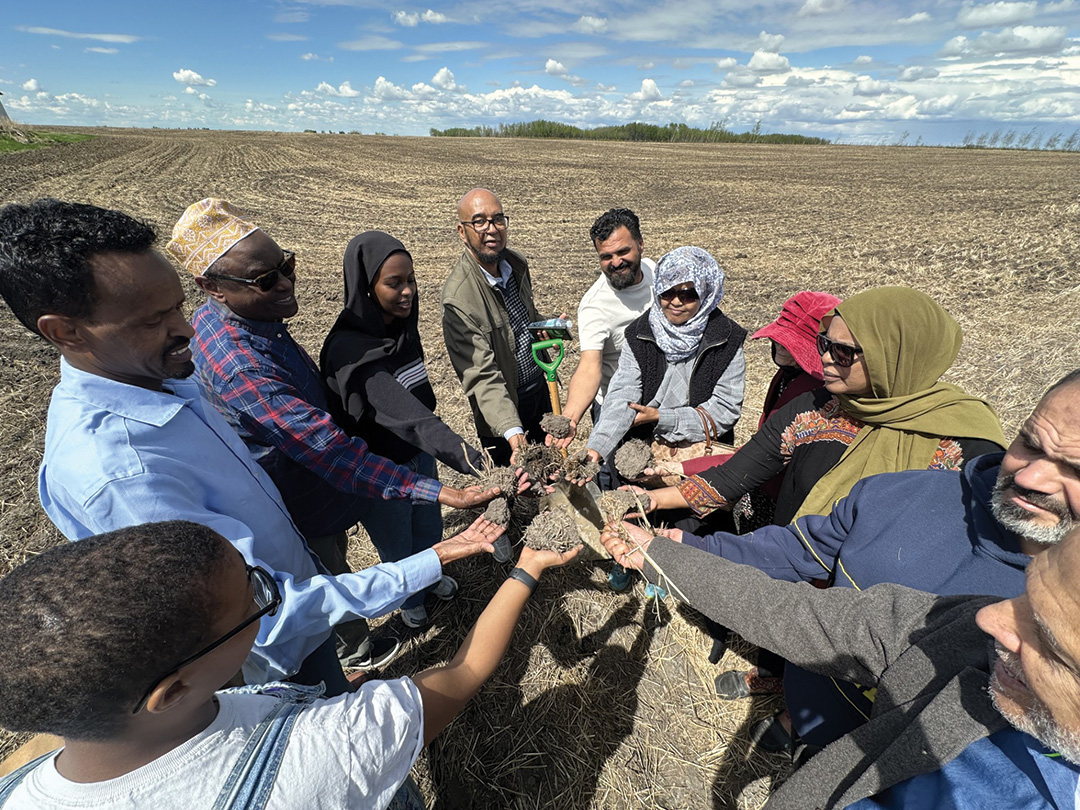
On a patch of farmland near Westlock resembling a big community garden, 20 immigrant farmers tested one big idea. Kurudi Mashambani, meaning “back to the land” in Swahili, gives newcomers access to soil so they can grow both food and community.
Created by Partners for Humanity Council (PHC), an Edmonton social equity group, the initiative has involved the co-operation of the Town of Westlock, Westlock Terminals, the John Humphrey Centre for Peace and Human Rights, the Somali Art and Cultural Association of Canada and Gateway Research Organization (GRO).
PHC handles the project’s day-to-day operation. It is named for a slogan of self-reliance used by the post-independence government of Kenya in the 1960s, explained Ahmed Noor, executive director of PHC. “Our vision of Kurudi Mashambani here is a community-led initiative that moves away from short-term charity models towards long-term economic autonomy, food sovereignty and rural revitalization by connecting experienced newcomer farmers with the land.”
Westlock Terminals, a business co-operative, maintains an approximately 160-acre farm site adjacent to its distillery and grain handling facility. To support the pilot project, the company provided five acres for a one-year term.
With help and support from GRO, a Westlock-based applied research group, the farmers were given technical advice on the suitability of crops for local conditions as well as access to machinery and equipment. Established local farmers played a supportive role, too. “Every grain farmer in the county is really quick to share their expertise and knowledge about local crops and growing intentions,” said Clifford Bell, CEO of Westlock Terminals. “So, participants don’t have to go too far to get advice.”
They also employ farming skills, experiences and methods such as intercropping they developed in Kenya, Nigeria, Palestine, Somalia and Syria. The group grew beans, beets, cantaloupe, carrots, corn, cucumbers, peas, peppers, potatoes, pumpkins, radishes and raspberries.
The project involved a lot of regular work and travel time. Edmonton, where most live, is about an hour away from the farm site. Weather conditions proved a challenge as well. Seeding started late, and due to excess moisture, Westlock County declared a state of agricultural disaster on July 14. “Miracles happen. Despite all that, the crops we grew did very well,” said Habiba Mohamud, a PHC volunteer and its founding CEO.
Harvested produce has been distributed to Westlock-area charities and the participants’ own households. In the future, it could be sold at farmers’ markets and additional commercial venues. “We are thrilled the vision has turned into tangible action faster than we expected,” said Noor. He and Mohamud emphasized their gratitude to their partner organizations for the project’s lack of red tape and speed at which it went from concept to realization. They hope to scale it up across the Prairies.
Herself the holder of an agriculture degree, Mohamud noted immigrants with farming backgrounds often make their homes in big cities and cannot use their agricultural skills in their new country.
“The goal is to empower newcomer and immigrant families to contribute to Alberta’s agricultural economy by doing what they know best: farming, food production and land stewardship,” said Noor. “We aim to revitalize rural communities by attracting skilled, hardworking immigrant families eager to settle and build roots in rural areas.”
“It is a fledgling project, but it has lots of room to grow,” said Bell.
In a rural community where agriculture is both an economic engine and a way of life, five acres could launch something much bigger.


Comments