


AG TECH ROUNDUP
BY IAN DOIG
Digital innovation is seemingly everywhere in agriculture. In the field, or soon to be, this collection of new and in-development products, much of it digitally enhanced, primarily aims to improve decision-making and increase efficiency of farm operations.
Go airborne
Advanced UAV
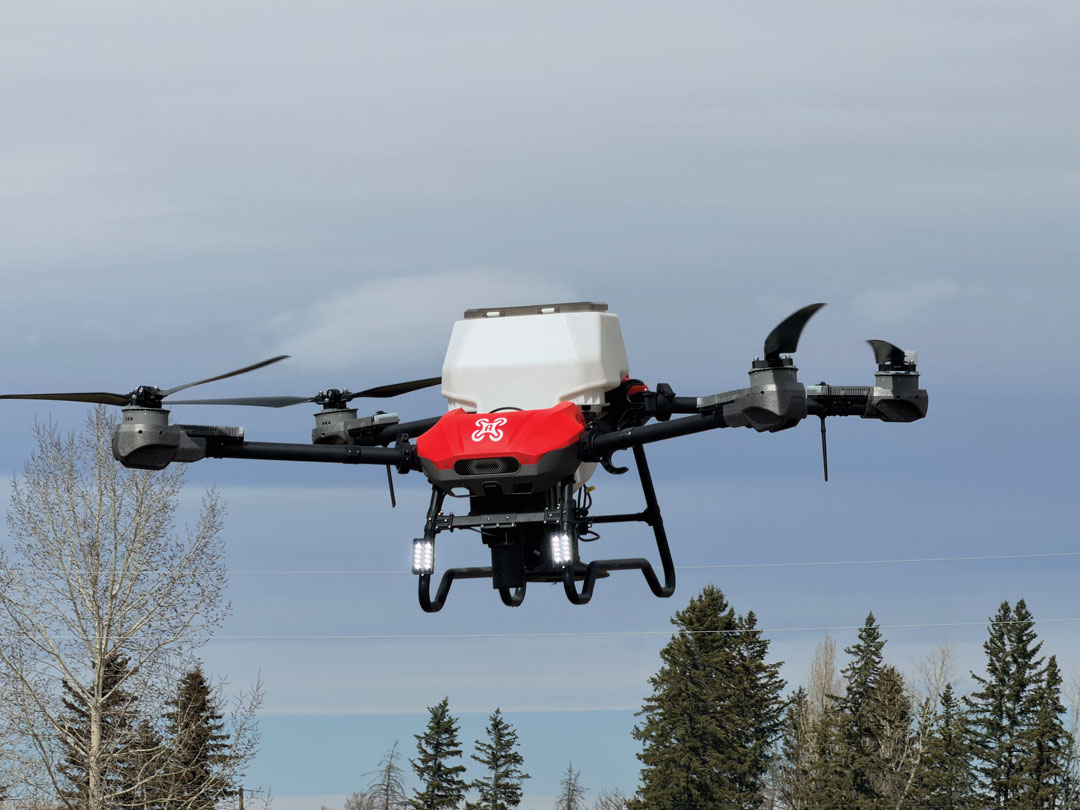
Headquartered in northeast Calgary, drone manufacturer Advanced UAV launched operation in 2020 with a focus on firefighting and other tasks but quickly made precision agriculture its mainstay. Its flagship aircraft is the A70 agricultural drone, so named for its 70-litre liquid capacity.
Advanced UAV manufactures the drone in its own facility, employs proprietary operational software and uses hardware components that are partially supplied by local manufacturers. As such, the business can service its drones more quickly and efficiently than users can expect with foreign models. “You get that support straight away,” said Christina Jarmics, Advanced UAV’s marketing representative. The business also offers operational and drone certification training.
Jarmics noted the A70 is constructed to be lightweight yet durable enough to withstand tough Canadian weather conditions. Crop protection products approved for drone application and liquid fertilizer can be sprayed using two or four nozzles with an adjustable application rate. Seeding can be carried out with the addition of a spreader mechanism. Clients in B.C. use the drone to tend blueberry and cranberry crops, while A70 users on the Prairies primarily employ the unit on broadacre crops and pastureland.
Typically, two A70 drones employed in tandem can apply product across 65 acres every hour. The rate of coverage depends on factors such as weather, the type of product being employed and terrain, said Jarmics. “Let’s have a discussion, so you know exactly what the drone can do for you.”
The federal On-Farm Climate Action Fund offers 50 per cent reimbursement for a drone purchase up to $20,000. For farmers interested in drone application but not ready to commit to a purchase, leasing is an option, and Advanced UAV also offers custom spraying and spreading services.
Put it on autopilot
TerraClear
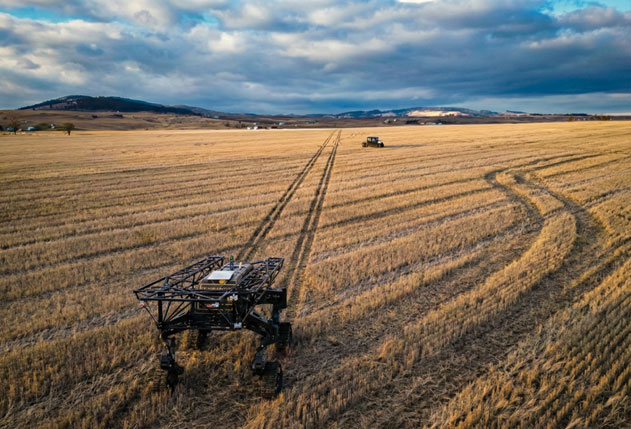
Now available in the U.S., TerraClear of Bellevue, Wash., will launch its TerraScout Autonomous Robot and a companion drone mapping system in Canada in 2027. The company initially developed equipment to map and remove rocks from farmland. The expansion to include weeds was natural, said Don Scribner, TerraClear director of product. To deliver immediate results, the company developed Aerial Edge Processing, a drone system that processes weed maps at the field edge during swap-outs of the battery and SD card. Alternatively, a ground-based TerraScout unit can roll over the field to capture an 18-metre imagery swath at 19 to 24 kilometres per hour and process on the go while it pipes data to the cloud.
Field tested in the U.S., the autonomous TerraScout will make its Canadian debut in the eastern provinces for corn and soybeans. Scribner said it will map rocks, do pre- and post-plant row following, conduct stand count for corn and green-on-green weed detection for both crops. He noted the unit can produce spot spray maps and serves well as a field scout across multiple passes to produce a clear picture of the weed situation.
“We are working on developing models for canola and wheat,” said Scribner. “Those are obviously very high priority for us. We do a lot of rock business in Canada already, so we want to continue to bring this to Canadian farmers and give them both rocks and weeds.”
The system now delivers weed count and density, and the next upgrade being developed promises to identify weeds by species. Further work is being done to capture weed height as an indicator for control timing. The company’s eventual ambition is to produce end-to-end scouting capabilities that include such aspects as pest identification and crop growth stage.
Stay grounded
Portable soil analysis
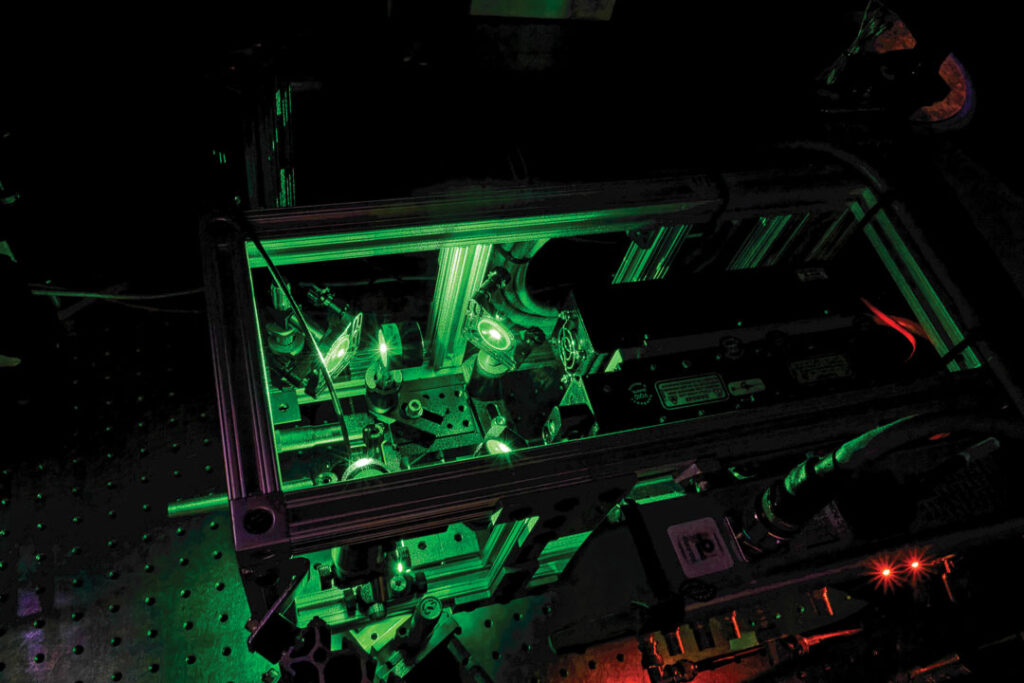
As a McGill University undergraduate student studying laser technology, Amina Hussein read about the challenges farmers face in sustainably feeding the world’s growing population. “I wanted to help address this looming challenge,” she said. Later, as a PhD student, she read scientific papers about how laser-induced breakdown spectroscopy, or LIBS, may be used in agriculture. Now a laser plasma physicist and University of Alberta associate engineering professor, Hussein leads the development of a portable soil analysis device that uses LIBS.
Currently a prototype, the device is intended to supply instant nutrient profile data and save the time and expense of sampling and lab analysis. The target is commercialization.
Funded by Alberta Innovates, the project team includes specialists in agricultural machine learning, electrical and computer engineering and soil science.
The briefcase-like device plugs into a laptop. When a soil sample placed in the device is hit with its laser, ionized gas-like plasma is produced. As this cools it emits light. The device’s spectrometer registers the light wavelengths produced by the elements present in the sample.
Soil can be difficult to analyze in this way due to its complex composition. Extensive expertise with laser plasma has allowed Hussein’s team to refine the device. “We are uniquely trained to understand this interaction of the laser with the material and with the plasma, so we could optimize the system,” said Hussein.
The system’s analysis software displays soil components in real time. It can zero in on elements of interest such as carbon, nitrogen, phosphorus and potassium. Machine learning software has increased accuracy and enabled the classification of samples by soil type. Accuracy of these functions improve as additional data is collected.
Headquartered in Edmonton, The Canadian Agri-Food Automation and Intelligence Network funds Canadian ag tech research and development across the agrifood value chain. It has collectively awarded its latest cohort of six projects $1.7 million to advance their products and services. These include a digital marketing platform for livestock feed and a crop-specific Drought Severity Index for daily monitoring at the regional and farm level.
The need for feed
Ox + Plow Ag
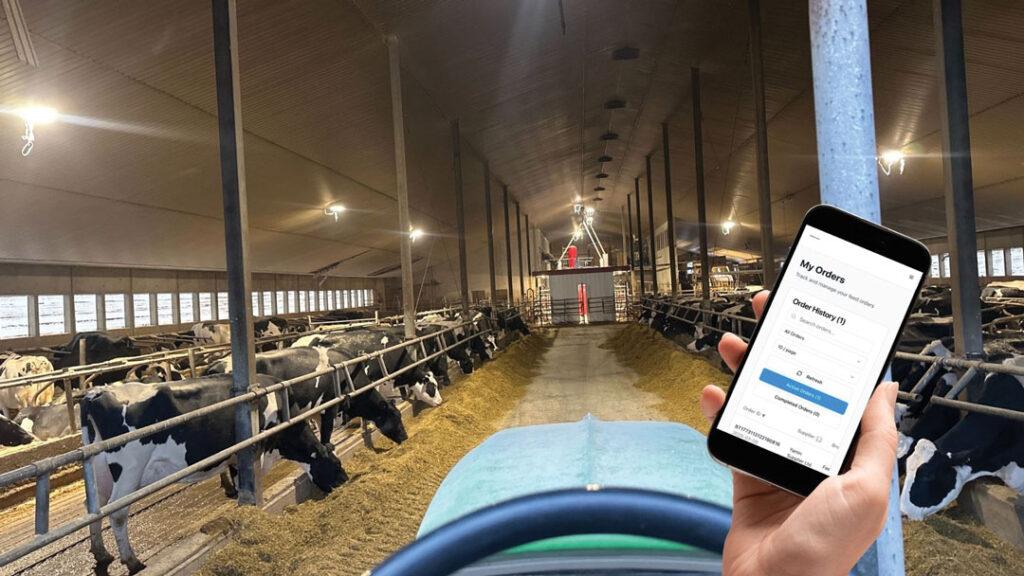
Ox + Plow Ag is a Calgary venture studio that invests in the development of technologies in partnership with the owners of these products. It will receive up to $330,000 to develop the FeedXchange feed procurement app created by Red Deer area dairy farmer Styn Nieuwenhuis. Aimed at farmers, feed brokers and nutritionists, it’s intended to increase efficiency and decrease expenses on dairy farms, feedlots and other livestock operations.
These typically handle feed one of three ways, explained Ox + Plow CEO Kevin Frankowski. They may purchase prepared feed or grow their own and do the necessary ration balancing. The third option is to purchase and self-blend ingredients, especially high-protein, nutrient rich co-products such as canola meal, spent grain from brewing and distilling and grain screenings.
These are typically only available through brokers. The purchaser must make numerous inquiries about constantly fluctuating price and availability. FeedXchange simplifies this. “The brokers don’t need to field those phone calls,” said Frankowski. “The information is on the app. The broker inputs the pricing formula, and the app calculates the rest, including estimated transportation price.” Access to guidance from a nutritionist is also in the app’s development plan. A commercial release is expected by mid-2027.
Moisture matters
A.U.G. Signals
A.U.G. Signals of Toronto, ON, has received $595,000 to develop its crop-specific Drought Severity Index (DSI). A tool for agronomists and farmers, it is intended to aid decision-making across dryland and irrigated acres. The system will employ multiple data sources to calculate crop stress and assess drought conditions on farms and across regions.
The company has worked in remote sensing since 2014, including crop mapping, phenology monitoring, pest and disease prevention and control and yield forecasting. Moisture conditions influence all these factors, noted Ting Liu, A.U.G.’s executive director. Drought indexes have been published for years, but have not delivered field-scale variability. To do so, the DSI will use AI to analyze remote sensing data such as satellite imagery and weather data while addressing crop type and growth stage.
The goal is a field-level snapshot of moisture conditions while AI forecasts drought progression. This will support farm decision-making, said Liu. “We are experiencing very dry years, increasing climate variability and rising input costs.”
A web-based platform that displays a colour coded map is being developed. The app will be tested with farmers and stakeholders for feedback and fine-tuning. It may take approximately another two years to fully launch.
Through its Cultivator program, Conexus Credit Union of Regina, SK, conducts AgTech Accelerator, a three-month business incubator program for Canadian and U.K. ag technology businesses. Its fifth annual session was completed in July. Among the technologies that received assistance were a digital grain delivery management platform and a field performance monitor system that utilizes high-definition cameras.
Get it there
GrainFlow
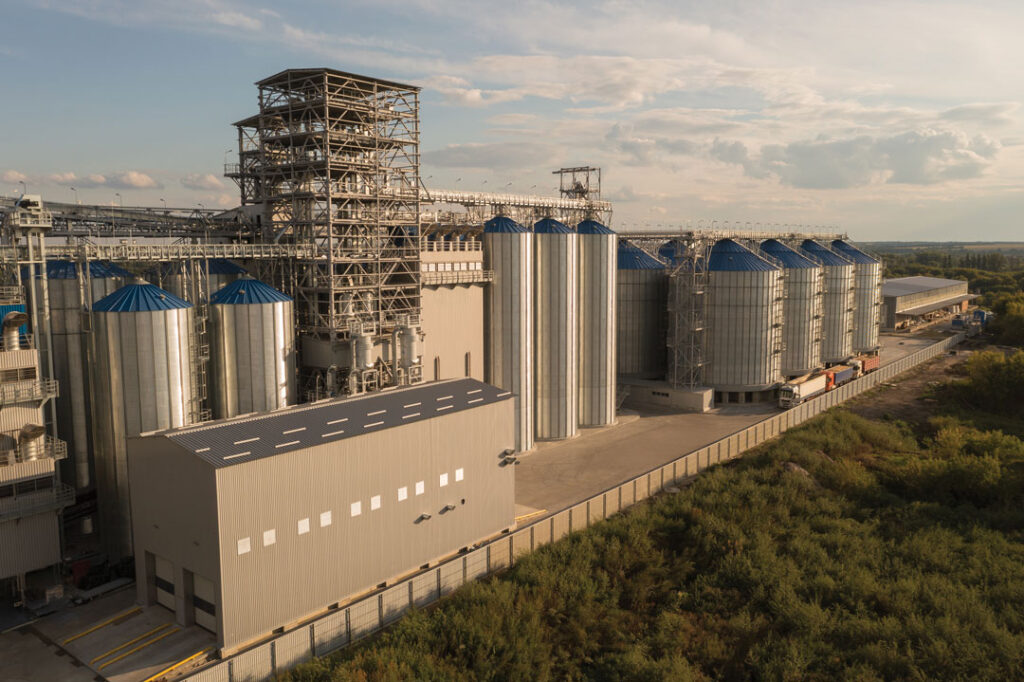
Congestion is common at elevators and other grain facilities. Bryan Wattie, GrainFlow founder, had a lightbulb moment reading a friend’s Facebook post about delivery frustrations. He arrived ahead of a 10 a.m. appointment stuck behind a 20-truck lineup. “When you waste a farmer’s valuable time, you erode trust,” said Wattie. “You make it less likely those farmers will do business with you in the future.”
Now in development, the GrainFlow grain delivery platform will help grain facilities make delivery more efficient for farmers and haulers. The real-time scheduling and forecasting app will offer self-serve slot booking with queue information and propose-and-confirm negotiation. It will also include fleet management for farms with multiple trucks and current and historical wait times at facilities. In turn, facility operators can view truck lane counts, throughput information and receive congestion alerts. Both sides can create and manage contracts. “When lines shorten, it creates goodwill and people return,” said Wattie. He estimates the system can bring wait times down substantially.
In January, Wattie launched a pilot project now in operation with a major grain handler with facilities in Saskatchewan and Illinois. These pilot locations will go live in September.
Keep an eye on it
AgVision
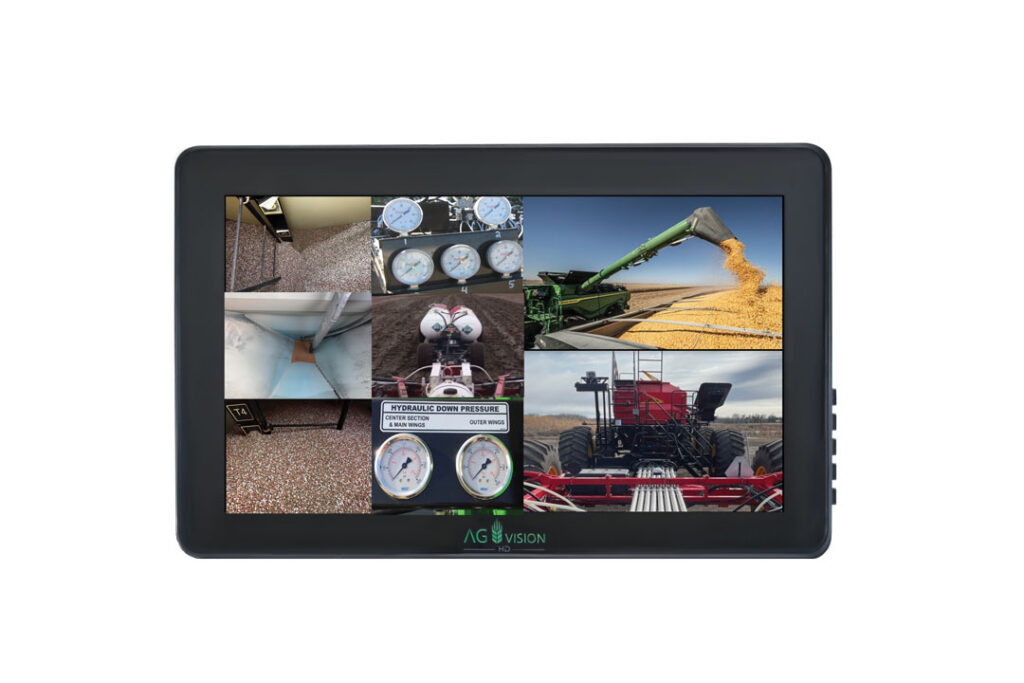
In its second year on the market, the AgVision performance monitoring system by UltraView Technologies allows farmers to manage and monitor agricultural equipment. Initially focused on air drills, it uses multiple high-definition cameras. The first generation model featured a 10-inch, four-channel tablet style touchscreen monitor. Its upgrade offers a 12-inch, eight-channel display. This minimizes cabling and cab clutter. Arrayed on an air drill, system cameras are installed inside the tank to monitor seed level and outside to view bearings, gauges and sprockets.
Word of mouth generated sales and dealer inquiries and the need to quickly refine business operations, which the Cultivator helped with. UltraView co-founders Brad Reykdal and Kyle Boxall conducted service and installation training with their network of 20 dealerships while they participated in the latest Cultivator cohort. During the process the duo rethought and perfected their business procedures and upgraded their marketing roadmap for new products.
“The camera technology that’s been available until now hasn’t improved,” said Reykdal. “The low-quality components and low-quality images weren’t good. We wanted to offer the customer a better option.”


Comments