



AGRICULTURE GIVEN VOICE AHEAD OF TRADE TALKS
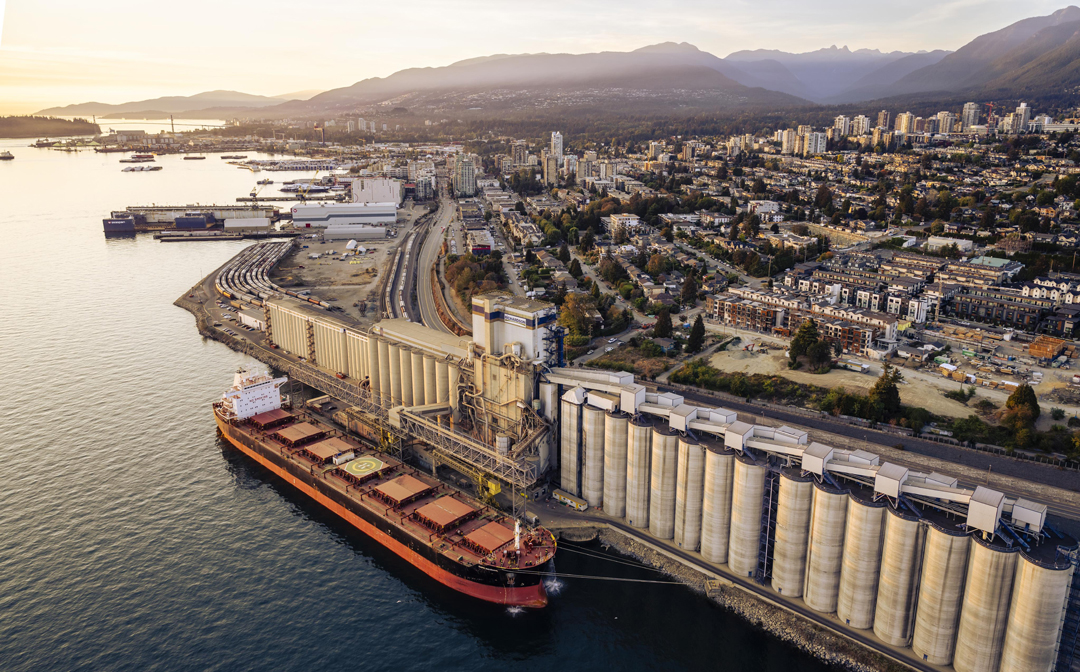
BY IAN DOIG • PHOTO COURTESY OF VANCOUVER FRASER PORT AUTHORITY
The agriculture industry will have a voice in Canadian preparation for looming trade talks. On April 21, Canadian Agri-Food Trade Alliance (CAFTA) executive director Michael Harvey was appointed to the Advisory Committee on Canada–U.S. Economic Relations as a representative of agri-food exporters. Chaired by Trade Minister Dominic LeBlanc, the body was formed ahead of the 2026 Joint Review of the Canada–United States–Mexico Agreement (CUSMA). According to a the federal government, “The committee will serve as a forum for expertise and strategy on all aspects of the Canada–U.S. economic relationship.” GrainsWest spoke with Harvey in late April.
GrainsWest: Is it standard procedure to launch an advisory committee such as this ahead of a North American trade review?
Michael Harvey: I don’t think there’s any such thing as standard procedure, because these things happen very rarely, and this is the first time we’ve done a review of the CUSMA agreement. There was a committee that Prime Minister Trudeau had set up that was very briefly active and then fell into disuse. So, I’d say it’s more of a strategic reaction from the government to the situation.
GW: The relationships between the U.S. and its fellow signatories to CUSMA—Mexico and Canada—have been described as tense. What are the main concerns for CAFTA and the Canadian agrifood industry ahead of the process?
MH: President Donald Trump has got a negotiating style that’s largely about ratcheting up the drama. But that said, for the agri-food industry, we haven’t seen the U.S. put tariffs on us, and we’ve got a big ally in the U.S. agrifood industry, which has been pushing for the agreement to be renewed.
GW: The relationship between the U.S. and the Canadian agrifood sector is less fraught than it is for certain other sectors.
MH: That’s right. For Canadian agrifood, the U.S. agrifood sector sees us as partners, largely, and we produce food together. And the U.S. sector sees us as a supplier of inputs that make them more competitive. So, we’re not seen as a threat to specific U.S. sectors, the way some Canadian sectors are.
GW: Every day $3.6 billion worth of agricultural goods and services cross the Canada–U.S. border. What is at stake for Canadian ag in the upcoming CUSMA review?
MH: Stability. What we’ve got now is a stable legal process for Canada–U.S.–Mexico trade and weakening the CUSMA agreement would create more political instability, and political instability has a cost.
GW: How confident are you that stable, reliable trade relations can be maintained under CUSMA?
MH: I’m highly confident, but not infinitely confident. Highly confident because it’s obviously in the economic interest of the United States to continue purchasing Canadian agri-food products. Not infinitely confident because of the negotiation style of President Trump.
GW: What concerns and recommendations will you take to the committee?
MH: I really bring the fact that we make food together with the U.S. And probably the most important thing we bring to the committee is our network of U.S. agrifood contacts, who can influence the U.S. administration to maintain the agreement in a way that we want.
GW: For Canadian agriculture, what are the best and worst scenarios that may play out in the CUSMA review?
MH: The best-case scenario is a renewal of the agreement that really recommits the three countries to a solid, stable trading relationship. I don’t really want to think about worst-case scenarios. I don’t think they’ll play out, but the worst-case scenario is that somebody decides to blow up a relationship that’s working very well. That would be against their own economic interests. But politics is politics.

Comments