



FOCUS ON FEED AND FORAGE
STORY AND PHOTOS BY IAN DOIG
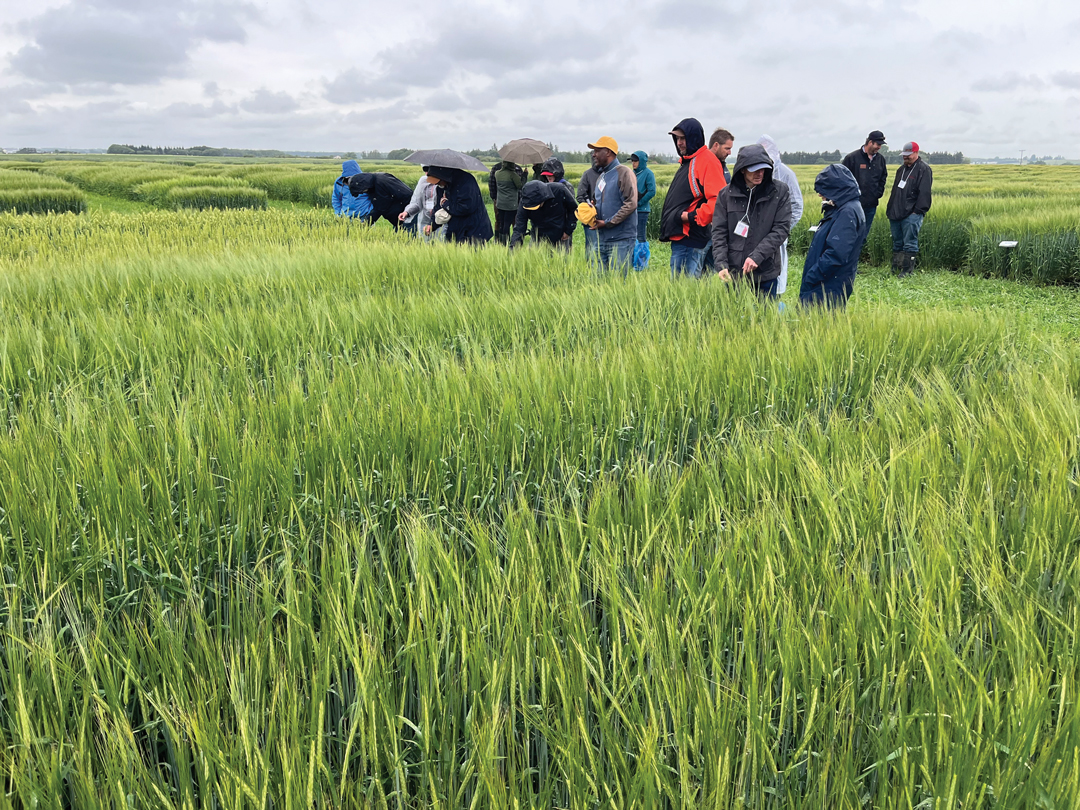
On July 22 of last year, Western Crop Innovations (WCI) held its inaugural field day at its farm facility near Lacombe. Overcast but bright, drizzle was the order of the day, and guests were dressed appropriately in multicoloured rubber boots and raincoats. Curious about the organization, which launched April 1, 2024, this event drew about 150 farmers and assorted ag industry representatives. As chair and area farmer Kevin Bender welcomed the assembled guests in the shelter of the farm’s spacious service garage, the event felt like a birthday celebration, albeit a damp one.
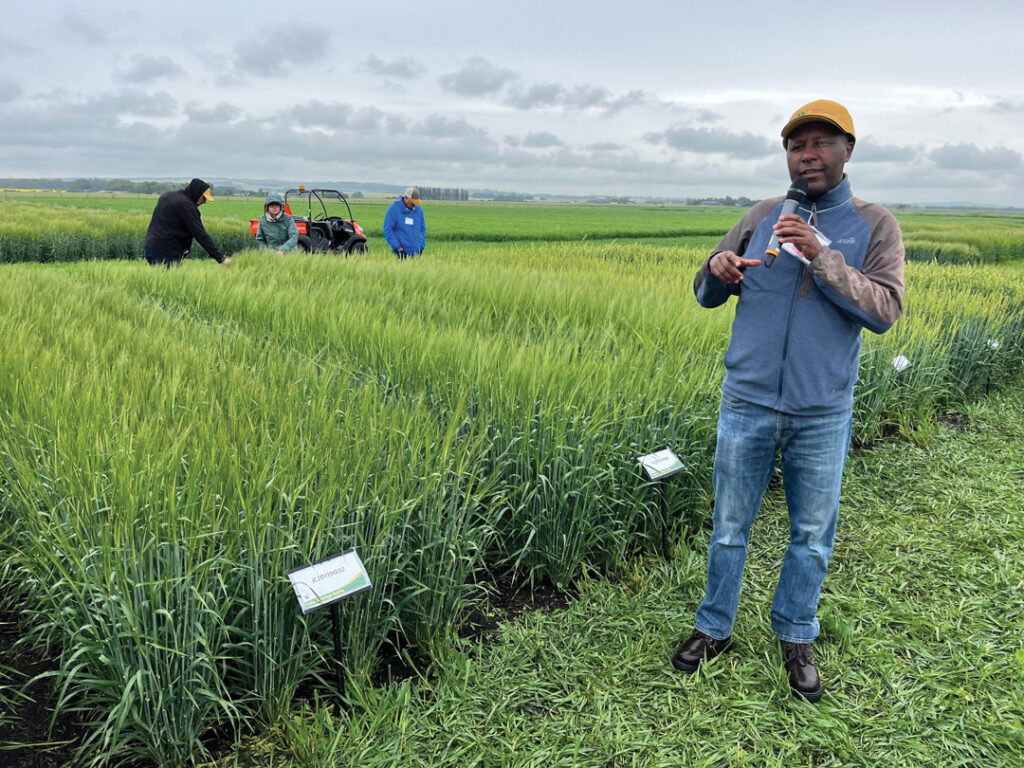
In the field a short time later, the well-timed moisture added to the good cheer and gave the research plots a healthy glow. A familiar face among the breeding staff of WCI’s forerunner, the Field Crop Development Centre (FCDC), Yadeta Kabeta led a presentation among the barley plots. Breeder Mazen Aljarrah spoke on the triticale plots. The varieties now in play include cultivars that began development under FCDC and will be seen through to completion under WCI.
For example, TR22669 is a two row semi-dwarf barley developed for malt but registered for feed in 2024. It has a promising disease package, has performed favourably against check varieties and is well suited to farmers who wish to push yield by maximizing inputs. Another feed grain now in the works, FB24623 did very well in the 2024 growing season despite very dry conditions. It will be submitted to the Prairie Grain Development Committee (PGDC) in 2026. “We’re excited about this line,” said Kabeta.
WCI inherited a string of breeding success stories from FCDC. In February 2025, the PGDC approved all five new WCI varieties submitted for registration approval—two barley and three triticale. Among these, a dual-purpose barley variety, FB23618 produced five per cent higher grain and forage yield than check varieties. A rarity, it also shows intermediate to high resistance to all priority-one diseases. It has been licensed to FP Genetics. Approved the year prior, malting barley variety TR21665, has great agronomic characteristics, and yields five per cent higher than AAC Synergy.
A spring triticale variety with exceptional yield and quality, T318 was adopted as a new check variety by the Prairie Recommending Committee for Wheat, Rye and Triticale. A significant development, it was given the designation in 2024, the same year it was recommended for registration. It has been licensed to SeCan.
Additional recent successes are now in farm fields. Available to farmers since 2024, AB Standswell is licensed to Mastin Seeds. A six row, semi-dwarf smooth awned variety, it has high forage quality but is well suited to grain production. AB Maximizer, a two row variety licensed to Canterra Seeds, was made available to farmers in 2025. Derived from food and general purpose barley Canmore, Maximizer is a strong forage variety with higher yield and better disease resistance.
A NEW DIRECTION
As the drizzle turned to rain, Kabeta waved a hand toward the collection of barley and triticale plots and posed the obvious question that faced WCI as the organization blossomed. “This is what we have, but what’s next?
“We aim to build a centre of excellence for feed and forage barley breeding,” he said. Five decades of experience and a diverse germplasm collection built over many years provide a strong foundation for this initiative, he added.
In triticale, it will focus on smooth awn and semi-smooth awn types suited to flexible use as grain or forage. Though WCI does not now have such varieties in production, Aljarrah said there is a need and market interest.
YEAR TWO
In the months that followed the WCI field day, a couple of foundational developments occurred. The Alberta Cattle Feeders’ Association joined WCI member organizations Alberta Beef Producers, Alberta Grains and SaskBarley. As well, late last year, Alberta Grains announced it will contribute $600,000 over three years to WCI to support existing barley breeder and a senior technician roles. WCI funding partners also include Alberta Agriculture and Irrigation as well as RDAR.
Central to the WCI approach to crop breeding, the organization works closely with these groups. Also key, WCI reviewed the FCDC program and made strategic adjustments to its not-for-profit corporate business plan. “The strength of the Lacombe team has always been on the feed barley side,” said Kabeta.
The plan calls for malting barley activities to be wound down in favour of feed and forage varieties. The program will focus on the four main attributes of disease resistance, grain yield, lodging resistance and kernel quality, especially plumpness and test weight. “Having the focus on feed and forage barley allows us to make a greater impact,” said Kabeta.
Further industry collaborations include agreements with Lakeland College, Olds College and the University of Calgary to share projects and resources. In co-operation with the Global Institute for Food Security at the University of Saskatchewan, WCI also launched a three-year project in April 2025. The initiative will work to build and streamline genotyping capacity.
SUSTAINABLE SOLUTIONS
Trevor Sears joined WCI as executive director in spring 2025 having spent more than three decades in the pork industry. “FCDC released more than 50 varieties over the years,” he said. “We owe FCDC a legacy of excellence. We can retain that world class capacity, germplasm and experienced staff who have been here a long time.” Sears credits the organization’s first-year interim leadership,
which was headed by executive director Mark Olson, with building its infrastructure from scratch. Functions such as finances and HR had previously been overseen by Olds College, which administered these operations starting in 2021 when it assumed control of FCDC from the Province. Another fundamental step, in January of 2025, agronomy manager and researcher Laura Bony was tasked with the creation of WCI’s agronomy program. The organization now employs 26 full-time staff supplemented with contract and seasonal positions.
Prior to the establishment of WCI, many in the ag industry felt that two very successful western Canadian crop breeding centres—the University of Saskatchewan Crop Development Centre (CDC) and the Brandon Research and Development Centre—produced adequate malting barley varieties. This considering very few malting barley varieties are ever adopted. However, Western Canada did not previously have a breeding centre focused solely on feed and forage, the destiny of most Prairie-grown barley.
“It made sense, instead of targeting malting qualities very early in the pipeline, we can target the feed and forage side,” said Sears. “Hopefully we can improve those varieties even more.” He emphasized that the promising selection of malting barley breeding projects now in the WCI pipeline will not be abandoned but seen through to completion.
Sears is confident the organization is on the right track. “We’re in a stable position, but we will work with the government and producer organizations to seek sustainable solutions for the breeding industry in Canada.”
INDUSTRY SUPPORT
Alberta Grains was the first organization to supply financial support of approximately $375,000 for the FCDC-to-WCI transition. Mike Flynn, the commission’s executive director, gives WCI interim leaders credit for taking time to absorb feedback from stakeholders as they worked up a sustainable budget and business plan.
“There is a need for such a facility in our province,” he said. “We want to be able to support it the same way in which we support CDC, and it’s a rich opportunity for collaboration with the provincial government and post-secondary institutions.”
He noted Alberta Grains is proud to have two of its own on the WCI board. Kevin Bender is a former Alberta Grains chair, and Harvey Hagman serves as a director on both boards. Flynn is also confident in WCI’s leader. “Given his industry experience, Trevor Sears is an excellent choice for the executive director position. I have enjoyed working with him, and look forward to tackling the significant challenges ahead.”
Alberta Beef Producers was on board early, and committed to a three-year, $300,000 funding agreement with WCI in June 2024, said Karen Schmid, the group’s beef production and extension lead. “We felt it was important, as one of the largest users of forage and feed barley, to demonstrate our support for the organization and to ensure that Alberta continues to be a leader in this area.” She is pleased to see support has since grown considerably.
“We are excited to watch WCI grow into its full potential, utilizing new approaches and strengthening collaborations,” said Schmid. “It has a unique opportunity, with the feed and forage focus, to be able to adjust relatively quickly to producer needs and market pressures.” She added that Alberta Beef strongly believes in the value of WCI but that its pre-existing programming required significant changes.
WCI will continue to align its programming with industry needs. A third-party scientific review of WCI programs was recently completed. Results will be used to craft the organization’s strategic plan and to update and modernize its breeding programs, boost efficiencies and potentially draw additional funding.
To learn more about WCI and its breeding program, visit westerncropinnovations.com.

Comments