


REAL-WORLD EDUCATION
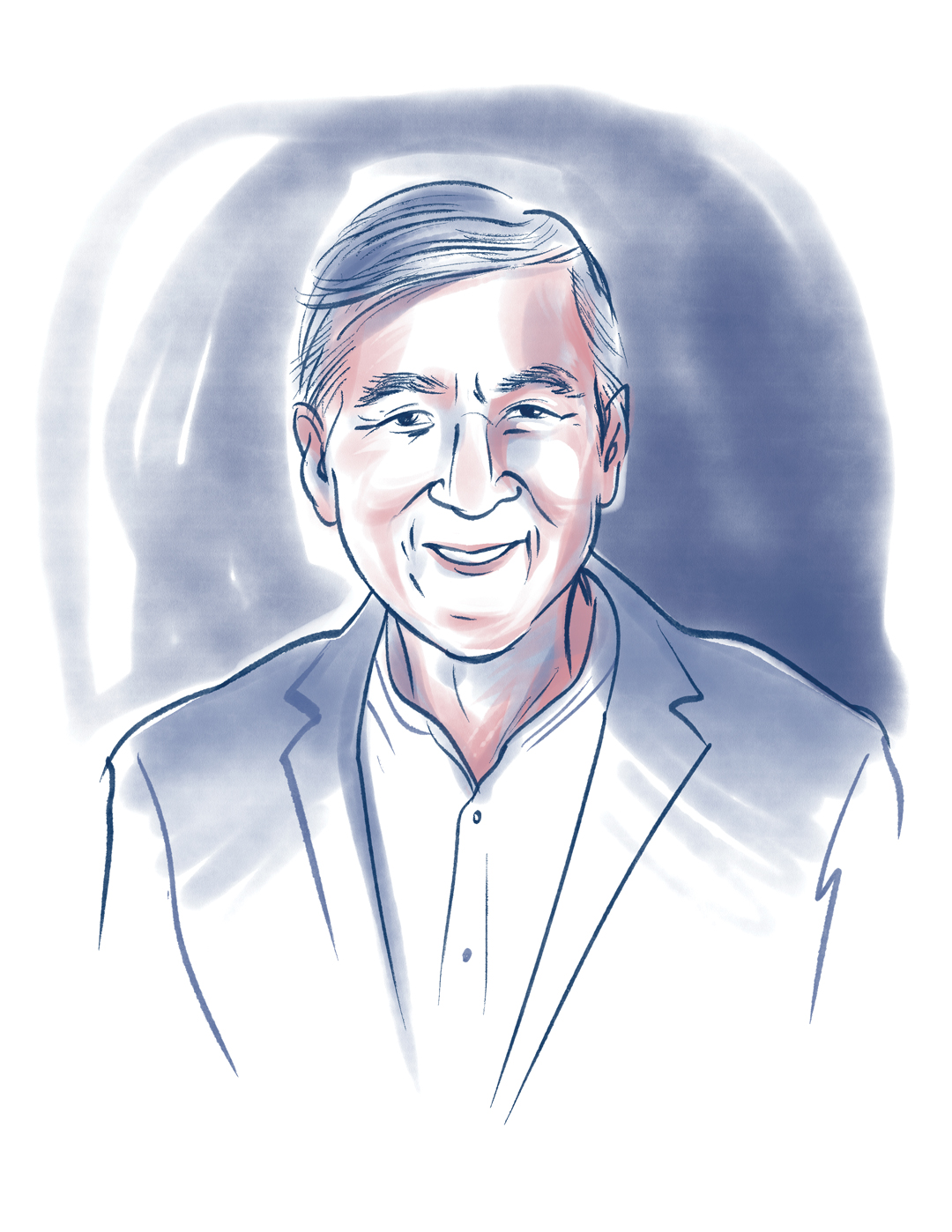
BY IAN DOIG • ILLUSTRATION BY EMILY CHU
As a microbiology student at the University of British Columbia, Rickey Yada struggled with his chosen path, until he received a recruitment letter from the school’s Food Science department and sat down with its chair. The young student had taken classes in chemistry, biochemistry and physics, and the administrator suggested Food Science addresses these disciplines as applied to food. Yada loved the idea, and the offer of a scholarship sealed the deal.
As a budding food scientist, Yada appreciated the fact his work had real-world applications. He completed a master’s degree and PhD and his protein specialization earned him a job at the University of Guelph’s Ontario Agricultural College (OAC). During his time with that program he worked closely with the farm community. “Guelph reinforced in me that it’s really important to listen to the growers about what their challenges are,” said Yada.
To make a long academic journey short, he eventually returned to UBC as dean of its Faculty of Land and Food Systems. Ten years along, he was offered a five-year stint as dean of the University of Alberta Faculty of Agricultural, Life and Environmental Sciences (ALES), which began in the fall of 2024.
GrainsWest: What do you like about your position as dean of ALES?
Rickey Yada: I was brought in to reimagine what ALES could look like. I thought, ‘Well, they’ve thrown down the gauntlet, can I pick it up?’ My focus during my first year was putting in place a three-year strategic plan for ALES, because I had done this at UBC.
GW: Why was it important to create this strategic plan?
RY: It is really an action plan, which has defined milestones. We launched it in September of 2025. Economist Vic Adamowicz was the acting dean before I was hired. I asked him to head up the implementation group. One of the pieces of advice I got from the dean at OAC was to get to know the people you serve. I’ve spent my time meeting various agriculture groups and listened very carefully to what they say we need to do.
It’s also important to get to know the students, because they are our clients and our best ambassadors. If you deliver a lousy program, they’ll tell their buddies. We can’t afford to put on poor programs. Part of the strategic plan is to focus on what we do best, but let’s be Gretzky-ish and look for open ice. You need to constantly change and evolve and meet the needs of your clients, students and the farm community.
GW: What priorities have ag groups, farmers and students identified?
RY: Sustainability and food security are topical issues, of course. That’s what we do well, but we need to figure out the science that helps to address these things. For example, climate change: Can we develop drought-tolerant plant varieties?
We intend to do more policy work. Affecting policy change is kind of like pushing a rock up a hill, but it happens with good science. Hopefully the science we do in ALES will help make those policy changes, because a lot of the policies in this country and every other jurisdiction are way outdated, and they haven’t evolved with time.
GW: Is there a lot of rethinking about policy going on in the world of agriculture and agri-food?
RY: Yes. For example, ultra processed foods are quite topical now. The name demonizes certain foods and the notion of moderation gets lost. These are the kind of things we’re trying to help with. Even the government is struggling with what to do about ultra processed foods. What do we do about genetically modified foods? Misinformation from various food influencers? If we do the rigorous science within the faculty, hopefully we can help correct misinformation.
GW: Is there an appetite out there for that scientific truth?
RY: When I was at OAC, we’d have townhall meetings about research. A question came from the audience about universities being bought and paid for by the industry. My response was, ‘It’s not the purview of universities to have an opinion about something. They do the research, deliver credible results and let the receptor of those results make the decision about whether X is better or worse than Y.’ That’s still our focus here at the academy: let’s do the good science.
GW: What have you discovered about Alberta agriculture as dean of ALES?
RY: I’m blown away by how much farmland is in Alberta. But what we need to worry about is where are we going to grow the food, because we’re seeing rapid urbanization of the countryside. Some of what was farmland between Edmonton and Leduc is now industrial parks.
If you believe economists and social scientists, in 2050 there will be X bazillion people, and we’re not growing enough food. So that’s been the epiphany for me—how expansive this province is and how focused it is on food production. We really need to pivot to value-add to those commodities. We’re great at producing high-quality food and exporting it, then importing it back as a finished product. That’s got to stop. If we face the next pandemic, whatever that is, and borders close, we’re not going to have access to some of that stuff.
GW: In 2025, you received a federal Lab2Market grant, which is meant to assist scientists and students to
commercialize innovative ideas. What is that project all about?
RY: This is a pan-Canadian network to address how we get those bright ideas in the agri-food space ramped up to become commercially viable products or technologies. It’s been a gap in the ecosystem in Canada. Myself and my colleague Lenore Newman at the University of the Fraser Valley are trying to promote this philosophy in the western provinces. How do we foster entrepreneurship and prepare students for the real world?
Recently, we had a hackathon in Winnipeg with student teams from across Western Canada. With input from corporate mentors, the challenge was to solve a hypothetical problem faced by a company and get it to that point of commercial viability. Hopefully, once they graduate, these students can take their own good ideas and incubate them.
GW: What do you hope to achieve over the remainder of your term as dean?
RY: Strategic plans are great, but it’s all about execution. My goal is to execute on the things we said we would do. If we do pivot, I want to provide a reason.
GW: Why should students consider enrolment at ALES?
RY: We’ll always have rubber boots, pitchforks and tractors, but agriculture is a high-tech industry. Every day there is a food story in the media, and agri-food is one of the major drivers of GDP. Students can be part of the solution. Parents can be sure that by sending their children here they will be job-ready once they come out of the faculty.
GW: You’re known to wear shorts year-round, even as formal wear. Having left Vancouver, have you adapted to Alberta’s more challenging climate?
RY: I’ve tried to keep the shorts on as long as possible. There was one week in February it was -25 C with the wind, and my wife said to me, ‘Are you going out in this weather with shorts on?’ It was like us talking to our children: ‘You’re not wearing that?’ I listened, and I put on long pants.
I do miss the water, but Prairie people are warm, welcoming and hospitable until you tell them, especially in Edmonton, you’re a Canucks fan.
Comments