



FOREVER IN ROTATION
BY MELANIE EPP • PHOTO: iSTOCK
On Tim van der Hoek’s irrigated acres near Vauxhall, potatoes, seed canola and sugar beets are central to the bottom line, but CWRS and durum also play a key role. In fact, cereals reliably hold his high-value rotation together. Of his more than 3,000 acres, much is rented, all is irrigated. Potatoes and sugar beets are grown once every five years while cereals or corn fill out the balance. The cereal years can be the thinnest on the balance sheet, but they are essential to the good health of his operation.
This is the story across southern Alberta’s irrigation districts. Cereals rarely pencil out on irrigated land, but agronomically and even in terms of labour, they hold everything together. Farmers recognize this necessity, and each farmer employs cereals in their own unique way.
ANNUAL ACREAGE SHIFTS
Yield data compiled by AFSC and Alberta Farmer Express capture year-to-year shifts in the crops grown by farmers on irrigated land between 2019 to 2024. These were likely due to contractual and rotational adjustments.
Over the six-year period, wheat acreage was relatively stable. In 2019, irrigated wheat reached 248,322 acres. This number rose to 271,064 in 2022, peaked at 292,736 in 2023 and slipped to 272,668 in 2024.
Barley acres followed a similar pattern. In 2019, total acreage sat at 87,562. Seeded area dipped in 2020 to 82,173 acres, then climbed in 2023 and 2024, reaching 106,389 and 104,175 respectively.
Canola acres fluctuated more dramatically. In 2019, 86,207 acres were seeded to canola under irrigation. Acreage jumped sharply in 2021, hitting 139,250, and declined annually until acres reached 98,504 in 2024.
Potatoes remain a consistent part of irrigated rotations but total acreage varies annually. Acreage rose from 43,762 in 2019 to a high of 61,226 in 2023 and dropped to 43,220 in 2024. Sugar beet acres also remained steady at somewhat greater than 21,000 acres and fluctuated by no more than 7,000 acres over the six-year period.
While acreage does shift, wheat and barley remain firmly embedded in irrigated rotations.
A PILLAR OF THE ROTATION
While contracted crops bring in the big bucks, cereals grown on irrigated land are fairly consistent in yield and quality and they keep the rotation on track. Agronomist Scott Gillespie works with irrigated farmers across the Taber and Vauxhall region, where most of his clients include cereals in their rotations out of necessity.
Gillespie noted several areas in which cereals are indispensable. Dry beans, peas, potatoes, seed canola and sugar beets all require long rotational breaks.
Without cereals to fill intervening years, farmers would quickly run out of options and paint themselves into a corner. Potatoes and sugar beets leave soil almost bare of plant residue, and repeated years of low residue crops under irrigation cause soil structure to deteriorate. Cereals add substantial residue that helps rebuild organic matter and produces soil conditions suitable for potatoes and sugar beets. Cereals also give farmers room to rotate herbicide groups and slow the spread of resistance.
Potato Growers of Alberta ag relations director Ashley Wagenaar said cereals keep irrigated rotations grounded. In favour of higher value crops, cereal acres under irrigation declined between 1996 and 2016, to just under 35 per cent from around 45. However, they will remain a consistent component of four- to six-year rotations, said Wagenaar. “[Cereals are] the foundation of our healthy growing system,” she said.
Cereals allow farmers to reduce tillage because they can be direct seeded with little soil disturbance. This gives the soil a break from the heavier tillage associated with potatoes and helps maintain soil structure.
Wagenaar’s list of cereal crop benefits echoes Gillespie’s. Barley, fall rye and wheat help break weed, pest and disease cycles in high-value crops. Winter cereals add particular value as they reduce wind erosion and make use of shoulder season moisture. Their fibrous roots build organic matter after low residue crops, and they give farmers flexibility when water allocations tighten, allowing redirection of water toward thirstier crops.
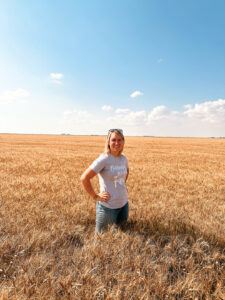
I like to seek longer term rentals because it allows us to do more forward planning and tackle any challenges with rotational crops.—Alison Davie
CEREALS IN ACTION
Alison Davie and her husband Michael employ a diverse rotation that includes potatoes, seed canola and a wide mix of cereals, oilseeds and pulses on their 3,000 acres of owned and rented land south of Taber. On rented land, she prefers longer term agreements because lengthier contracts give her more options in the rotation. “I like to seek longer term rentals because it allows us to do more forward planning and tackle any challenges with rotational crops,” she said.
The choice of cereal crops Davie grows each year are influenced by market conditions and agronomic considerations. While returns can be slim under irrigation, she said cereals play an important role in maintaining soil organic matter and long-term productivity within the rotation. Because potatoes leave little residue behind, she counts on subsequent wheat and barley crops to rebuild organic matter. Straw is chopped and incorporated to strengthen soil structure. She also employs cereals to mitigate erosion. “Potatoes leave the soil pretty vulnerable,” said Davie. “Winter wheat holds the soil in place over the winter.”
Cereals also fit into her disease management plan. When sclerotinia is present in a canola field, she follows the crop with wheat or barley to diminish the disease’s presence. To thwart tough to control pesticide-resistant weeds such as kochia, she sows fall rye, a competitive crop that establishes and matures rapidly.
Not far from Davie, Brady Valgardson works within a different set of constraints. On his 2,500-acre farm, the availability of water and labour shape the incorporation of cereals within his rotation. Nearly all of his acres are under irrigation. He grows durum, malting barley, mustard, processing peas, sugar beets, sweet corn and winter wheat on a multi-year rotation. Many of the crops can only be grown on the same field once every four years. He grows more sugar beet acres than anything else, as the crop pays best, followed by sweet corn, processing peas and mustard.
As on the Davie farm, cereals serve several agronomic roles in Valgardson’s operation. While sugar beets reduce soil organic matter, residue from wheat and barley, along with cover crops, rebuild biomass and reduce erosion.
With just two full-time employees, cereals are a benefit to the farm’s labour demands. Incorporation of barley, durum and winter wheat staggers field work across the season and spreads labour demands ahead of beet harvest.
Water management has also become an important consideration. In drought years, when water supply is restricted, cereals allow Valgardson wiggle room and he prioritizes water for sweet corn, processing peas and sugar beets over cereals, the latter of which are less impacted by drought.
Valgardson noted cereals provide diversity when disease tightens rotation options in peas or canola. Severe root rot in peas, for instance, necessitates an eight- to 10-year break. With no rotational restrictions, cereals offer versatility. Straw sales to feedlots can also provide revenue.
On farms built around potatoes and sugar beets, farmers such as Valgardson use cereals to keep their systems running smoothly. On his land, cereals function less as standalone crops and more as a scheduling tool that helps him co-ordinate fieldwork, manage inputs and prepare acres for the demanding seasons ahead.
Timing is an operational variable he manages closely. Beets require tightly scheduled sowing and harvest windows, and cereals give him the flexibility to spread labour and machinery demands across the growing season. They also help him sequence fields to suppress weeds ahead of high-value crops.
Rental agreements also encourage cereals within the rotation. Valgardson explained that irrigated land rental rates often vary depending on the crops grown. Typically, cereals command lower rates because they are less taxing on the soil. Taking the crop mix into account, an agreement is typically averaged over the long-term. Cereals maintain good soil quality and ensure rented acres remain viable for future cropping decisions.
On his farm near Vauxhall, van der Hoek recognizes the benefits cereals offer, but that they can also introduce challenges. When cereals occupied three of the five rotation years on his farm, herbicide resistance became a challenge, particularly with wild oats, a weed he noted is “very tough to control” in cereal crops.
The limited herbicide choices for use with cereals eventually pushed him to introduce corn, which offered access to different herbicide groups and reduced pressure. Still, cereals remain indispensable. They help protect soil structure, reduce erosion after high disturbance crops and build soil organic matter. “We grow cereals because we have to,” he said. “If you want to be a long-term sustainable farmer, you need to have them in your rotation.”
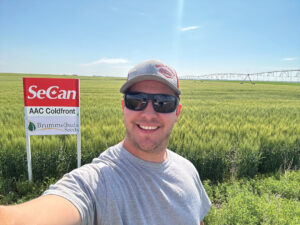
I’ll be honest with you, I didn’t know winter wheat could yield that high.—Mack Brummelhuis
Near Vauxhall, Mack Brummelhuis farms 2,800 acres under many of the same pressures faced by Davie, Valgardson and van der Hoek, but his experience shows cereals can play a more strategic role when irrigation, pricing and rotational timing work in his favour.
Whereas his grandfather grew mostly cereals, Brummelhuis’s rotation includes barley, dry beans, durum, hemp, hybrid seed canola, sugar beets, triticale, winter wheat and yellow peas. He rents land out to neighbours for potatoes, and trades acres back for bean or beet production. As crop options have expanded, the place of cereals within the farm’s rotation has changed with them.
Most years, given high land values and operating costs, cereals do not generate strong returns on his farm. Most years they break even or operate at a loss. Brummelhuis structures his cost of production so high-value acres carry a greater share of the land expense. This creates room for cereals to play their agronomic role even when margins are tight. He prefers rental agreements of four-plus years to incorporate rotations that manage disease, residue and weed pressure.
Winter wheat has been a notable bright spot in his employment of cereal crops. Newer varieties have performed well under irrigation, he said. In 2025 he saw yields of around 150 bu/ac on relatively low inputs. “I’ll be honest with you, I didn’t know winter wheat could yield that high,” he said.
Winter wheat works well with timing, too. It lengthens the total harvest window, sets up a clean field for the next crop and is also one of the few cereals he grows that has made money.
WELL-PLACED
Cereals continue to hold their place on Alberta’s irrigated acres, even when they don’t directly drive revenue. On most irrigated farms, these crops are used as a practical tool that maintains a healthy rotation. This versatility will ensure cereals remain in the mix.

Comments