



WILD OAT THREAT TOUGH TO TAME
BY GEOFF GEDDES • PHOTO COURTESY OF THIERRY FONVILLE
The need to control herbicide-resistant wild oat has become increasingly urgent. In response, a new three-year study by Farming Smarter will examine the effectiveness of agronomic practices to manage wild oats in canola, peas and wheat. The project is supported by a $60,000 grant from Alberta Grains, $26,000 from Farming Smarter and $52,000 from RDAR.
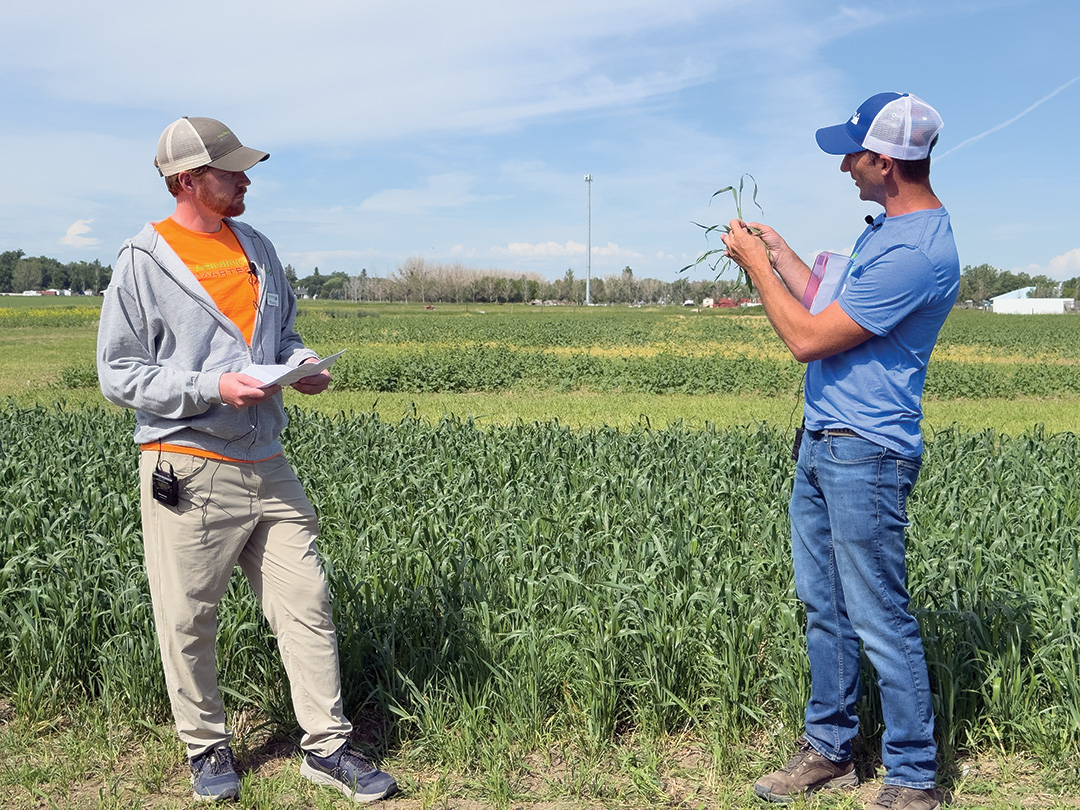
“Wild oat is harder and harder to manage, and the threat to farmers is significant,” said Thierry Fonville, a research scientist with Farming Smarter. At the applied research group’s field trial site near Lethbridge, the project takes a multi-pronged approach. “Each year we focus on a different theme and apply it to all three crops in a three-year rotation,” said Fonville. Year one will focus on crop competition to limit the weed. Normal and high seeding rates and normal and narrow row spacing will be studied.
The following year, scientists will use winter wheat seeded as a cover crop to outcompete weeds in spring 2027 when the canola, peas and wheat are seeded. Spring tillage or in-crop, interrow tillage will also be tested. By mixing soil layers and burying weed seeds deeper in the soil, tillage can reduce weed pressure.
Herbicide resistance will be the theme of year three. Researchers will spray in the fall to kill emerging and established weeds and in spring prior to seeding. They will layer herbicides with distinct modes of action at a variety of timings.
“Wild oat can survive up to nine years in the soil and germinate and grow at any time if it gets the right amount of heat and moisture,” said Fonville. “Based on this project, we hope to advise growers on how to apply various herbicides in multiple passes for best results.”
Even when these three strategies fail and wild oat renders a crop unfit for grain production, it may be used as silage. “It’s a last resort, but if you take the crop off before the wild oat starts shedding its seed, it can still be a valuable forage crop for cattle feed, for example, while reducing the amount of weed seeds left in your field,” said Fonville.
The study’s comprehensive approach fits it within the concept of integrated weed management, a holistic approach that can use multiple strategies. “To best assist growers, we try to consider every aspect of how to manage wild oat,” said Fonville. “We want to arm them with practical and theoretical knowledge so they can build an optimal wild oat management plan that works on their farm.”
“Multiple herbicide resistance in wild oat is one of the primary weed management challenges faced by Prairie farmers today,” said Charles Geddes. A research scientist with Agriculture and Agri-Food Canada, he is also project lead for the Prairie Weed Monitoring Network. “Surveys conducted by the Network have shown the on-farm impact of this issue is increasing,” he added. As a result, farmers are in dire need of effective management strategies, and Geddes believes the Farming Smarter study, with its combined strategies, is well timed.
Successful management of herbicide-resistant wild oats will require combined control practices that use chemical and non-chemical tools. “Finding optimal combinations of these tools will be key to managing this issue,” said Geddes. “This project is another step toward an improved wild oat management system for farmers in southern Alberta.”


Comments