



CWAD CONCERNS
BY TREVOR BACQUE • LEAD PHOTO COURTESY OF CANADIAN GRAIN COMMISSION
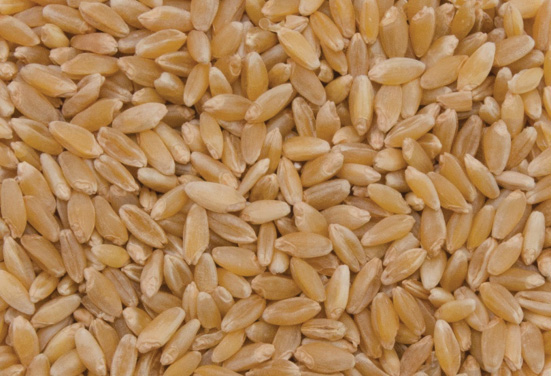
Farmers struggled with multiple issues in their durum last year. This was apparent in the Harvest Sample Program submissions graded by the Canadian Grain Commission (CGC). Only 22 per cent of farmers received a No. 1 grade. Another 22 per cent scored No. 2 and 39 per cent hit No. 3. Severe issues caused by midge damage, darkened kernels and mildew were the primary reasons many farmers experienced downgrades.
Overall, the report labels the 2025 crop year as “good” despite these factors. The top five varieties were CDC Defy, Transcend, AAC Stronghold, CDC Precision and AAC Grainland. Of all the severe midge-damaged CWAD samples, those graded No. 2 were at 44.5 per cent and mildew showed up in 31.9 per cent of No. 2 samples.
The CGC’s Kris Wonitowy said the two top grades usually account for at least half the total Canadian crop. While 2025 was an outlier, he is hopeful 2026 results will be better. “We can be improving this year,” said Wonitowy, CGC’s program manager for national inspections standards. He added that time, rain, heat and harvest conditions will dictate the quality.
When it came to DON levels, 89.5 per cent of the 873 samples were under 1.0 ppm. Protein levels remained high at 14.7 per cent and kernels were more uniform. As well, TKW was eight and 11 per cent higher on No. 1 and No. 2 from 2024 to 2025.
Wonitowy said this report brought about multiple positives. The darkened kernels initially identified were not as detrimental to quality as first thought, and their appearance helped to usher in changes to grading guidelines. Before changes last fall, darkened kernels were downgraded due to severe midge.
Research conducted last fall showed the CWAD crop hadn’t suffered as much as first thought. “That confirmed that the end-use quality impacts of darkened kernels are really not as detrimental to the durum semolina quality as severe midge damage kernels,” said Wonitowy.
The issue was then raised at the Western Standards Committee meeting in November 2025. A new process was issued for the grading of darkened kernels. As a result of this change to the grain grading guide, the CGC will now assess darkened kernels as smudge. It will have a much smaller tolerance than severe midge, and the penetrated smudge tolerances will increase.
“[Farmers are] going to be allowed a little bit more leeway in terms of grading factors; smudge, penetrated smudge, darkened kernel or severely darkened kernel, and still be able to maintain that quality and get a higher grade,” said Wonitowy.
FARMER POV
Dave Bishop farms at Barons and is Region 5 director for Alberta Grains. His main CWAD issue has been wheat stem sawfly. He made the management decision to switch to solid stem varieties several years ago and hasn’t looked back since. “It’s been pretty steady the last few years,” he said. “We haven’t been able to grow anything other than solid stem.”
He said concerns with midge have been minimal to non-existent at his farm, but he continues to grow midge-tolerant varieties of durum all the same. This year he is growing Weyburn VB, a medium height variety with better yield than current check varieties, including Stronghold. Last year he had some ergot, but after cleaning, his grain was fine.
Greg Stamp of Stamp Seeds sells durum varieties and said requests for midge-tolerant varieties continue to increase. “Lots of farmers are buying midge-tolerant varieties even if they don’t have the issue because they yield well,” said Stamp. He added that Alberta is not the primary market impacted by midge. “As you go east into Saskatchewan, they care a lot more about if a variety is midge tolerant.”
His top seller is currently AAC Stronghold, which his customers say performs well on irrigation and dryland acres. For extreme drought conditions, many have reported AAC Grainland has done quite well, too.
He recommends farmers buy a durum variety that carries at least an I rating for Fusarium. Depending on location, farmers will want to ensure their variety is also solid stem to combat sawfly.
SCOUTING REPORT
Tyler Wist is a federal field crop entomologist based in Saskatoon, SK, and has seen firsthand the damage caused by wheat midge. While 2025 did have issues, he’s even more concerned with what he had seen in 2026.
“The midge population has exploded this year,” he said when he spoke to GrainsWest in mid-July. “We got a bumper crop and in most places the wheat is just now coming into susceptibility, and the wheat midge populations are picking up.”
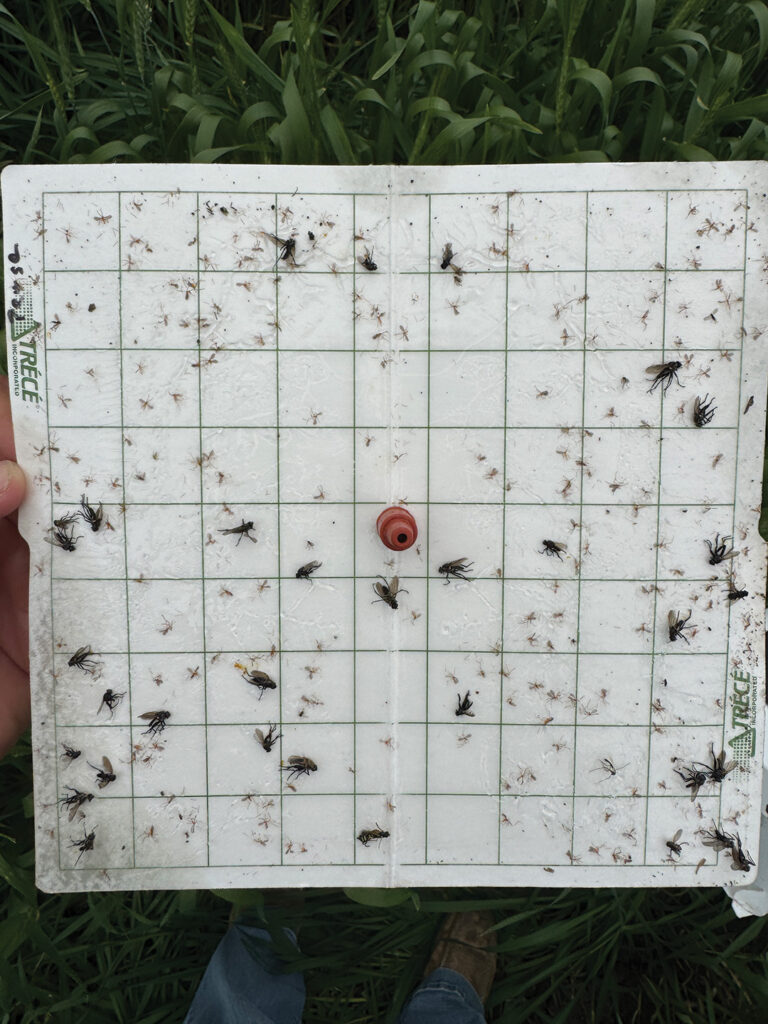
As soon as the boot splits on wheat, the plant is vulnerable to attack from midges. In fact, it can be susceptible all the way up until anthesis, or even after. Wist encourages farmers to scout at dusk when it’s calm and warm. After spending the day hanging out in the canopy, this is when the females typically emerge.
He encourages farmers to go into a few different areas of the field, get down level with the spikes and examine the heads. The midge itself is very small, only about two to three millimetres in length and distinctively orange in colour. They overwinter in the soil and can live for more than a decade.
One midge per 10 heads is the official guidance to maintain grade while one midge per five heads is the yield threshold at which farmers should consider spraying. Currently, dimethoate is the only remaining registered product on the market that is effective against the insect. One midge per five heads represents about a 15 per cent yield loss. “The thresholds are definitely something farmers have got to be aware of,” said Wist.
This aside, the Sm1 gene in midge-tolerant wheat is the only other defence. Wist estimates about 45 per cent of all wheat grown on the Prairies is midge tolerant. He currently operates a program he calls Midge Busters. Farmers interested in joining the program and receiving a pheromone trap can reach out to him directly at tyler.wist@agr.gc.ca.
GET SMART ON BUGS WITH IRIS
Created by Wist and his colleagues at Agriculture and Agri-Food Canada, the Insect Risk Intelligence System (IRIS) is a robust platform to both monitor and forecast the potential risk posed by insects across the Canadian Prairies. This includes projected climate change influence on pest populations. IRIS is built on a combination of historical observations made between 1990 and 2025, citizen science and other modelling. Through these contributions, farmers help to identify hotspots and add their observations to a broader and ever-expanding dataset.
To participate, a farmer can download the app or scan a QR code on the IRIS website at agriculture.canada.ca. From there, they enter their field data which is mapped and publicly displayed online. It tracks everything whether a pest or a beneficial insect. “They can see their data in real time,” said Wist.
The federal government estimates Prairie farmers lose $204 million every year due to insect pest damage.
Comments