



THE CURVEBALL APPROACH
BY JEANINE MOYER • LEAD PHOTO COURTESY OF MANITOBA CROP ALLIANCE
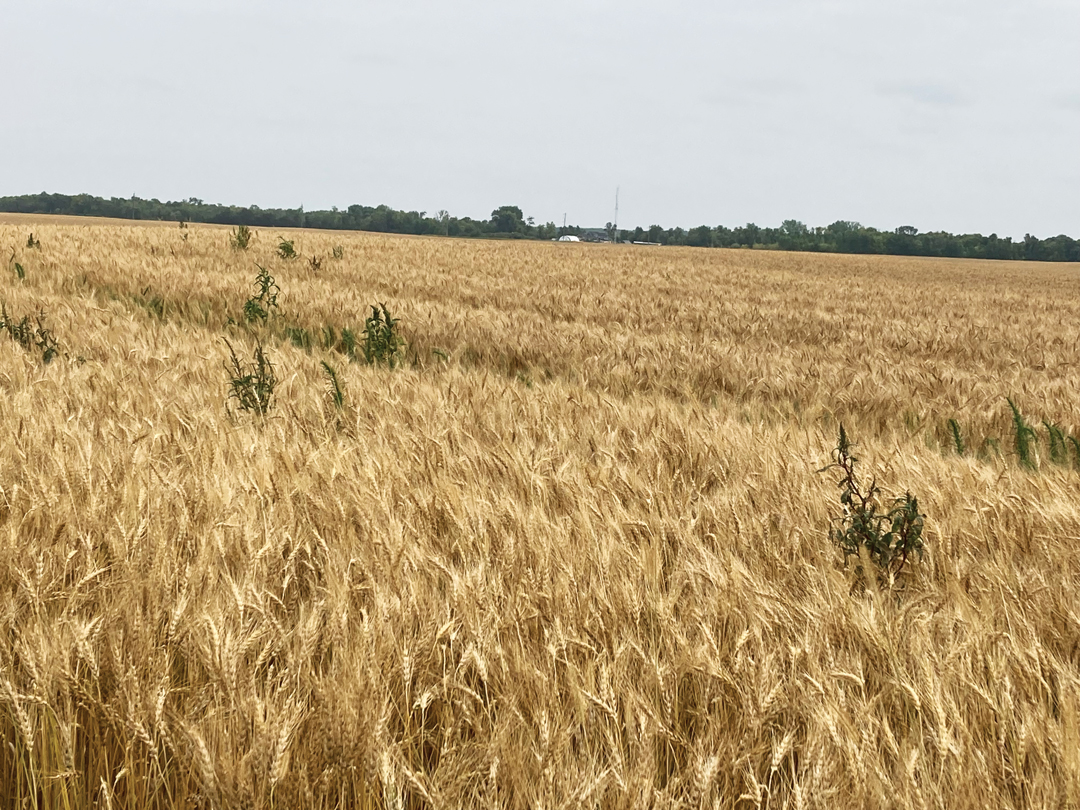
The cost and complication of herbicide resistance is reshaping the way Prairie farmers manage their acres. It’s a frustrating problem that demands adaptation, typically in the form of integrated weed management (IWM), a customized, field-by-field strategy. One size does not fit all as farmers and agronomists tackle herbicide resistance with a multi-strategy approach.
START WITH A PLAN
Cremona area farmer and agronomist Craig Shand said, as of this year, herbicide resistant wild oats occur in 11 per cent of his clients’ fields. Many now find Group 1 and Group 2 herbicides no longer effective against this weed. “Farmers need to take weed management seriously,” said Shand. “We need to implement new strategies to proactively protect what still works, and in some cases, reactively manage the weed problems that are already there.”
Start planning for next season as soon as harvest wraps up, Shand advised. Calculate your moves by field, soil type, zone and fertility and account for seed variety selection and optimal seeding rates. “We need a good crop management plan that farmers can easily execute,” he said. Weed management tools can be used individually or in an integrated approach within a crop management plan.
“We want as much crop competition as possible, because it is the best weed control option.” Shand noted that less competitive crops such as peas, lentils and flax will not compete as strongly with weeds compared to cereals and canola. Delaying seeding, especially when dealing with wild oats can be helpful and establish a clean field for crop emergence. The addition of crops such as greenfeed, perennial forages or winter cereals to the rotation is also effective, especially against wild oats.
Consider all herbicide options, including multiple timings and applications such as soil-applied pre-emergent, pre-seed and post-harvest passes to keep the weeds guessing. Adjustment of application timing and a pre-emergent and/or residual product can leverage herbicide success.

We want as much crop competition as possible, because it is the best weed control option.—Craig Shand
Shand believes crop rotation is the most critical component of an IWM plan. Without it, the likelihood of weed resistance multiplies. Diverse crop rotation can help maintain effectiveness of herbicide groups. Groups should be rotated and not overused while multiple groups can be added to the tank to diversify actives. “Throw something different at the weeds by rotating and mixing,” said Shand. And of course, follow product labels when tank mixing.
Five or six times per season, Shand will scout fields to measure the success of management efforts. This includes tracking emerging or encroaching weeds and following up with herbicide resistance testing. He also assesses herbicide efficacy after applications to detect escapes and plan remedial treatment when necessary. All this shapes the ongoing weed management plan.
Shand recommends older but proven herbicides such as Avadex, Edge and Fortress as a base layer for early weed removal. Establishment of 80 per cent weed control using a pre-emergent layer takes the pressure off the in-season or post-emergent application.
Mechanical weed removal isn’t always feasible, Shand acknowledged, but he noted mowing patches of established weeds before seeds set can be effective, especially along headlands or in saline areas. Tillage can work in the right situation, as can weed patch management using silage or greenfeed. These strategies are most effective against wild oats and kochia.
“An effective weed management strategy means considering every tool available, not just herbicides, and requires field-specific information,” said Shand.
BETTER WITH DATA
A Strathmore area farmer and agrologist who specializes in precision agronomy across southern Alberta and Saskatchewan, Matt Gosling strongly emphasized the necessity of IWM strategies. “No farm is the same, and almost everything we achieve in each crop is directly related to what has been done in previous years,” he said. “It’s why weed management has become such an intensive job.”
A diverse crop rotation is one of the best agronomic management tools, especially if fall crops and forages are included, said Gosling. Next is alternating chemical groups annually and resistance testing of weeds that escape herbicide applications. He noted while weed testing can be costly, applying ineffective herbicides is more so. Also highly rated, increased seeding rate and timing, especially for cereals, enables effective crop establishment that out-competes weeds.
Good weed management is based on data, said Gosling. “We can’t manage what we don’t measure.” To this end, he added, track the application of herbicide actives and their timing on each field. This yearly snapshot is essential to monitor weeds, identify and document concerns and establish an effective crop rotation and success standards.
“Planning is valuable, but every year is different,” he said, and noted application timing strongly affects herbicide performance. This was the case in 2025 because crops were stressed. “When plants have enough stress, they don’t take up chemistry well. In 2025, we had a lot of kochia and wild oats make it through a competitive crop, and we suspect it was a result of application timing of the herbicide during a stressful period,” said Gosling. “Successful weed management comes down to careful planning, diligent scouting and adapting strategies to stay one step ahead of resistance.”
KEEP THE WEEDS GUESSING
A pedigreed seed grower in the Stirling area, Ryan Mercer knows the value of weed management. Profit is higher when weed seeds are not present in his seed grain. “We have high standards for crop quality,” said Mercer. “That starts with clean, weed-free fields.” He noted kochia is his most problematic weed. Over the years he’s tested and confirmed resistance to several herbicide groups in kochia and wild oats.
The most effective way to combat weeds and prevent resistance, Mercer believes, is to grow a healthy, competitive crop. This starts with healthy soil that is properly fertilized, well-drained, has suitable pH and ample organic matter. “Weed populations can be a sign of poor soil,” he said. Healthy soils support strong crop establishment that can out-compete weeds and reduce reliance on herbicides. Crop rotation, cycling through chemical groups and sowing fall and winter crops round out Mercer’s go-to weed management practices.
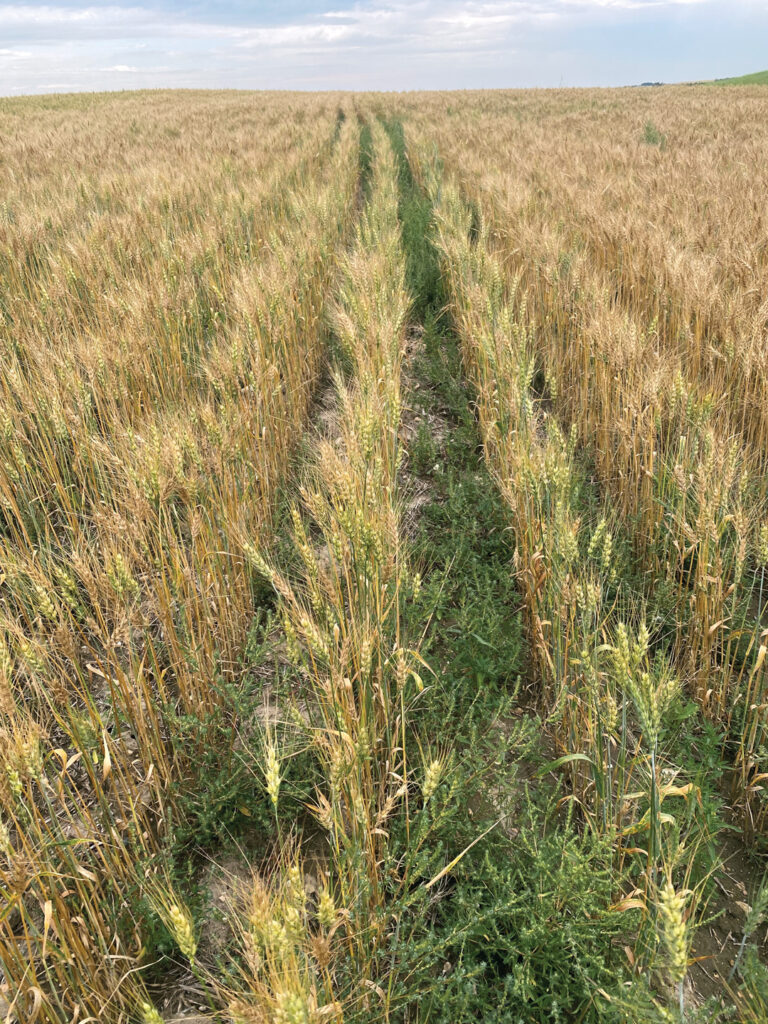
“Do anything you can do to throw curve balls at weeds,” he said. Fall and winter crops have proven especially effective because they change the timing of typical cropping stages. While it’s harder for weeds to overcome these crops, less herbicide is required. “We need to keep weeds guessing so they don’t get comfortable and become a problem.”
Mercer suggested herbicide treatment is too often central to weed management. “We need to be open to new ideas,” he said. He pointed to Farming Smarter, a southern Alberta applied research group that investigates new agronomic approaches on behalf of farmers.
Developing a weed management plan is an ongoing process for Mercer, who collects data via tablets that he keeps in the tractor cab. GPS tracking allows him to input useful observations on the go. This information, plus input from an agronomist and input supplier, guides decision-making in-season and ahead of the coming year.
“As farmers, we have to do what’s best to grow the healthiest crop we can,” said Mercer. “That requires thinking and planning for the long-term and preserving one of our most important tools—herbicides.”
THE LAYERED LOOK
Over the years, Standard area farmer Jay Schultz has refined his weed management strategy, but its key principle remains in place: use as many tools as possible in an integrated system. “No matter the approach, weeds eventually adapt and become problems,” said Schultz. Farmers need to protect their efficacy, he added. “It’s our job to adapt what we’re doing and layer in new approaches.”
Shultz has enhanced the effectiveness of his own herbicide application strategies by studying how they work and assessing weed biology. He applies herbicides when weeds are most vulnerable, which requires diligent planning of application timing, strategic mapping of crop rotations and rotation of chemical groups. He also maintains a diligent scouting routine.
Taking a four-year approach, he builds an overall goal that accounts for crop type, soil health, weed pressures and problems. Next, he layers in the weed control products required for each crop and determines how each active will be rotated and tank-mixed. Most importantly, said Schultz, he includes additional weed control tools and practices to ensure the actives remain effective. He then depends on scouting and monitoring to spot weed escapes. When escapes do occur, he investigates to determine their cause. He notes the environmental conditions at the time of herbicide application, tests weed samples for resistance and incorporates the results in his management strategy.
Schultz has found wild oats a major challenge and dry conditions have accelerated the spread of kochia on his land, so he incorporates a wide range of tools. They include crop competition, crop and herbicide rotations, herbicide layering and variable fertilizer and seeding rates. He also relies on sprayer technology such as pulse width modulation, which includes turn compensation. Herbicide droplets are uniformly applied across the field on hills and corners and across environmental conditions. This technology provides a huge advantage over conventional sprayers, which enables him to manage weeds in tough-to-control field corners and reduce weed germination.
“If you don’t control weeds, they end up controlling you,” he said. “I’m always trying a multi-tool approach to prevent and manage resistance. If there’s a practice that makes sense to integrate, that will protect active ingredients and allow us to use them for as long as possible, I’m open to trying it.”
A robust and reliable weed database
At prairieweeds.com, farmers can access the latest weed survey results and resistance updates to help plan smarter weed control. Using a weed biovigilance strategy, a key component of which is weed monitoring, the Prairie Weed Monitoring Network (PWMN) equips farmers with the tools and knowledge to fight back against problem weeds and herbicide resistance.
According to Charles Geddes, PWMN project co-lead, 70 per cent of fields surveyed between 2019 and 2023 held at least one herbicide-resistant weed biotype. He estimated the financial impact on Prairie farmers to be $658 million annually. “By looking at the big picture—surveying fields across the Prairies for weed resistance—we can help farmers deal with the weed populations they have and predict what’s coming next,” said Geddes. He noted PWMN resources such as factsheets and weed survey series reports are increasingly valuable tools that can inform weed management practices and reduce the occurrence of resistant weeds.
The PWMN collects survey data from 4,000 fields and utilizes historical survey information that dates to the 1970s. By combining new information with past weed survey data, it can predict where resistant weeds are most likely to appear and how weed communities may change over time.
To learn more, visit prairieweeds.com.

Comments