


SACRED GROUND
BY TREVOR BACQUE • ILLUSTRATIONS BY DARYA SHNYKINA
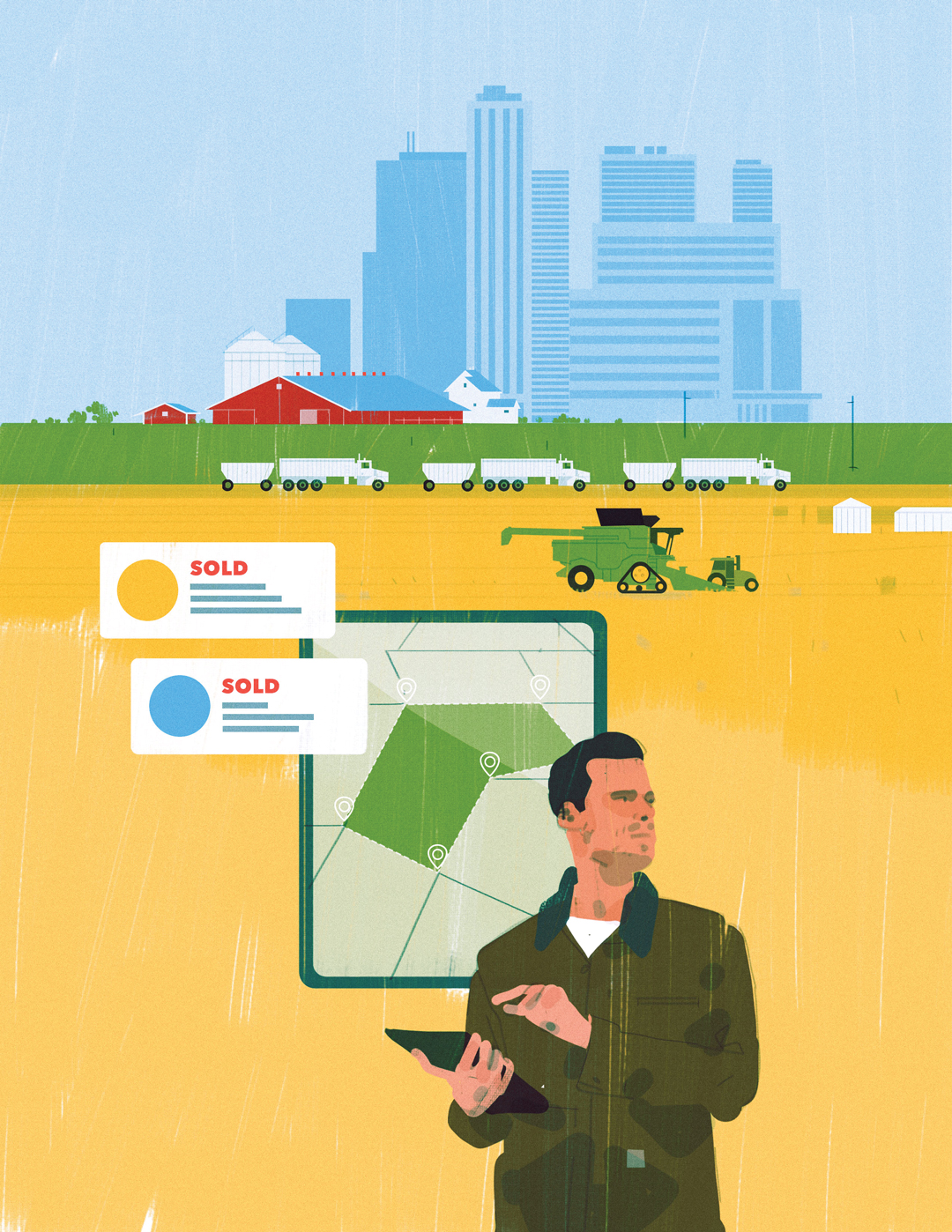
Farmland is sacred, just ask a farmer. Historically, when land changed hands, it was a simple process: Farmer A sold land to Farmer B. However, in the last 20 or so years, a curious trend has emerged. As the farm economy has risen, so has the financial potential of the land as an investment vehicle. The ownership details of Canadian farmland are hard to quantify and lately have generated anger, speculation and plenty of conversation across the Prairies.
NEW OWNERSHIP PATTERNS
Mitch Newman is getting established at his family farm where he works with his father Roy and uncle. The 26-year-old is hopeful a farm transition will occur within the next five years. In his area near Blackie, about 50 kilometres from Calgary’s south ring road, land goes for about $8,000/ac, up from $5,000 just five years ago. He intends to begin like his father did, by receiving a few rented quarters.
Newman believes land value is being driven up by multiple factors, including foreign investment and purchases by large domestic farmers. “When you have to battle that, it gets tough,” he said. “You have to give investors credit; a lot of people realize owning land is better than owning Tesla stock,” he said. “We get the right rains, beautiful soil and we can grow a big crop. This year we grew record-breaking crops. People got smart. They realized this is what your land’s worth. What do you do?”
He intends to use a first-time farmer’s loan when he goes out on his own but knows it will be slow going at first. “Every chance we can get to buy land, let’s try and buy it, get into debt; who cares? You have to spend money to make money.”
Being in a coveted farmland area close to Calgary, he wonders if land he may purchase will remain his own. Annexation is a fear. To combat outside competition, Newman intends to maintain positive relationships with friends and neighbours, believing this will ultimately help with rental or purchase of land in the future.

At the University of Regina, André Magnan studies farmland ownership patterns and the restructuring of agriculture in Canada. A trend, he confirms, is the purchase of farmland by investors who then rent it out.
While consolidation, retirements and buyouts occur across the Prairies, investor interest is on the rise. “Saskatchewan is and remains the focal point,” he said. “That’s because land prices in Saskatchewan historically were quite a bit lower, although the gap has been closing.”
Every province has experienced escalation in farmland value over the years, but none as consistent as Saskatchewan over the last two decades, according to Farm Credit Canada. From 2022 to 2024 alone, the province’s land values rose an average of 14.3 per cent each year, more than any other province. In that same stretch, Alberta’s value grew 7.9 per cent and Manitoba’s growth rate was 9.6 per cent. The national average during that period was 11.2. Even with a shrinking land value gap, investor interest remains high across Canada.
Magnan acknowledged the sacred, innate value of farmland and rural communities held by residents of these areas. When investors buy the land, the dynamic changes, he said. “The social investment notion of farmland is where, traditionally, a homesteading family acquires land, builds it up slowly and passes it down. There’s a strong connection to place and community. Not to overly romanticize it, but this is the understanding over several generations. In the last 25 years, we’ve seen a financial logic becoming more prominent, this investor mentality, which is that the value of land is likely to go up and it’s a safe and stable investment and we can get rental income in the meantime. That is new and partly what may bother people who are multigenerational. It strips out some of those social and community ties.”
It’s an impersonal experience to bid on land against those who don’t live or farm in the area. He noted nothing illegal is happening, but it impacts the spirit of rural life. As the western Canadian countryside hollows out, investors don’t help the process, he believes. “On the margins, in a market that’s already tight, when you add those investor players, it will have an effect. They’re not totally responsible. It’s a bit like the real estate market, which is largely individual buyers, but if you add investors into the mix looking for rental income, that inevitably has an impact on the market.”
Farmers tell Magnan they worry investor actions accelerate the decline of their communities. He doesn’t believe the purchase of farmland by investors is all bad, though. Many who snap up land have the money to immediately improve marginal aspects of it in order to make every square foot arable. On their own, that process may take a farmer multiple years.
While economically positive, such development risks loss of important natural habitats such as riparian areas and wetlands. “In that case, you lose biodiversity and other ecosystem services and benefits and even natural beauty in the countryside when all farmland becomes a homogenized, optimized platform for growing grain.”
Magnan also uncovered that foreign ownership is negligible. While he said no system is perfect and concedes there has no doubt been slippage, it doesn’t amount to much.
The Saskatchewan NDP has nonetheless demanded the governing Saskatchewan Party make changes to that province’s Farm Land Security Board after several recent transactions lacked mandatory declarations of residency. In Saskatchewan, a non-Canadian or foreign controlled corporation is allowed to own just 10 acres of farmland, while in Alberta, the number is 20, and in Manitoba it’s 40. However, B.C., Ontario, Nova Scotia and Newfoundland and Labrador have no limits. Quebec requires permission from an agricultural regulatory body. In Alberta, a person found in violation of the rules could be subject to a fine, jail time or both.
While advocacy groups such as the NFU are in favour of land caps, Magnan acknowledges this may stir lots of emotion. “It’s a very thorny policy question,” he said, and added he’s not in favour of such a measure. However, he does wonder if measures can be implemented that are preferable for families who live on and farm the land in each province. “We do need to think seriously about facilitating, encouraging and protecting family ownership of farms,” he said. “Are there tax measures or other things we can put in place that make it easier or show some kind of preference of family ownership of farms?”
WHAT DO INVESTORS SAY?
From a successful career as a commercial real estate developer in Winnipeg, MB, Robert Andjelic now works primarily through farmland investment. He owns more than 250,000 acres, primarily in Saskatchewan with small parcels in B.C., Alberta and Manitoba. He doesn’t mind the criticism faced by investors. He knows he offers a fair deal to farmers. “We rent it at half what it would cost to buy it,” he said.
Andjelic suggested certain critics don’t appreciate that he shoulders all the risk the purchase of land entails. “They don’t have to lay out the capital,” he said. “It’s capital intensive enough with the inputs and equipment let alone the land. Farmers come to us to rent. I’m being pushed to acquire land by the tenants. The reality is quite a bit different than the coffee shop talk that occurs.”
Several very large farms rent land from him. Recently, a farmer asked him to buy a 5,000-acre block near his existing farm, while he would buy an accompanying 1,000, and farm it all. It made sense, so Andjelic agreed. “There’s a reason tenants come to me. It’s not my looks,” he said.
He also claimed he cannot compete with farmers because of the return he would need on the land itself, and he and other investors own a fraction of Saskatchewan’s total land base. “The pure investors like myself constitute about two to three per cent of the total land,” he said. “It’s peanuts, it’s nothing. Don’t tell me two to three per cent moves any market. I can’t compete against the producers.”
Andjelic, believe it or not, insists money is not the primary factor for his farmland investment habit. He wants farmers who will take care of the land. If the land is mistreated, nobody makes money. His field co-ordinators check properties to ensure proper rotations and farming practices are followed. “If they don’t adhere to the best farming practices, we won’t renew their lease because we don’t care how much rent he pays, that’s not the bottom line,” he said. “The bottom line is doing the right thing for the land. Otherwise, there won’t be anything for anybody. We’re only as good as the land.”
It’s not just Andjelic who has taken notice of farmland’s potential for long-term stable ROI. Avenue Living, whose primary business is residential condo towers in Alberta and Saskatchewan, has snatched up more than 50,000 acres of Saskatchewan farmland. In Quebec, Bonnefield holds 134,000 acres between B.C. and Nova Scotia that totals more than $1 billion in assets under management.
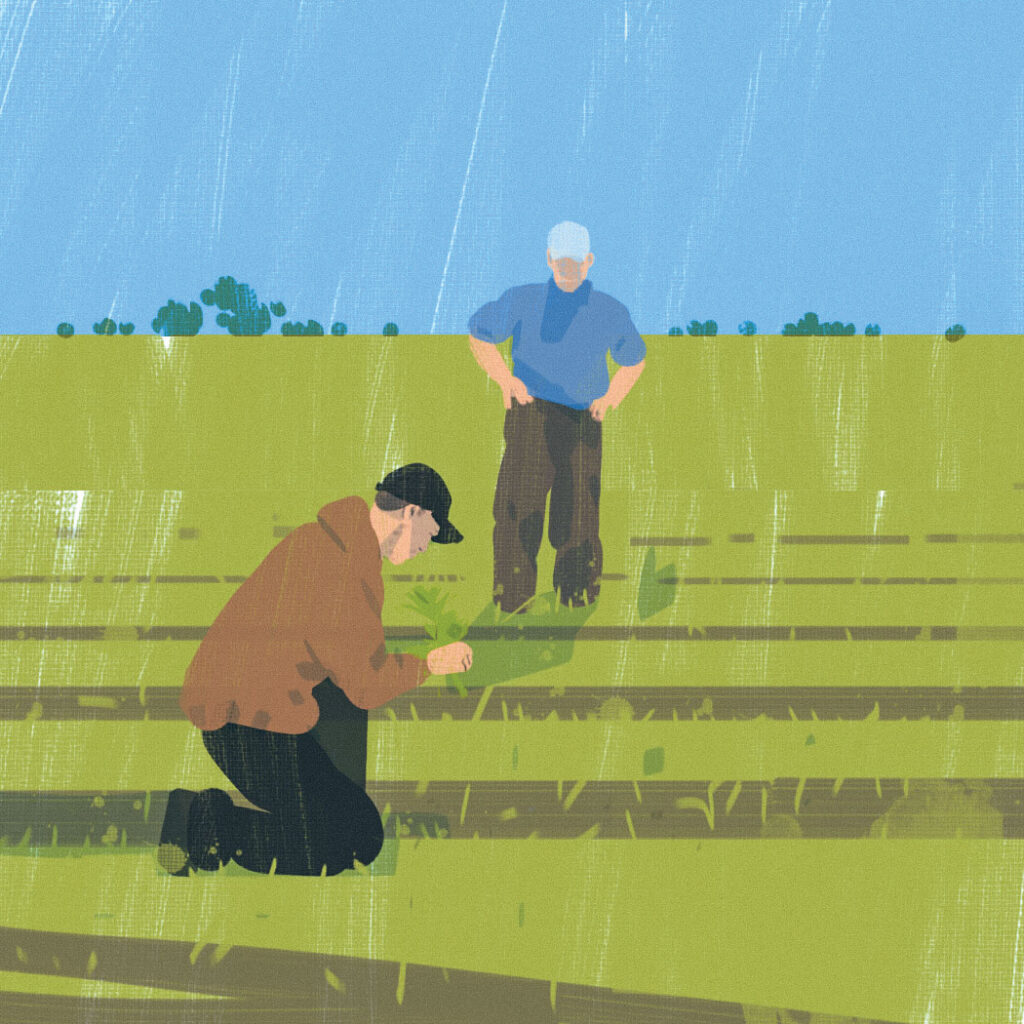
Area One Farms (AOF) takes a very different approach to farmland investment. Based in Toronto, ON, and founded by dairy farm kid Joelle Faulkner, the company ultimately wants farmers to own the land.
Launched in 2012, it now works with 55 farmers across 200,000 acres, the majority in Western Canada. AOF buys land in partnership, as co-owners, with farmers. On land the farmer finds, AOF offers two options: a crop share or a full farm partnership. The former sees farmers earn crop revenue minus crop-share rent and operating expenses as the tenant and earn appreciation on their ownership share of the new land. Land taxes and a portion of the crop insurance is paid jointly.
As a full farm partnership, AOF and the farmer own land, machinery and infrastructure together. The farmer earns 15 per cent net income and 10 to 15 per cent of the whole farm’s appreciation. The farmer also earns income and appreciation from their ownership share in the joint venture.
“If the farm makes $100, whether income or appreciation, the farmer gets $15 because they’re running it,” said Faulkner. “If they own 20 per cent, they get 20 per cent of the remaining $85. That means $32 instead of $20. That’s on income; but everyone expects that because they’re doing more work, but it’s also on appreciation.”
Unlike other investors, AOF intends the farmer will buy the land after a time. “Farmers should own farmland,” said Faulkner. “The further you get from farmers owning the land the less secure farming becomes.” She said at the time of buyout (Year 10) a farmer typically purchases about half the available land, and the rest is usually bought by neighbours.
AOF’s approach isn’t typical of investors; the goal isn’t permanent landlordship. “The solution we provide is valuable to farmers, so it doesn’t have to be that I hate the other approaches. I just think it’s better to be on this side and be the good guy,” said Faulkner.
She is keenly aware farmers approach AOF as a last resort. “If you could do this with debt, you wouldn’t come to us,” said Faulkner. Clients may be young farmers whose first attempt to launch a farm didn’t pan out, or farm families whose operations are too small to support the next generation. “The goal is for our partners to have access to the land until they can buy us out and own it outright. But we also care about their neighbours. We don’t want to mess up their communities or push up land prices. We focus on purchasing land that is offered to our partners privately from family or landlords; we avoid setting new highs and we don’t offer on land at all if it should go to someone else, like a neighbour who has rented it forever.”
The company also assists with crop marketing, agronomy, purchase of inputs, fixing operating problems and even maintains a network of retired farmers to mentor younger farmers.
EMOTIONS AND POLITICS
Ag realtor Ted Cawkwell is a fourth-generation Saskatchewan farmer-turned real estate agent. More than 95 per cent of his clients are farmers with the remainder being investors. It’s clear from his vantage point most farmers aren’t too thrilled with the investor trend.
“Farmers in general don’t want as many investors buying in their backyard regardless of politics, but it does vary a lot with their political belief,” he said. “It’s not logical, it’s emotional. If they are left-leaning in their politics, they don’t want it. People on the right side aren’t as worked up about it.”
Cawkwell may hear about one case of foreign ownership per year, but said it is not a sustained issue. About two per cent of Saskatchewan farmland is owned by investors. Hypothetically, if 10 per cent of the two per cent are bad actors who flout foreign ownership rules, this is 0.02 per cent, he said. “So, when people say these people are pushing the market up it’s interesting to me that two-tenths of one per cent could move the market that much,” he said. “We know the investors can’t invest as much as the farmers.”
In Cawkwell’s experience, a farmer who is selling prefers nine out of 10 times to sell to a farmer they know. “Farmers have a soft spot for other farmers, especially young ones, but usually only ones from their area,” he said. “If you move from 100 kilometres away, not so much. I see it all the time.”
Investors, he noted, will hold onto land only if it provides a return. “They don’t have the emotional attachment,” said Cawkwell. “If they buy a quarter of farmland and next year there’s more money in buying Nike shoes, they’ll sell the farmland and buy Nikes, and on and on.”
Cawkwell suggested the conversation requires realism, because investors are not all bad. He recounts his own experience as a farmer to illustrate his point. “When I started farming, I bought one quarter and rented two. Next year I rented another one. If you don’t have the capital to buy land, then the investors are good because that’s just one more person you can partner with. Investors are good for young and undercapitalized farmers because they need to rent land.”
What he believes to be true of his home province is perhaps common to farmers nationwide. “I think because it’s political and emotional, it really fires people up.”
Comments