



GOOD INTENTIONS, LOW UPTAKE
BY EMILY R. JOHNSON • LEAD PHOTO: iSTOCK
Long before sustainability became a policy buzzword, farmers worked to protect soil from wind erosion, manage moisture conditions and conserve fuel and other inputs. What’s changed in recent years is the level of public and industry awareness of environmental issues. This has generated a host of funding initiatives directed at conservation, climate and environmental programming in agriculture. Over time, federal and provincial governments have rolled out an ever-growing suite of programs aimed at soil health, biodiversity, water conservation and greenhouse gas reduction.
Despite the array of options and attention paid to sustainability, farmer participation remains low. This disconnect is highlighted in two reports published in late 2025 by the Canadian Agri-Food Policy Institute (CAPI), a national, independent agriculture policy organization. They examine how conservation programs resonate with landowners and why so many farmers are reluctant to participate. The issue isn’t a lack of farmer interest in conservation. It’s that many programs, though well-intentioned, don’t reflect the realities of farming.
RESULTS MATTER
Matching Conservation Programs to Canadian Farm Realities is based on a national survey of 453 farmers and ranchers across eight provinces, including Alberta. The report offers a farmer perspective of program awareness, adoption and barriers to participation. Its sister report, Perspectives on a New Path Forward: The Future of Conservation Payments, builds on this data through feedback gathered at a multi-stakeholder workshop held in Manitoba that brought together farmers, conservation organizations, researchers and policy-makers.
The reports deliver consistent findings. Awareness is low, with just seven per cent of farmers being very familiar with available conservation programs. Just one-third have participated in at least one program. Many initiatives are fragmented, often administered by multiple levels of government or independent groups, sometimes with overlapping goals. While many look good on paper, it’s unclear whether they are effective in the long-term. “We hear from producers that these programs are an opportunity, but they’re not working as well as they could,” said Tyler McCann, managing director of CAPI.
These reports arrive at a critical moment as governments prepare to negotiate the next federal-provincial-territorial agriculture policy framework under the Sustainable Canadian Agricultural Partnership (S-CAP). This provides a rare opportunity to rethink the design of conservation programs and whether they can be made more practical for farmers while still delivering environmental outcomes.
PRACTICAL PROBLEMS
Though the reports note farmer awareness of these programs is very limited, on its own this doesn’t entirely explain their low participation rate. Farmers point to structural barriers.
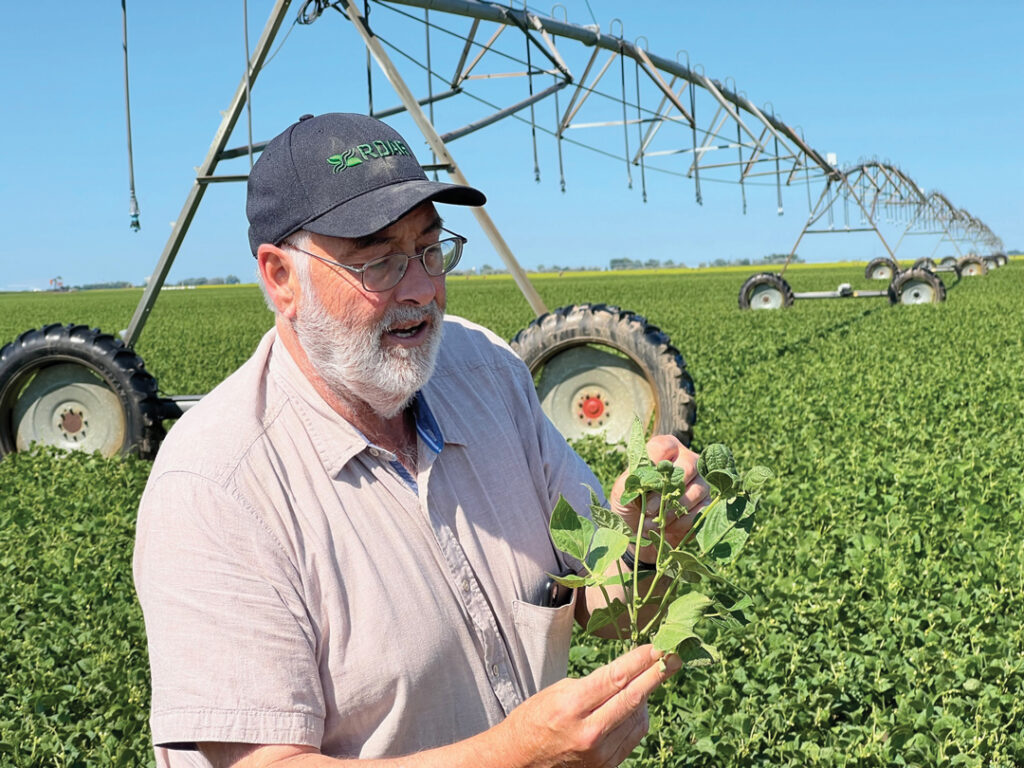
John Kolk farms dryland and irrigated acres near Enchant and serves on the boards of Alberta Pulse Growers and the Alberta Biodiversity Monitoring Institute. He’s heavily invested in conservation on his own operation but said some programs simply don’t make sense on the ground. “We’ve participated in water efficiency programs,” he said. “But with some of the newer initiatives, we were pushed away by complexity, lack of clarity or it just wasn’t worth the time and effort.”
Farming in the Palliser Triangle, Kolk is focused on water retention, wind erosion and buildup of soil organic matter. He has invested significantly in conservation practices on his farm, often without program support, because existing initiatives haven’t always aligned with the realities of his region.
The disconnect, he said, stems from programs designed to apply broadly across varied landscapes. “You can’t put a broadacre dryland farmer in Swift Current into the same program as a Red River Valley farmer growing specialty crops.” Such one-size-fits-all failure is echoed in the CAPI reports. Standardized programs don’t account for Canada’s immense agricultural diversity and regional concerns. McCann believes a national program with a common set of solutions can’t work well. “Environmental issues end up being national issues and national priorities, but on the ground, they are local issues impacting local regions and local conditions,” he said.
“We think the priorities and solutions should be driven locally as much as possible, recognizing priorities will be unique to that watershed or region,” said Jordan Sinclair, CEO of ALUS, a community-led and farmer-delivered national non-profit that supports conservation on marginal farmland.
Kolk also pointed to frustration among farmers who adopted conservation practices before funding incentives became available. “I spent money on wind erosion work years ago,” he said. “When support finally came along, the people who had already done it got no credit, but they’re competing for land and cropping against those who were compensated.”
Economics comes first for most farmers, and not because they don’t value conservation, but because margins are tight and risk is high. Input costs, commodity prices, taxes and interest payments still drive most land-use decisions. Conservation payments often don’t cover opportunity costs, especially on high value cropland. “If the finances don’t work, you’re not going to keep it up,” said Kolk. “Farmers can’t afford to subsidize society’s interests.”
THE PATCHWORK PROBLEM
One of the most common frustrations raised in the CAPI reports is the patchwork nature of conservation programs. They vary by province and administrator as well as by the definitions of conservation and sustainability.
It is often difficult to judge how multiple programs that target soil health, biodiversity or climate fit together, or whether they can be stacked at all. Each comes with its own application process, reporting requirements and funding window. “National targets for climate and biodiversity don’t translate clearly at the farm level,” said McCann. As a result, success is often measured by acres enrolled or practices adopted, rather than whether environmental conditions are improved.
Where governments, particularly provincial ones, once ran most on-farm environmental programs, the delivery has grown fragmented. Administrators now include multiple provincial ministries, the federal government, non-profits and private groups. Stakeholders such as CAPI argue better co-ordination is possible. “Ideally, we’d like to see more collaboration and co-operation between those groups,” said McCann.
ALUS aims to simplify this landscape by pooling funding from governments and private partners, offering annual payments to establish and maintain conservation projects over time. “We have to remember that farmers are living their lives and this is all extra,” said Sinclair. “If it’s too difficult, they’re just going to walk away.”
MEASUREMENT, DATA AND TRUST
The reports recommend a move toward outcome-based conservation efforts—paying for results rather than prescribing specific practices. Many farmers support the approach in principle. Outcome-based programs allow farmers to rely on their own knowledge, equipment and systems to meet the program’s goals. But in practice, it raises tough questions about how to make programs less rigid yet aligned with the needs of funders.
Soil health, biodiversity and water quality don’t lend themselves to simple metrics, yet governments and funders require clear reporting to justify their expenditures. “There’s a real trade-off,” said Sinclair. “The more flexible a program is in the field, the harder it becomes to standardize reporting.” While ALUS is a principle-based program rather than a prescriptive one, she points out that funders nevertheless want to see clear evidence outcomes are being met.

“An incentive alone doesn’t necessarily lead to
change. You need sustained presence over time to move the
needle.”—Jordan Sinclair
A related hitch is the sensitivity of data sharing. Trust is central to farmer participation in environmental programming. “Farmers aren’t against measurement; they do that for a living,” said Kolk. “They’re against uncertainty in how that data will be used, and if it will be used against them.”
CAPI describes the current roadblock in environmental programming as a “trust crisis” and calls for establishment of farmer-governed data co-operatives as one potential way forward. Such an initiative would allow farmers to retain control of their information and combat fear of regulatory action or corporate misuse. McCann stressed that finding a solution is key as environmental programming continues to grow. “The earlier we can fix this and get systems that farmers believe in, the better.”
The solution begins with transparency, said Sinclair. “Be clear about what data you want to collect and why,” she said. “Then it’s up to the farmer to decide.”
FIND THE MONEY
To locate adequate funds for even the best program is a big hurdle. One-off, short-term incentives may convince a farmer to try a new practice but does not guarantee lasting change. Concrete results often require significant time. “If we really want to make change on the land, we should be thinking in multiple years,” said Sinclair, who pointed to the limits of short-term funding. “An incentive alone doesn’t necessarily lead to change. You need sustained presence over time to move the needle.”
The CAPI reports point to the need for funding models that are more stable, co-ordinated and a blend of public, private and non-profit investment. With clearer priorities and less overlap, dollars can go farther. Kolk is skeptical that governments are taking this long-term approach. He argued they focus on buying environmental outcomes at the lowest possible cost. “If that’s the driver, don’t expect a lot coming your way,” he said.
The funding question cuts to the core of credibility. Conservation programs are more likely to earn trust and participation if they recognize environmental stewardship as an ongoing service rather than a one-time project.
CAPI acknowledges funding can’t be unlimited but argues it can be better targeted. “We need to focus on high impact areas and practices that work for farmers,” said McCann. “Ultimately, any practice is only going to work if it works for farmers.”
MAKE IT WORK
Whatever forms it takes, farm conservation programming is here to stay. Climate and sustainability are part of the soil of agricultural policy. The question is whether programs can work better for Canadian farmers and ranchers.
While CAPI’s dual conservation reports inform the next round of S-CAP policy negotiations, they stress meaningful change requires continued farmer involvement. “Better approaches are possible,” said McCann. “But having producers more engaged and having more discussions is ultimately what gets better outcomes.”
Kolk agreed. “There needs to be a bit more dirt underneath the fingernails of the people setting the targets.”
Comments