



A WINNING COMBINATION
BY JEANINE MOYER • PHOTOS BY BRYCE MEYER PHOTOGRAPHY
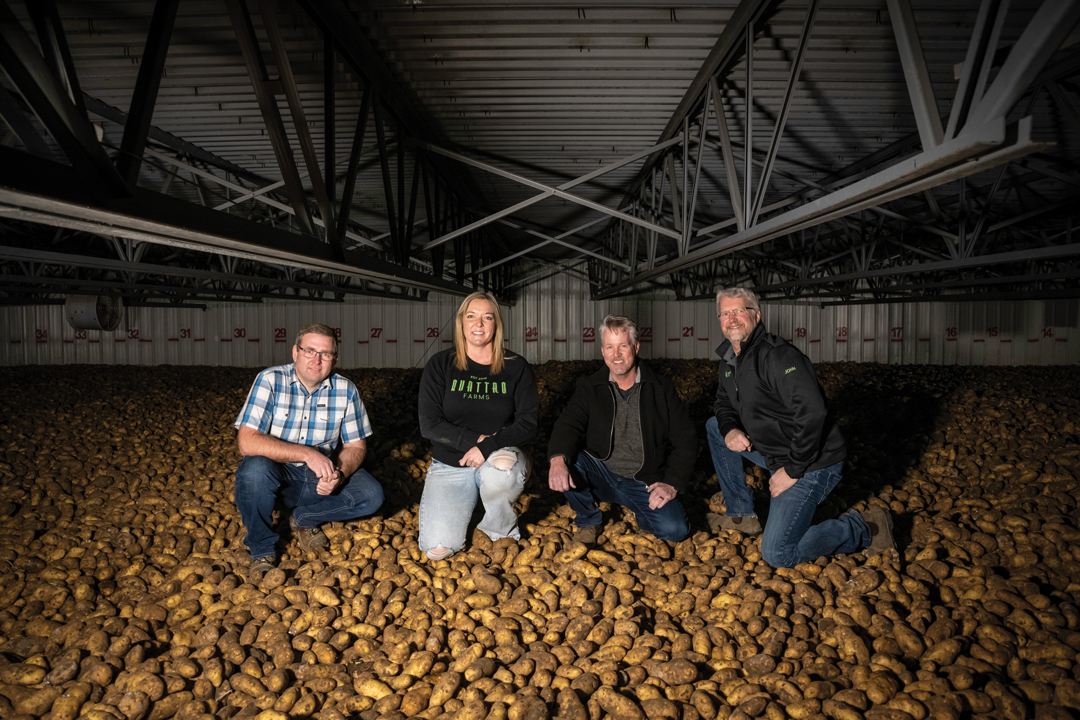
Most farms evolve on their own, but the five farm families in the Bow Island area that make up Quattro Ventures chose to grow together to take advantage of collaborative opportunities, economies of scale and shared vision. They chose a unique business model that has merged their farm operations.
Launched by four families in 2010 and expanded to five in 2018, Quattro defines itself as a farmer-owned joint venture that operates like a co-operative. Land, labour, expertise and decision-making are shared yet allow each farm to remain an independent legal and tax entity. Across irrigated and dryland acres, this large, diversified operation grows more than two dozen crops, from sugar beets and potatoes to catnip and spearmint.
“We had the idea that if we combined our skills, our knowledge and our resources we could make an awesome farm,” said John Van Tryp, CEO and a member of one of the founding families.
COLLABORATION IN ACTION
The mid-’90s was a particularly challenging time for the agriculture industry. In response, a group of 25 Bow Island area farmers formed the Palliser Triangle Marketing Club to share ideas. “There was a downturn, and farming looked bleak at the time, so we formed a group to learn more about marketing and find success,” said Van Tryp.
Eventually, the group’s focus shifted from marketing to broader farm management. When talk turned to co-operative agriculture, four member farms put the idea into action. To form Quattro Ventures, seven farmer-owners from the four families spent two years in preparation. To ensure its members were treated fairly and felt comfortable with their individual business arrangements, they carefully negotiated every aspect of operational and management structure.
The members identified strong marketing opportunities and the means to create flexible career options for each family’s next generation. To manage the operation, they initially looked outside their circle. However, they soon concluded effective leaders had to be invested in their operational vision and strongly committed to collaboration. The board and CEO would be family members. Van Tryp was hired in 2010, and each family appointed one farmer-owner to serve on the Quattro board. Van Tryp also holds a seat on the board.
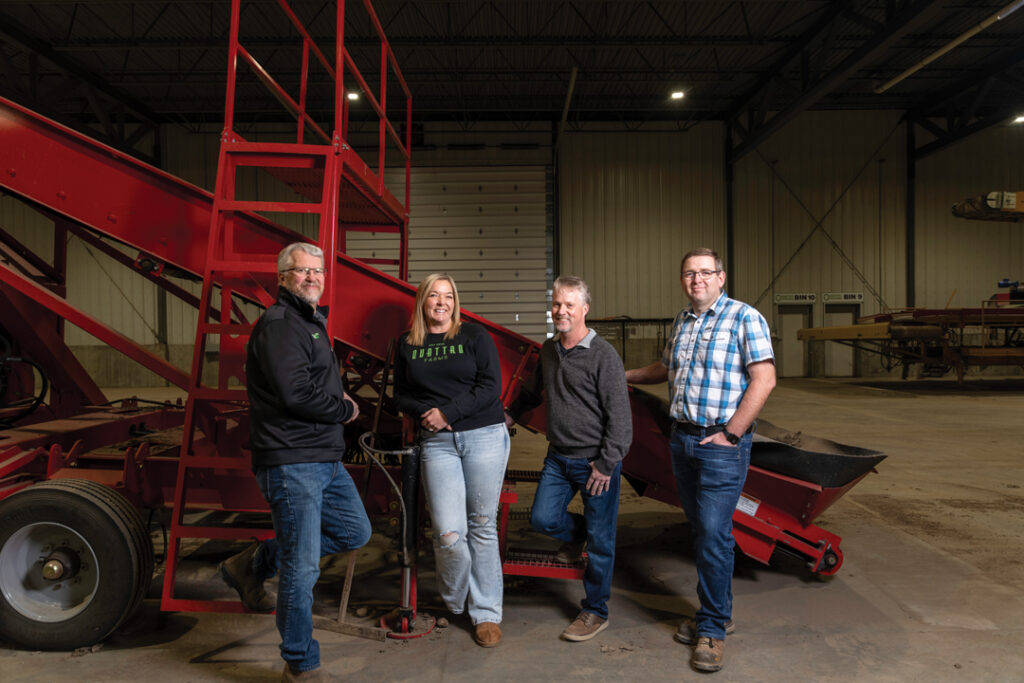
This management structure allows the farm to effectively leverage the labour, skills and expertise of its owners and hire approximately 100 staff, including full-time, part-time and seasonal employees. These include individual crop division managers for dryland durum and lentils, essential oils (extracted from crops such as spearmint), hemp, irrigated cereals and peas, potatoes, row crops and also seed canola. Because acreage is 60 per cent irrigated, a dedicated manager is also assigned to this section of Quattro. Van Tryp works closely with these managers to oversee operations across 25,000 total acres. Facilities include a central office and processing complex just outside Bow Island as well as multiple shops and bin yards.
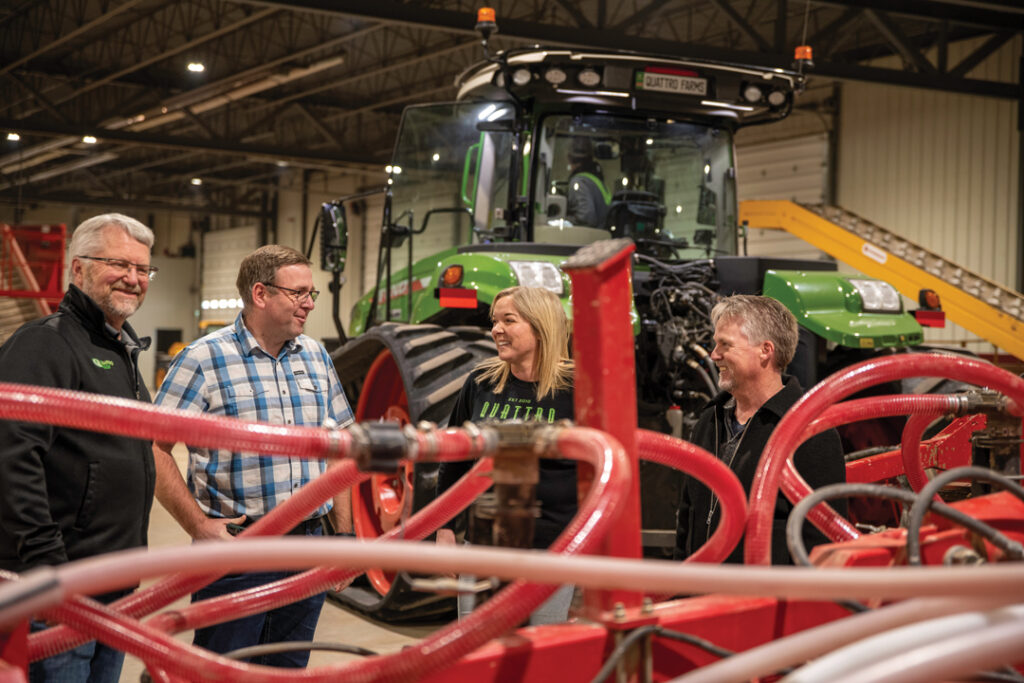
Early on, as business operations took shape, so too did Quattro’s corporate culture. Because Van Tryp became CEO with limited management experience, he immediately sought leadership training and has since continued his business education. Initially very “hands-on” in his approach, he admitted he has refined his leadership style to better reflect Quattro’s collaborative nature. He now empowers crop division managers with greater decision-making autonomy. He is also open to guidance from outside experts and does not hesitate to bring in industry consultants and services. This includes outsourcing human resources to dedicated, specialized professionals.
The operation’s structure and mindset also encourage mentorship between experienced staff and younger employees. This includes members of the next generation of the founding families. “In the collaborative spirit of why we formed in the first place, we actively encourage younger family members to get involved, bring forward new ideas and take ownership, giving them the freedom to be creative,” said Van Tryp.
EFFICIENCY THROUGH DIVERSITY
Between Lethbridge and Medicine Hat, the Bow Island area in the County of Forty Mile supports a wide range of high value and specialty crop production. With its sandy loam soils and a high-heat growing season, the region is well suited to irrigation and intensive cropping. It receives roughly 300 to 350 millimetres of precipitation annually and averages about 125 frost-free days, with long daylight hours and cool evenings.
Quattro leverages these natural strengths as it employs a wide crop mix to maximize efficiency. With this diversity of specialty and commodity acres spread across its land base, crop rotation is optimized for soil and crop productivity. Seeding and harvest are staggered, which aids the planning and co-ordination of field work, management of labour, the purchase and employment of inputs as well as equipment maintenance.
“We are constantly capitalizing
on new marketing opportunities,
improving yields and delivering
consistent quality. It’s all thanks to
the progressive, open mindset of the
venture.”—Emily Ford
Quattro’s resident agronomist for the last six years, Emily Ford said the scale of the operation allows staff to specialize. Farming co-operatively aids efficiency, but its diversity and scale also generate complexity. To manage all the farm’s parts, people and processes requires constant co-ordination supported by digital tools and careful tracking. She relies on approximately 15 farm management apps.
Ford noted Quattro annually gathers formal employee feedback and uses the information to improve processes and address challenges. The approach contributes to efficiency but also to employee retention. “Quattro’s leadership is made up of entrepreneurs and innovators, and, as an employee, it’s empowering to be encouraged to think outside of the box and try new things.”
She has taken the approach to heart. Tasked by the board to explore the possible addition of catnip to the crop roster, she followed the venture’s decision-making process. She conducted research and presented her ideas to Van Tryp, who then informed the board a 300-acre test plot would be sown. “And now we specialize in another niche market—catnip,” said Ford. “That’s one of our key strengths: the ability to focus and excel in specialized markets.”
Ford is proud of her contributions to Quattro. “We are constantly capitalizing on new marketing opportunities, improving yields and delivering consistent quality. It’s all thanks to the progressive, open mindset of the venture.”
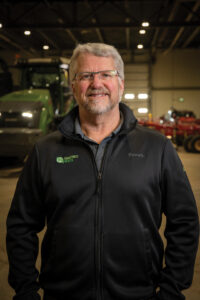
“In the collaborative spirit of
why we formed in the first place, we
actively encourage younger family
members to get involved, bring forward
new ideas and take ownership, giving
them the freedom to be creative.”—John Van Tryp
SPECIALIZATION ADDS VALUE
Quattro’s diversity is strategic. Its specialty and contract crops can be priced ahead of the growing season or tied to multi-year contracts with built-in pricing mechanisms. This approach is key to the farm’s risk management strategy. “We look at these diverse crop types as our workhorses that allow us to venture out into new crop types while maintaining profitability,” said Van Tryp. An aspect of this specialization, he added, many acres are dedicated to seed production, including pedigreed cereals and
hybrid canola.
This variety does present marketing challenges. The sheer number of crop types can diminish economies of scale. “In some cases, it can be a disadvantage,” said Van Tryp. “Because we farm together and have more acres of a certain crop, if a [corporate customer] reduces the acres or production volume they want to buy, it can limit our marketing options.” Still, the farm balances profitability and innovation in production of high value and experimental crops that target specialty markets.

“I’ve worked on other farms, but Quattro’s work
environment stands out.”—Juan Peters.
As the manager of Quattro’s grain division, Juan Peters oversees irrigated and dryland cereal acres, growing durum, spring and winter wheat as well as rye. He draws upon the expertise of his colleagues across the farm, consulting with the seed division on variety selection and with Ford on agronomics.
“I’ve worked on other farms, but Quattro’s work environment stands out,” said Peters. “There’s always clear direction, no one hesitates to help, including owners. And everyone is invested in a successful outcome.”
When Quattro became Cinco with the partnership of a potato farm, this introduced a new crop to its roster, which tested the strength of the group’s collaborative culture. Ultimately, the move strengthened the operation by expanding acres, further diversifying its crop lineup and increasing efficiency. “We’ve always been good at problem solving as a group,” said Van Tryp. “We’re able to take emotion out of decisions and look at issues from each other’s perspectives.”
COLLABORATION OPPORTUNITIES
Quattro Ventures has partnered with additional area farmers to diversify and create shared business opportunities. Longtime collaborator Cory Nelson has closely followed Quattro’s growth. “They’ve had some great success and are well respected as a high end, high quality producer,” said Nelson. “Quattro is a large employer in our area and a great champion of our agricultural community.”
In 2017, Nelson and other members of the Palliser Triangle Marketing Club partnered with Quattro to create Forty Mile Pollinators, a leafcutter bee pollination service. Nelson again partnered with Quattro in 2022 to launch Forty Mile Turf Seed. “In my experience, there’s more success to be found working together than apart,” he said. “I like to collaborate with people who want to specialize and who look for opportunities like I do, and Quattro Ventures makes a great partner.”

“In my
experience, there’s more success to be
found working together than apart.”—Cory Nelson
NEXT GENERATION LEADERSHIP
In 2025, for the first time, Quattro appointed a board chair from outside the business. The organization has also transitioned several board positions from founders to next generation family members. Van Tryp takes pride in this recognition that younger voices, new ideas and ways of thinking should be encouraged.
As with all farms, succession must be addressed. “We’ve built this farm to continue as long as the founding families want to continue, so we are managing a farm transition [for the entire Quattro operation], too,” said Van Tryp. He added that despite Quattro’s joint venture structure, the process mirrors that of standard farm operations. “We know Quattro will look different, but that’s exciting, and we’ve got some great people on board with us.”
RESILIENT BY DESIGN
Its co-operative approach sets Quattro apart in a sector where collaboration can be as valuable as capital. “I don’t know why more farmers aren’t working more co-operatively,” said Van Tryp. “Any group of farmers can do this. There’s no magic, it’s a matter of individuals being willing to work together and stay in their lane to make it happen.”


Comments