



NEW SOFT WHITE WHEAT DELIVERS
BY GEOFF GEDDES • PHOTO COURTESY OF HARPINDER RANDHAWA
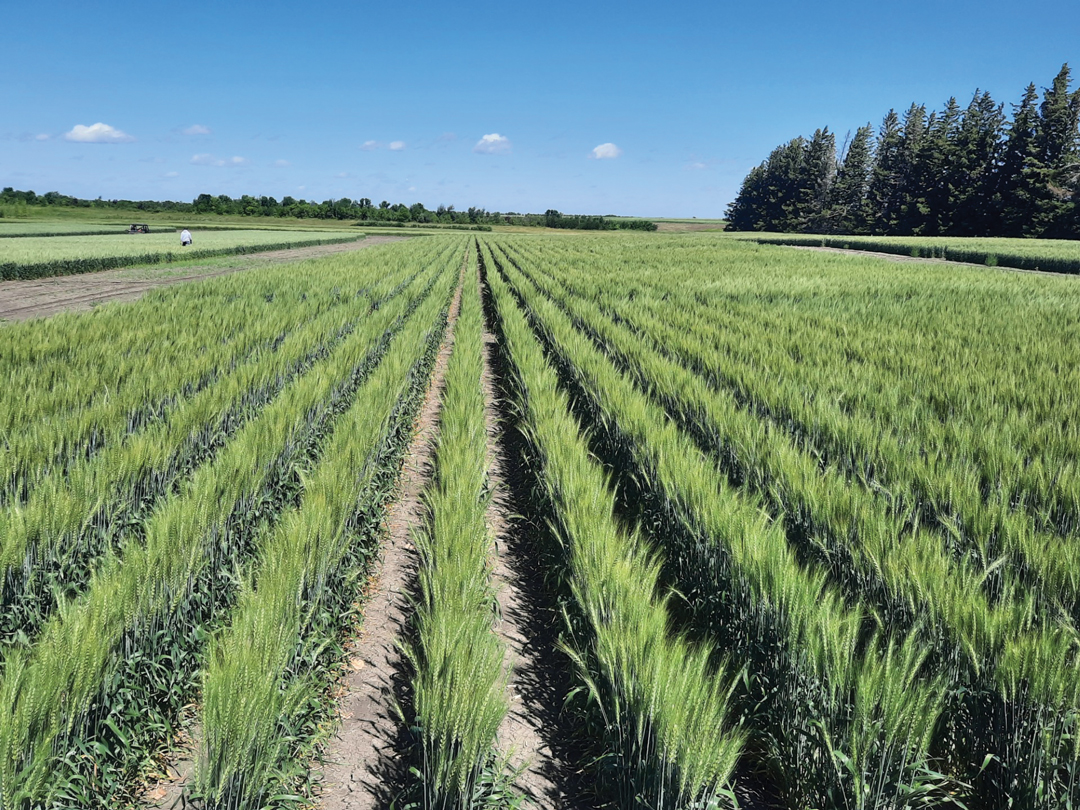
Agriculture and Agri-Food Canada crop breeder Harpinder Randhawa has made impressive gains in soft white spring wheat breeding in recent years, and AAC Raymond is his latest success. “Soft whites are unique in their end-use potential,” said Randhawa, who works at the Lethbridge Research and Development Centre. “Historically, soft white wheats have been grown in southern Alberta and Saskatchewan for milling cookies, cakes and biscuits. Owing to their low protein and high starch content, however, they are also ideal for ethanol and brewing malt.”
This new variety has good resistance to pests such as wheat midge and a robust disease package. It also exhibits superior drought tolerance, yielding 10 to 12 per cent higher than the check variety under drought conditions. Given Western Canada’s frequent dry spells, this figure is significant.
The variety’s attractive characteristics may expand the appeal of soft white wheat for Alberta crop rotations. “AAC Raymond fits multiple rotations, including pulses and cereals, which gives the grower some attractive options,” said Randhawa. “Given its yield numbers, resistance to stresses, straw strength and end-use quality, it should be a strong addition to farmers’ fields for years to come.”
AAC Raymond is now registered and was recently licensed for sale by Herle Seed Farm of Wilkie, SK.
As with all variety development, breeding AAC Raymond was a lengthy process. “We were seeking certain traits, which involves selecting multiple parents with complementary traits,” said Randhawa. “For example, one parent might be better for end-use quality, while another has a stronger disease package. We may start by crossing two parents and may end up crossing as many as four parents.”
Scientists run multiple breeding cycles, as the plant’s genetic makeup is unique to each generation. After seven or eight generations, its genetics become stable enough for farmers to sow. “In Canada, we can grow one generation, then send it to New Zealand where they can grow it from October to February,” said Randhawa. “This allows us to move through two generations in one year, reducing the time to develop a new line from 10 years to five.”
Each year, breeders screen for multiple traits such as disease resistance, height, plant type, standability and straw strength. This is followed by three years of registration trials, review by a recommending committee, registration with the Canadian Food Inspection Agency and licensing by a Canadian seed company. The company then multiplies the seed and distributes it to farmers for commercial production.
It’s a long journey, but Randhawa feels the time and effort involved has paid off handsomely in the development of AAC Raymond. “In terms of agronomic performance, the line will increase grain yield and offer higher net returns for farmers. It’s not too tall and has good straw strength, so it won’t fall flat close to harvest and slow the process or ruin end-use quality.” Based on testing conducted in various regions of Alberta, AAC Raymond also has the right maturity range to accommodate the total growing days found within an array of ecological regions.

Comments