



MAKING RESEARCH CLICK
BY EMILY R. JOHNSON • PHOTO COURTESY OF JENNIFER OTANI
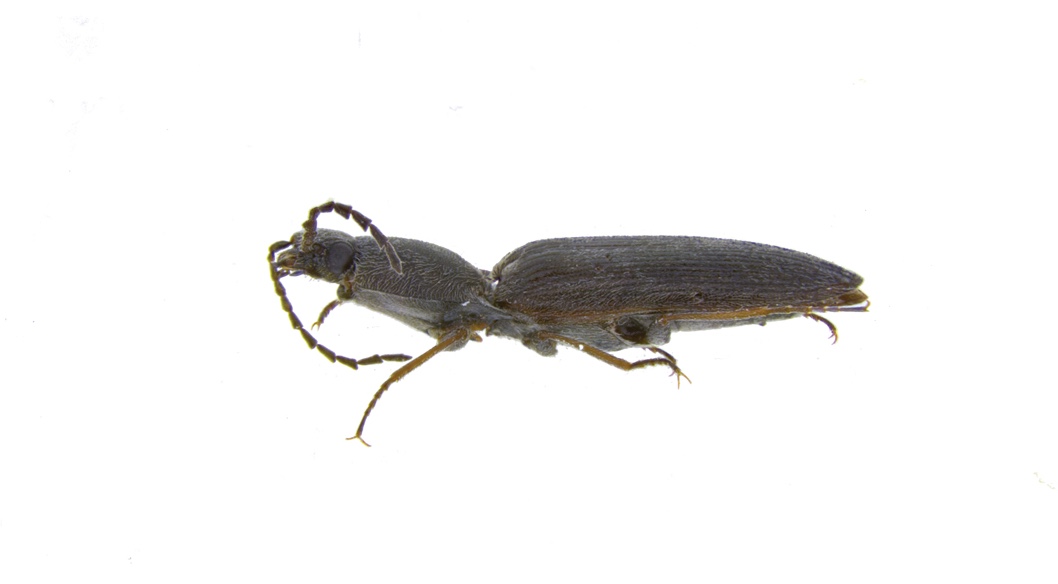
For nearly a decade, Sexsmith area farmer and Alberta Grains region 6 director Greg Sears has opened his fields to researchers for pest studies. These researchers set traps, use sweep nets and record findings. During a routine sweep in 2022, the net captured a donkey click beetle (Dalopius asellus), an uncommon type.
Jennifer Otani, Agriculture and Agri-Food Canada (AAFC) research scientist at the Beaverlodge Research Farm, recalls an unexpectedly large number of the species was found. AAFC Agassiz research scientist Wim van Herk was keen to study the species. “That long-standing relationship with the farmer enabled our team to be at the right place at the right time to get what they needed,” said Otani.
The find initiated a two-year research project in 2023 and 2024 to develop monitoring capability for the beetle and its cousin Dalopius maritimus. With support from farmers, including Sears, and the Beaverlodge research team, van Herk worked with chemical ecologists Gerhard and Regine Gries from Simon Fraser University to identify the sex pheromone of the beetles. Such pheromones are synthesized and used by scientists in traps to attract beetles for population monitoring. With field experimentation, the scientists determined which components of the pheromones successfully lure male beetles into traps. This will allow synthetic pheromone lures to be developed.
Uncommon in Alberta, van Herk estimated the donkey click beetle makes up about five per cent of the click beetle population in the Peace Region. “Is it a pest, is it not? Without monitoring tools, we don’t know.”
Wireworms are damaging and unpredictable soil pests. As larvae, they feed underground for years. Hollowing out seeds or chewing roots, they emerge as adults, commonly dubbed click beetles. Historically, farmers relied on neonicotinoid seed treatments to protect crops, but these products only temporarily disabled wireworm larvae. Newer pesticides in development may offer population control. “The larvae don’t recover,” said van Herk. “They get sick and they die.” He stressed farmers should avoid pesticides not proven to work on these insects. “A lot of pesticides are being used for wireworms that maybe aren’t necessary,” he said. “I hope to bring that number down. That saves the environment, and that saves the farmer a lot of money.” Traps baited with species-specific pheromones reveal pest pressure and help farmers decide whether chemicals are needed.
Identifying the donkey click beetle pheromone is, in van Herk’s words, “a big step,” but just one piece of the wireworm research puzzle. “It doesn’t directly answer the question, ‘If I put out a trap and I get a hundred beetles, what is the risk to crops?’” he noted. To answer this requires the pheromones of multiple species as bait and data that links beetle counts to wireworm damage.
Traditional monitoring methods generally only work well at high pest densities, leaving farmers guessing most years. With the use of pheromones, species can be detected at lower densities earlier in the season. “We’re able to gain a better idea of pest population densities and can build baseline data to help us understand wireworm changes in production systems over time,” said Otani.
Both researchers emphasize this work can’t take place without farmers. “The first step is always the producer allowing us access to their land to do monitoring,” said Otani.
Participating in pest monitoring research is common sense, said Sears. “The more knowledge we have on lifecycles and the biology of our pests, the more equipped we are to deal with them. Working with researchers benefits individual farmers and the ag industry.”

Comments